LinkedIn Outbound Sales Guide for B2B Teams in 2026
LinkedIn outbound sales explained: channel fit, message limits, buying signals, email sequencing, funnel benchmarks and APAC nuances for B2B teams.
The revenue meeting starts the same way it did last quarter. An SDR says LinkedIn is dead because eighty connection requests produced a few accepts and no conversations. The list was fine. The offer was fine. The missing piece was a reason to speak, aimed at more than one person, before anyone opened a pitch.
LinkedIn outbound sales works when you treat it as a buying-group and pre-contact preference problem. Most of the buying group will rank vendors before they ever take a sales call. A connection request does not create that preference. A specific, timed reason to talk might.
Table of Contents
Where LinkedIn Fits in a B2B Outbound Mix
Add LinkedIn to a B2B mix when it does the one job email cannot: earn a reason to speak before the first cold email lands. LinkedIn outbound here means a relevance-led first contact across connection requests, direct messages, InMail, and public comments. Email should carry most of the follow-up.
LinkedIn is the professional room where you walk up with something worth saying. Email is the mailbox you use once that conversation has a point. The platform is strong at naming accounts, confirming who holds which role, showing social proof, and warming a thread. It is weak when invitations become a volume sport.
Say it's Monday. A sales development rep fires off eighty connection requests before standup, gets a handful of accepts, and tells you the channel doesn't work. The fault is the missing reason to speak. A 2024 survey of 632 B2B buyers found that 73% actively avoided irrelevant outreach. A first name, a job title, or a company token is not a reason. Nearly three in four of those buyers indicated that irrelevant contact can cause avoidance, so ICP precision, a real trigger, and message-to-problem fit come before any send.

Once sequences and sending volumes span many accounts, HeyReach keeps that activity visible so a manager isn't guessing from a spreadsheet. Judge the channel by qualified replies and pipeline, not by how many invitations left the building.
Practical rule: If you can't name the business change that makes this week a sensible week to write, don't send the request.
LinkedIn Message Formats and Their Hard Limits
Write to the field, not to a vibe. Each format has a job, a ceiling, and a failure mode that shows up the moment a template meets a long name.
Format | Hard limit | Best use | Common failure |
|---|---|---|---|
Connection request note | 300 characters | Earn acceptance with one specific reason | Generic note gets ignored or left pending |
Message after acceptance | No documented cap; keep it short | One relevant question with no link | Pitch placed in the first message |
InMail subject | 200 characters | Earn the open from non-connections | Personalisation tokens push it past the limit |
InMail body | 1,900 characters | Context, one reason and one call to action | Length mistaken for relevance |
Public comment on a prospect's post | No published character cap | Visibility before any request | Generic praise reads as automation |
What each field is for
A connection note over the character ceiling gets cut, so the reason has to land in the first line. One specific observation is enough. "Saw Acme is hiring two finance ops analysts. We cut month-end close time for similar Singapore firms. Open to a short look?" stays well under 300 characters and asks for nothing except the connection.
The first message after acceptance should be one question and no link. "How are you handling month-end close during the hiring push?" A deck, a calendar link, or a product tour in that slot trains people to ignore you.
LinkedIn's InMail limits set a subject of up to 200 characters and a body of up to 1,900 characters for people who aren't already first-degree connections. Those ceilings are maximum space, not a target length. Longer does not mean more relevant. A subject such as "Ravi, a finance ops question for Acme" is safe with a short name and can break once a longer name and company fill the token, so test both fields with real sample values. The body can hold context and one call to action. It should not hold three.
A public comment has no published cap worth writing toward. Use it to add a point of view on the prospect's post, not to praise the post and bolt on a pitch. If the comment could sit under any post in the feed, it reads as automation. Teams running paid inbox placements can use these tips for effective LinkedIn inbox advertising from CrowdTamers to see how a paid message differs from an organic note, especially on subject discipline.
A three-step check before launch
Count each field separately. Subject and body fail independently.
Render the longest name and company you have on the list.
Check localised text. A translated line often runs longer than the English original and truncates on send.
Mapping the Buying Group Before You Write
A single champion is a fragile plan. People leave, and the person who can block a deal often never appears in a one-contact sequence. High-performing sellers, in Ipsos research behind the Deep Sales Classification Model, research more thoroughly before outreach, use social activity for context, reach several decision-makers and influencers, and use warm paths through colleagues.
That is an account-research job, not a messaging job. Broader coverage cuts dependence on one friendly contact and surfaces blockers, influencers, and a second door in.
Five mapping steps
Define firmographic fit. Industry, size, region, and the tech stack you can serve. If the account fails this, stop. Don't hunt for a warmer title inside a bad-fit company.
Assign likely buying roles. Economic buyer, champion, technical influencer, end user, and a potential blocker. A B2B buyer persona is useful here only if each role has a different priority, not a different adjective on the same pitch.
Name two or three people per role. Titles drift. A second name keeps the account alive when the first person goes quiet.
Find warm paths. Shared connections, alumni, former colleagues, and mutual clients beat a cold request when one exists. If none exists, say so on the account record so nobody invents familiarity.
Score the account. Combine fit, role coverage, relationship paths, and recent activity, then assign outreach only to accounts that clear a bar you would defend in a forecast meeting.
Once the role list exists, Apollo is a practical way to enrich contact data and firmographics so the map isn't a pile of guessed titles.
Take a Singapore fintech that an APAC SaaS vendor wants to enter. The CFO is the economic buyer. The Head of Operations is the likely champion. A compliance lead is the likely blocker. A former colleague now at a partner is the warm path. One owner holds the account. One touch per role per day, at most, so the buying group doesn't receive three contradictory notes before lunch.
Prospecting Signals That Justify Outreach
Personalisation is not the hard problem. A rewritten first line on a cold account is still a cold account. The hard problem is spotting a change that makes a problem more urgent, or a buyer easier to reach, and then coordinating several people around that change.
A like or a profile view is not that change.
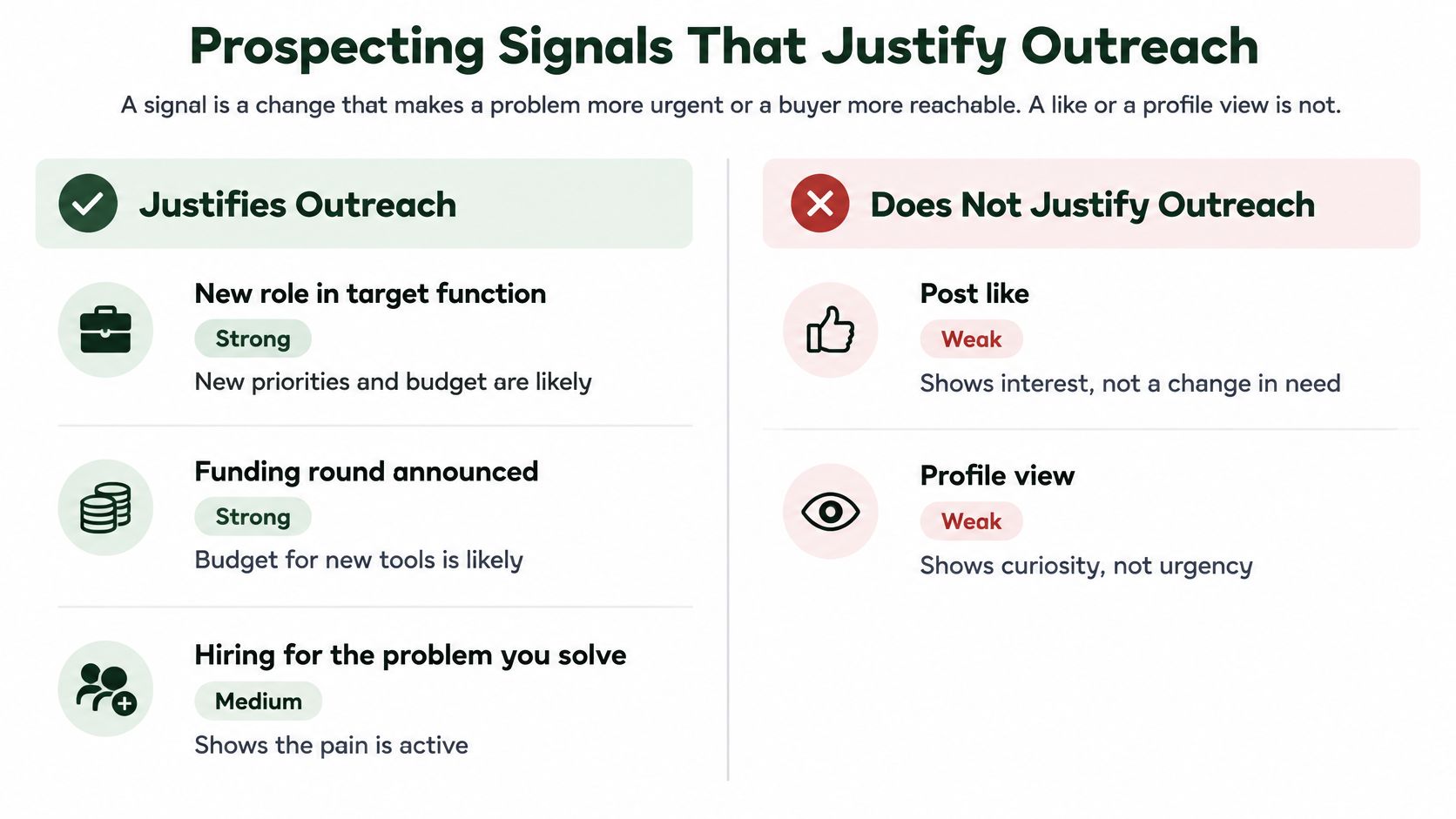
The windows below are operating defaults to test against your own reply data. They are not published benchmarks. Treat the freshness column as a hypothesis: if your data shows funding announcements still convert at 90 days, extend that window, and if post activity goes cold within a week, shorten it.
Signal | Strength | Action | Freshness window |
|---|---|---|---|
New executive in a target role | High | Contact within a week with a role-specific reason | About 30 days (suggested) |
Funding round or market entry | High | Map the buying group and reach two or three roles | About 60 days (suggested) |
Hiring for the problem you solve | High | Reference the job post in the opener | Until the role is filled |
Technology change or stack migration | Medium-high | Test relevance with one question | About 60 days (suggested) |
Public strategic announcement | Medium-high | Comment or share a point of view first | About 30 days (suggested) |
Prospect post or comment activity | Medium | Use as timing context rather than proof of intent | About 14 days (suggested) |
Profile view or like | Weak | Do not trigger outreach on its own | Not applicable |
Strong change versus weak attention
High-intent signals are a new executive in a target role, a funding round, a market entry, hiring for the problem you solve, a technology change, or a public strategic announcement. Weak signals are likes, profile views, and a one-off comment with no accompanying change in the business. The distinction matters more on LinkedIn than in email, because the buying group is visible there: typical B2B buying groups involve six to ten stakeholders, and one cited benchmark says a sales cycle may require engagement with as many as 11 people inside a target account, according to this LinkedIn outbound playbook. One signal should start staggered outreach across roles, rather than a single message to the friendliest title.
Confidence rises when two signals coincide, such as a new CFO plus hiring in finance operations. Whitewhale is built to surface intent signals across a target account list so reps aren't scanning news by hand. Pair that with a clear view of prospecting in the sales process so a signal gets an owner and a next step, rather than a notification nobody acts on.
Stop when the prospect says not now, the role changes, the account is already in an active evaluation with your team, or the signal is older than its window. A personalised note on a stale trigger is still late.
Running LinkedIn and Email as One Sequence
Space the work so each channel adds a new angle. Reusing the same sentence on LinkedIn and in email is how a buying group decides you are a bot.
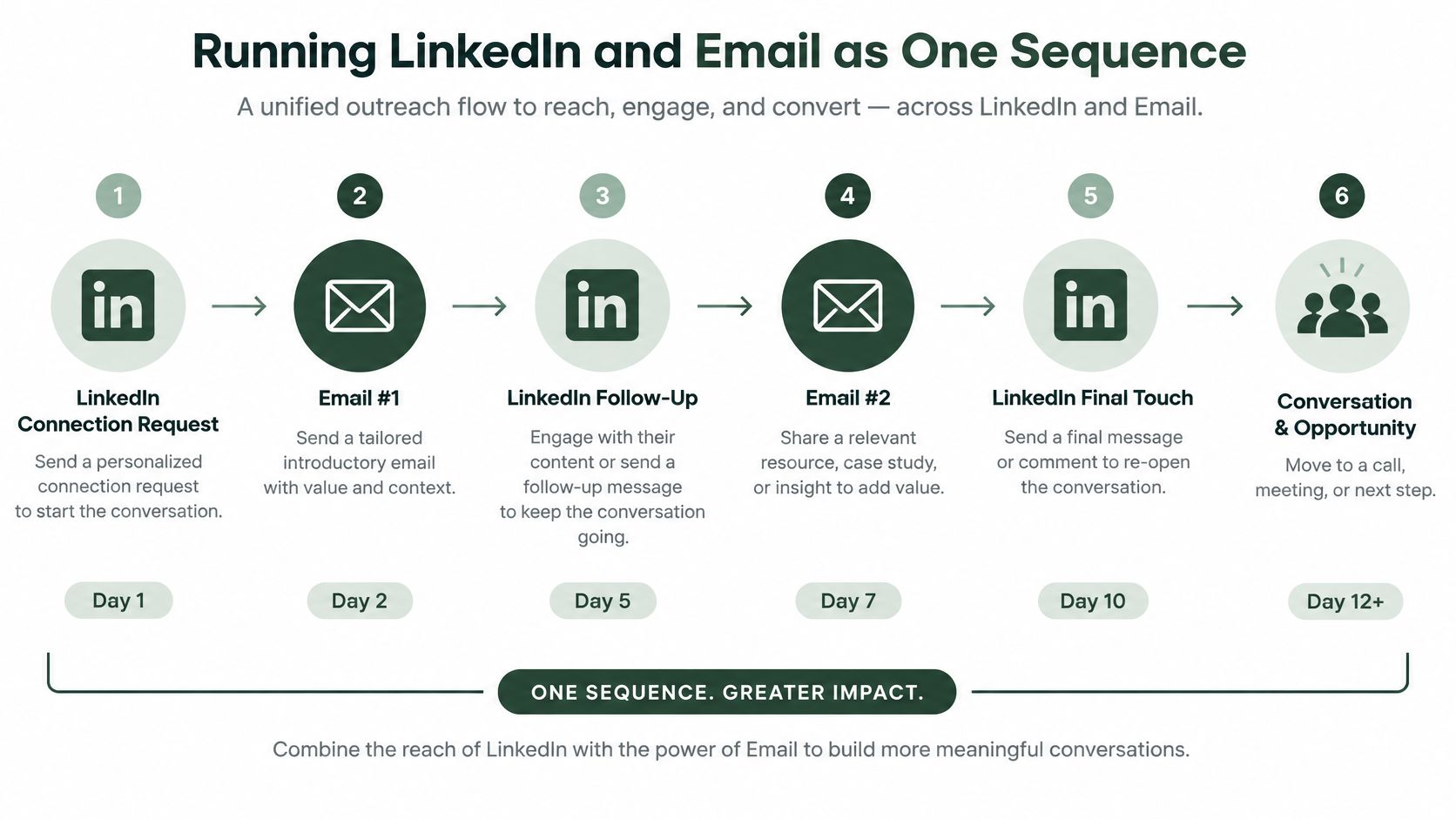
A fourteen-day pattern
Day 0. Send a connection request with one specific reason tied to a signal. No pitch.
Days 1 to 2 after acceptance. Send one relevant question. No link, no attachment.
Day 3. Email the work address with a different angle and the same proof point. Instantly handles warm-up, sending infrastructure, and deliverability monitoring so that email doesn't land in spam while the LinkedIn thread is still alive. A practical companion is this guide to book meetings through cold outreach from CleanMyList, which is worth reading beside your own cold email marketing setup.
Day 6. Connection request to a second stakeholder, tied to a different role priority. Don't paste the first person's note.
Day 9. InMail to non-connections where Premium is available, with the subject kept inside the InMail cap.
Day 14. A short closing note across the channels you used, then stop.
Each step should be readable on its own and still feel like a continuation. If message three could have been message one, you don't have a sequence. You have a reprint.
Why the gaps exist
LinkedIn's invitation guidance does not publish a universal daily or weekly invitation quota. Volume is judged dynamically. Sending many invitations in a short period, a high number of ignored or pending invitations, or invitations marked as spam can trigger a restriction. Both Basic and Premium members are subject to invitation limits, and restrictions generally last about one week. If the cause is too many outstanding invitations, LinkedIn advises waiting up to one month before sending more.
Watch acceptance, pending, and spam signals. Don't build the calendar around a number you invented. HeyReach can track those signals across accounts so a restriction on one seat doesn't stay invisible until the week is lost.
Any reply pauses automated touches and routes to a person. The video below walks through how a multichannel cadence looks when email and LinkedIn are planned as one motion rather than two competing blasts.
Measuring LinkedIn Outbound as a Funnel
Connection acceptance is not success. Each stage fails for a different reason, and a single weekly send count hides which one.
A compiled benchmark report citing a 13.2-million-data-point dataset, summarised by Traxy, puts average direct-message reply rates at 10.4%, connection-request reply rates at 3.0%, and connection-acceptance rates at 28.5%. InMail response ranges sit higher, typically 18–25% on average and 30–40% among top performers. Treat every figure as directional. Methodology, audience, automation policy, and what counts as qualified all vary.
Funnel stage | Benchmark | What a weak number signals |
|---|---|---|
Connection acceptance | 28.5% average | Targeting or profile trust is weak |
Connection-request reply | 3.0% average | Note is generic; accepted prospects may still convert |
Direct-message reply | 10.4% average | Post-acceptance message lacks relevance |
InMail response | 18-25% average; 30-40% among top performers | Subject line or relevance fails to earn the open |
Meeting booked, qualified opportunity, pipeline | No public benchmark; use internal cohort rates | Track by segment and message variant using internal data |
How to read a weak stage
A high acceptance rate with a thin pipeline usually means the message after acceptance has no point. A low connection-request reply rate can be acceptable if the people who do accept later become qualified conversations. InMail that sits under the average range is usually a subject or a relevance problem, not a volume problem.
Track delivery, acceptance, reply, positive reply, meeting booked, qualified opportunity, and pipeline, split by segment and by message variant. Also track buying-group coverage, repeat profile visits, warm introductions, and branded-account engagement. Those show whether you are earning a place on a shortlist before an active evaluation, which a meeting count alone will miss. A lower-volume program that improves that position can beat an aggressive one. I would not judge the motion by weekly sends.
Say acceptance sits near 28% while direct-message replies sit at 4%. That is below the directional reply benchmark, so rewrite the first message. Don't buy more invitations. Tie personalisation to observable evidence: a role priority, a company change, recent activity, or a credible trigger. Run internal cohorts for four to six weeks before you lock send volume or timing, and put the stages on sales pipeline reports the revenue leader opens.
Adapting LinkedIn Outbound for APAC Markets
An Australian SaaS team copies a US sequence into Singapore and Jakarta and gets polite silence. The copy wasn't rude. It was written for a buying culture, a clock, and a proof set that don't match the account.
Warm introductions and local trust often outweigh a cold request, and cycles run longer when a regional office must align with headquarters. Your account map needs both seats. The economic buyer may sit in Singapore while the technical influencer sits in Sydney or at a global HQ. Touching only the local champion leaves the other half of the decision unread.
What to change in practice
Language. Write in the buyer's working language where that language is used in the business. Keep English where English is the company's operating language. A translated note to a team that works in English looks like a template. An English note to a buyer who doesn't work in English looks careless.
Time. Send windows and reply follow-up have to match the buyer's afternoon, not the sender's morning standup. A Day 3 email that arrives at 1 a.m. local time is a different message from the same email at 9 a.m.
Proof. Regional customers, local-currency pricing, and a regional case study beat a wall of global logos. The Singapore fintech in your map cares that a similar firm in the region cut close time, not that a US logo sits on your website.
Data handling. Before enrichment, confirm sourcing, opt-out, and retention under the regimes that apply, including Singapore's PDPA and Australia's Privacy Act. Invitation rules apply globally, and no regional quota is documented, so don't invent a higher cap because the market feels quieter.
A hybrid pattern fits better than a compressed two-week sprint. Ask a local partner or mutual contact for an introduction before the cold request, and space touches weekly across about six weeks. If you need outside help to stand that up market by market, an outbound marketing agency brief should require separate funnel numbers per country. A blended APAC average will hide a market that is working and a market that is silent.
Pre-Send Gate and Build or Buy Decision
Don't launch because the sequence is written. Launch because seven checks are yes.
Scored accounts. An ICP and a scored account list, built the way the buying-group map requires.
Role coverage. At least three buying roles named at each target account.
A dated signal. At least one signal per account, still inside its freshness window.
Offer before sequences. One proof point, one question, and one ask, written before any template.
Field limits. Every template counted against the format ceilings, using real names.
Stop rules. Written into the sequence, including pause-on-reply.
A daily health check. Acceptance, pending, and spam, reviewed by a named owner.
At day 30, read the same funnel stages you will manage ongoing and set internal cohort baselines. That review decides volume. It doesn't celebrate activity.
Build or buy
Build in-house if you already have SDR capacity, a defined ICP, and someone who will own reply data. Consider outsourcing if you lack that capacity or need a system that runs without constant management. We design and run outbound systems for B2B teams selling into APAC and beyond. The Social Search is one option for that build. A useful parallel, if you are weighing software as well as services, is how Internal Systems helps teams compare building versus buying AI tools.
Your outbound system is live in about three weeks, and first outreach goes out inside the first month. The system is tuned with real reply data before it is handed to a team that can run it. In the enablement handoff, the client's team runs the system and we stay on call for issues only. Before you sign with any provider, get in writing who owns the playbooks and sequence data, what the handover covers, and how issues are handled.
The first action is smaller than a tool purchase. Complete the account map for your top twenty accounts before anyone writes a message.
The Social Search designs, builds, and runs outbound systems across LinkedIn and email for B2B teams selling into APAC and beyond, with the buying-group map, the offer, and the sequences owned by you. If your team needs that system live without hiring a bench of SDRs first, visit The Social Search and book a working session on your top accounts.
