LinkedIn Outbound Marketing: The 2026 System
LinkedIn outbound marketing benchmarks, sequences, automation limits, and APAC routing so B2B teams book meetings without burning accounts.
In a 2025 survey of 100 B2B SaaS marketing leaders, 72% said they begin vendor research in dark social, such as private communities, while only 19% specifically turn to LinkedIn, mainly to check personal connections and organic commentary rather than ads, according to the survey findings shared on LinkedIn. That changes how to think about LinkedIn outbound marketing: a message often isn't the buyer's first exposure to a vendor. It may be the moment they check whether the sender and company deserve attention.
The operating goal, then, isn't to maximize connection volume. It's to earn permission, give buyers credible proof, and help useful evidence travel through a buying committee. Here's how to build a system that's measured by account progression, not just activity.
Table of Contents
LinkedIn Outbound Marketing Benchmarks That Matter
The funnel has two distinct rates worth separating: 28.5% of connection requests were accepted, while 10.4% of outbound messages sent after acceptance received a reply. An Expandi dataset covering 13.2 million connection requests and 6.7 million messages also reported a 3.0% response rate for connection-request notes. These are operating benchmarks, not a forecast for any particular list or offer. The Expandi outreach benchmark shows why the invite should be treated as permission to start a conversation, not as the conversation itself.
Stage | Benchmark | Per 1,000 requests | If this stage is weak |
|---|---|---|---|
Connection acceptance | 28.5% | About 285 accepted | Tighten ICP, title, and geography before rewriting copy |
Connection-note response | 3.0% | About 30 note replies | Stop pitching in the note; use it only as a short reason to connect |
Post-acceptance message reply | 10.4% | About 30 replies if applied separately | Change the offer and first message, not the invite volume |
Positive reply to meeting | Track separately; no universal rate | Depends on offer fit | Route positives the same day and drop soft asks |
Qualified pipeline | Track separately; no universal rate | Depends on deal size | Attribute meetings to list, signal, and message variant |
The per-1,000 figures are useful for understanding the stages, not for predicting a campaign. The note-response and post-acceptance rates are separate benchmarks, so don't add them together or assume the same prospects appear in both groups. Targeting, account quality, timing, and audience saturation all affect outcomes.
Operating rule: A low acceptance rate usually points first to account selection, role fit, or invitation quality. A low reply rate after acceptance points to the offer, the evidence in the message, or the next step.
Track acceptance, post-acceptance reply, positive reply, booked meeting, and qualified pipeline separately. That gives the team a way to find the actual leak instead of responding to a weak month by sending more invitations. A positive reply also needs a consistent definition, such as expressed interest or a request to continue, so the metric means the same thing across senders.
For the working stack, Apollo can support account and contact research, HeyReach can coordinate LinkedIn outreach across sender seats, and Instantly can handle the email lane and its sending workflows. Tools won't fix a poor list or an offer that doesn't fit. Before adding volume, baseline the sender's last 200 invites against these funnel rows and identify which stage needs attention.
Why LinkedIn Works as a Trust Layer
LinkedIn often matters before a buyer is ready to speak with sales. A prospect may see an invitation after hearing about a vendor from a peer, reading a private group discussion, or checking a colleague's profile. Research among B2B SaaS marketing leaders found that LinkedIn was used mainly to verify connections and read organic commentary, rather than discover vendors through ads. That makes LinkedIn a trust and validation layer, not a guaranteed first-touch channel.

The buying context reinforces the point. LinkedIn's 2024 Business of Influence research surveyed more than 1,700 B2B technology buyers and decision-makers in the United States, United Kingdom, and India. It found that 95% of B2B buyers are out of market at any given time, while 81% choose to purchase from brands they already know on day one, according to LinkedIn's announcement of the research. A cold message may arrive when a prospect has no active reason to change vendors. Repeated, relevant proof can make the company familiar when a buying need emerges.
That proof should be easy to check. Before accepting or replying, a prospect can review the sender's profile, company page, posts, and offer. A polished headshot cannot compensate for a vague headline or unsupported claims. Make the profile answer three questions quickly: who do you help, what problem do you solve, and what makes the claim credible?
A useful profile and content baseline includes:
A focused headline that names a market and a problem, rather than listing vague capabilities.
Operator content that shows how the team thinks about buyer problems.
A forwardable proof point, such as a customer example, useful analysis, or third-party validation a contact can share with colleagues.
In 2025, 94% of surveyed senior B2B marketers said trust drives B2B success, in LinkedIn benchmark research conducted with Ipsos among 1,500 marketers in six countries, as reported in LinkedIn's benchmark post. The practical test is whether a stranger can tell who you help and why your perspective is credible within ten seconds. That gives an outbound message proof to build on, while account-level progression remains a better measure of trust than connection volume.
ICP Data and Signals Before Any Message
A list is only as useful as the evidence behind each account. Define your ideal customer profile in terms a researcher can check, then apply those filters to real companies and contacts. This practical guide to defining an ideal customer profile can help structure the criteria: industry, employee band, geography, technology or operating model, and the job title most likely to feel the problem.
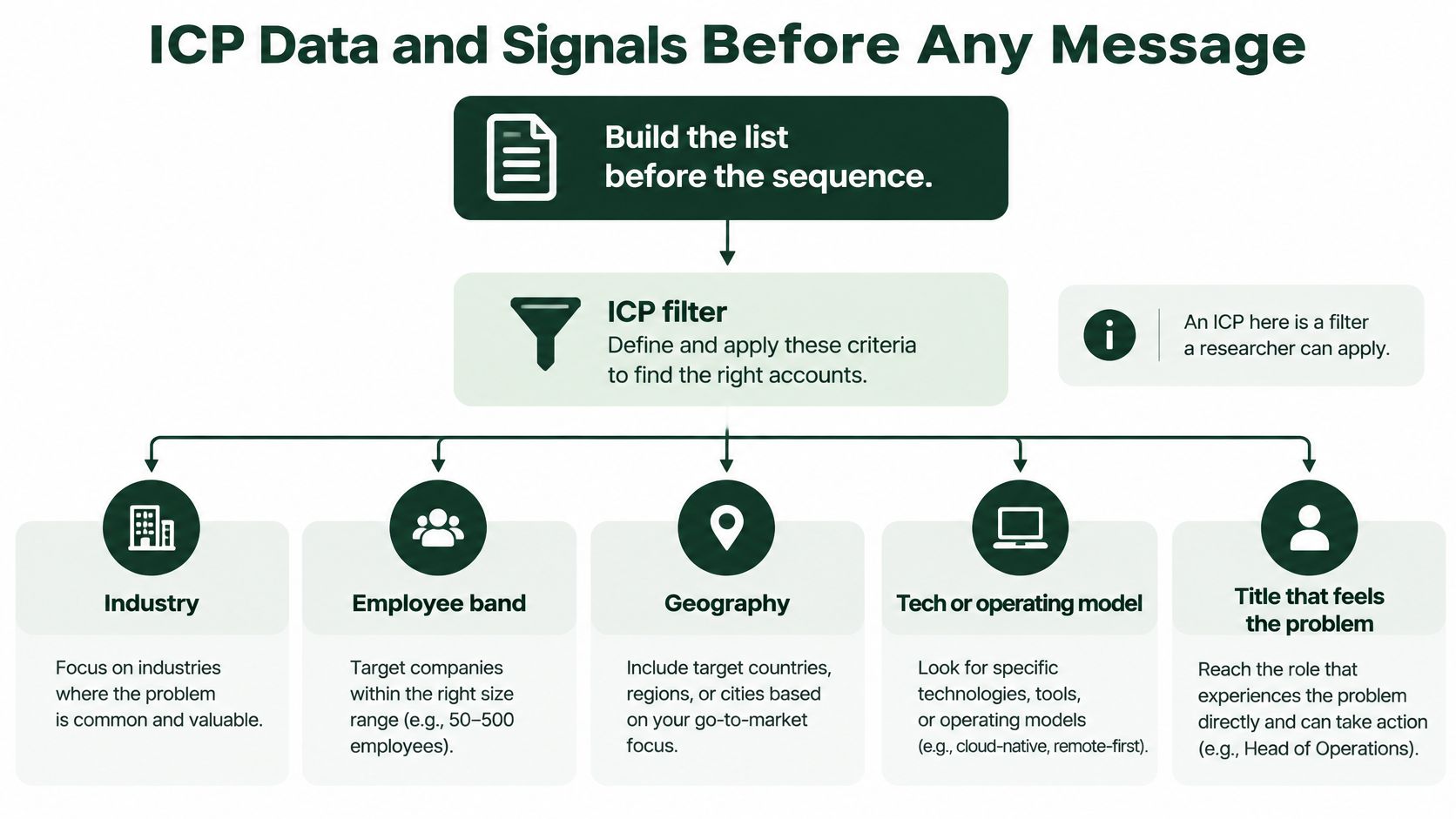
Separate account fit from timing. A strong firmographic match may still lack a reason to contact someone now, so tier accounts by both:
Tier | Qualifier | Sending rule |
|---|---|---|
Tier one | Named account with a live trigger | Automated sequence allowed |
Tier two | Firmographic match with no trigger yet | Sequence allowed after a trigger is found |
Tier three | Adjacent account | No automated sending |
Useful triggers include a leadership change, relevant hiring push, expansion announcement, technology change, or public complaint tied to the offer. A trigger is a reason to research further, not proof that a buyer is ready. Tools such as Whitewhale can support intent-signal timing, while Apollo can help fill gaps in contact and firmographic records. Keep adjacent accounts out of automated sending until research confirms a stronger fit.
For APAC prospecting, record the appropriate channel for each buyer rather than applying one country-wide assumption. LinkedIn can supply professional context, email can carry follow-up, and WhatsApp through Respond.io is better reserved for buyers who have engaged and where the channel is appropriate. A phone number alone is not a reason to start a cold WhatsApp conversation.
As an initial build, 200 to 400 Tier-one and Tier-two contacts per sender per month is a manageable research batch, not a platform benchmark. Score each account by trigger, seniority, and geography. LinkedIn's decision-maker insight report discusses the value of relevant business insights in seller outreach. Make that relevance observable: give every contact an evidence field the writer can use. If the researcher cannot state a credible reason to contact that person now, hold the record out of the sequence.
A clear sender headline helps the buyer interpret the relevance of the outreach. AiHeadshots offers headline ideas for job seekers; for sales, adapt the principle by naming the audience and problem rather than relying on broad claims. The list is ready when each contact has a defensible reason to hear from you.
How to Sequence LinkedIn and Email Together
Write the offer before any touch. The offer should name one painful job, one relevant proof point, and one low-friction next step, such as a short working session rather than a demand for a demo. The Social Search's messaging process moves from offer definition to sequence design across email and LinkedIn, then copywriting, and finally optimisation against live reply data. The sequence should carry one offer across channels, not repeat the same pitch in different places.

A sequence can follow this order:
Optimize the sender profile. State the market and problem in the headline, and make the profile credible to the intended buyer.
Review the prospect's profile and activity. Engage with a relevant post when there's a genuine contribution to make. Don't disguise a pitch as a comment.
Send a connection request. Keep any note to a brief reason for connecting. Leave the offer and links out; the note's job is permission.
After acceptance, send a contextual message. Wait one to two business days, then connect the offer to the contact's role, company context, or live trigger.
Follow up with proof. Three business days later, share one useful proof point that the buyer could forward internally.
Move the same offer to email. On day seven to ten, use the email lane rather than sending a third LinkedIn nudge that repeats the opening line. In 2024, 75% of B2B companies reportedly achieved better results when email prospecting was combined with other outbound channels, based on SoPro's analysis of 75.2 million emails and 22,120 multichannel prospecting campaigns, according to the SoPro campaign finding.
Stop at a clear no, a bounce, or silence on both channels. Don't let an open-ended sequence turn into repeated interruptions.
Personalization means the evidence field changes, not that the writer inserts a first name. One prospect may receive a note tied to a hiring need; another may receive one based on a specific operational change. Keep the offer fixed while testing the relevance of the insight. Draft two variants of step four first, so the team can learn whether the evidence changes the quality of replies.
InMail is a separate format from connection notes and messages to existing connections. LinkedIn's official rules allow a subject line of up to 200 characters and a body of up to 1,900 characters, according to its InMail character limits. Use the subject to make relevance clear and the body to explain the context, reason for contacting the recipient, and next step. Treat an InMail as a considered option when there's no accepted connection and the account merits the credit. Teams planning messages and sequences can also plan marketing campaigns with CRAIM. For more on sequencing email touches, see email sequence strategy.
The process is easier to operate when the offer stays singular and the sequence earns the next touch:
Automation Limits and Reply Routing
LinkedIn can restrict an account when invitations are sent quickly, ignored, left pending, or marked as spam. Excessive invitation activity that appears automated can also lead to a restriction or suspension. LinkedIn says most restrictions are automatically removed within about one week, but an account restricted for too many outstanding invitations may need to wait up to one month before sending again, according to its invitation restriction guidance. Automation should enforce sensible pacing and routing, not hide a list that isn't earning acceptance.
Set a cap from each sender's own recent baseline. Review pending invitations, pause campaigns that fall materially below the 28.5% acceptance benchmark, and investigate targeting before raising volume. Use LinkedIn outreach automation guidance to help define the controls and ownership needed to operate the system responsibly. When multiple seats are involved, coordinate the caps so one sender's activity doesn't create account-level risk for the whole program.
The inbox needs an owner and a response rule for every outcome. A clear handoff makes it less likely that an interested buyer waits while an automated sequence keeps running.
Reply type | Owner | Speed | Next action |
|---|---|---|---|
Positive, asks for time | Account executive or founder | Same business day | Book the working session and keep the trigger in the invite |
Not now or no budget this quarter | Original sender | Within two days | Exit the sequence and reopen in 60 to 90 days |
Wrong person | Original sender | Within one day | Ask for the right role, then stop messages to this contact |
Objection or competitor mention | Sender plus whoever owns proof | Within one day | One proof point only, then a single question |
Unsubscribe, hostile, or spam complaint | Operator | Immediate | Suppress the account and review the list source |
No reply after LinkedIn and email | System | Automatic | Exit; don't add a third channel that week |
Positive replies should reach a human the same day, with the original evidence line preserved in the handoff. A “not now” needs a saved trigger and an exit from the live sequence, not another follow-up tomorrow. A wrong person is a chance to ask for the right role once, then stop contacting that individual. An objection calls for relevant proof, not a fresh pitch.
Review the workflow weekly: invitations, acceptance, replies, positive replies, meetings held, and account restrictions. If meetings rise while acceptance deteriorates, the program may be borrowing from future audience quality. Assign one person to own the inbox so replies don't sit overnight and automated messages don't continue after a human response.
APAC Buying Committees and Real Campaigns
Consider a regional SaaS team selling into Singapore, Australia, and India. The economic buyer accepts a connection, but procurement, finance, and a local country manager don't reply. A campaign judged only on individual responses can look stalled even when other people in the account are consuming material that helps them assess the vendor.
LinkedIn and Edelman's 2025 B2B Thought Leadership Impact Report found that 63% of hidden buyers spend more than an hour each week consuming thought leadership, 71% consider strong thought leadership more effective than marketing material when assessing a firm's value, and 79% are more likely to champion an RFP from a firm that consistently publishes high-quality insights, according to the report findings shared on LinkedIn. Give each important role a different proof point, not a different offer: the user needs to understand workflow impact, the technical or compliance reviewer needs relevant implementation evidence, and the internal champion needs a concise explanation they can pass along.

Map stakeholders at the account level. Start with the user, economic buyer, technical or compliance reviewer, and internal champion, then record the role each person plays in evaluation and what evidence would help them. The B2B buyer persona guide can support that role-by-role thinking. A contact who doesn't respond may still be influential; a forwarded proof point can help a deal move even when the first message doesn't become a meeting.
A services firm entering APAC without a local SDR bench faces a different operational challenge. Keep the sender's location and context clear, respect local holidays and business hours, and write for the actual market rather than assuming one English sequence fits every buyer. If someone replies on LinkedIn and then goes quiet, continue the same conversation on WhatsApp only when they've consented and the channel suits the market. Don't initiate a cold WhatsApp message just because a number is available.
The Social Search builds outbound systems for B2B teams selling into APAC and beyond. For these campaigns, report account coverage, stakeholder touches, and progression alongside replies and meetings. A committee that hasn't yet booked a call shouldn't automatically be labelled a failed account if the evidence is reaching people who shape the decision.
Build the System or Hand It Over
Build in-house if one person can own the list, offer, sending caps, and inbox every week, while keeping the sender profile and buyer-facing proof current. That ownership matters more than enthusiasm for LinkedIn. If research, copy, and replies sit with different people and stop whenever one is busy, the system needs an operator who can connect the work end to end.
The Social Search offers three ways to engage: a system the client runs, done-for-you outbound, or an embedded GTM lead. A typical build is live in about three weeks, with first outreach going out inside the first month, and the client owns the system. The LinkedIn Starter plan is a one-time $500 done-for-you LinkedIn outbound setup; it covers LinkedIn only and doesn't include email, social, SEO, inbound, newsletters, or buying signals. If the team needs a connected email lane and signal-led research, the LinkedIn-only setup won't cover those requirements.
For teams that need to grow content production while preserving editorial standards, this guide to scaling content marketing offers a useful companion perspective. For broader support connecting outbound operations to go-to-market execution, explore go-to-market consulting.
Choose based on the work you can sustain. If you're building internally, start with 200 accounts, one offer, and a measured sequence inside your sending caps. If you're handing it over or co-managing, use a working session to examine how buyers will be found, how replies will be routed, and which account-level result will be reviewed in the next operating cycle.
The Social Search builds and runs outbound systems that connect ICP research, relevant messaging, LinkedIn, and email for B2B teams selling into APAC and global markets. If you need a system you can operate, done-for-you outreach, or an embedded GTM lead, visit The Social Search to discuss the right fit.
