GTM Consulting Services for B2B SaaS Teams
Learn how GTM consulting services build pipeline, sharpen ICP, and scale outbound for APAC and global B2B SaaS. Compare models and evaluate providers.
You've hired SDRs, bought a sales engagement platform, and perhaps paid an agency to send more emails. The dashboard shows activity, but qualified pipeline hasn't followed. The usual problem isn't a shortage of effort. It's that targeting, data, messaging, sending, routing, and reporting were set up as separate tasks, with nobody accountable for making them work together.
GTM consulting services should connect those pieces into an operating system your team can run and improve, not leave you with a strategy deck and a list of tools. That distinction matters even more when you're selling across APAC, where channel choices and local rules affect how the system needs to work.
Table of Contents
Why Founders Hire GTM Consulting Services in the First Place
A founder often calls for help after trying the obvious fixes. An SDR leaves, and their undocumented account list and messaging go with them. An agency promises more meetings, but its definition of a qualified lead doesn't match the sales team's. The CRM is full of records, yet reps still choose accounts by instinct.
Each fix may address a real symptom, but none necessarily builds a repeatable sales motion. A new hire can't compensate for a fuzzy ideal customer profile. A sequence can't rescue poor contact data. And a CRM doesn't create useful reporting if activity and outcomes aren't recorded consistently.
The practical test: Can someone other than the founder explain who you target, why those accounts should care, how outreach is personalized, what happens after a reply, and how the team decides what to change?
A serious engagement answers that question by connecting ICP definition, account selection, data, messaging, sending, routing, and reporting. It sits between pure consulting and execution. The consultant diagnoses where the motion breaks, then helps build the workflows and documentation that let the team operate it.
The broader advisory market gives context for why companies bring in outside specialists. One estimate puts global management consulting at approximately USD 303.1 billion in 2024, with projected growth to USD 457.1 billion by 2032; the same source estimates operations advisory at USD 115.01 billion and IT consulting services at USD 148.15 billion in 2024. Those categories are broader than GTM work, but they reflect demand for help that combines advice with operational and technology execution (market estimates for management consulting).
If you're weighing a new region, Sensoriium's market entry playbook offers a useful way to think about market choices before committing to an outbound build. The goal isn't to buy more activity. It's to create a system that survives staff changes and produces useful feedback from every campaign.
The Core of a Modern GTM Consulting Engagement
A proposal should spell out how the work connects, not just list deliverables. If an engagement promises sequences but doesn't explain where account data comes from or how replies get routed, it's missing operational foundations.

Start with accounts and a reason to buy
ICP and account lists turn a broad market into a prioritized set of companies, with clear fit criteria and exclusions. A useful list distinguishes high-priority accounts from names that only match an industry label. Offer and messaging then explain why a specific buyer should act, in language tied to their problems rather than your product features.
Messaging needs to respond to where the buyer is in their decision. Gartner describes six recurring B2B buying jobs: problem identification, solution exploration, requirements building, supplier selection, validation, and consensus creation. Buyers can loop among these jobs, and they spend about 17% of purchase time meeting potential suppliers. When comparing several suppliers, time with any single sales representative can fall to 5–6% (Gartner's B2B buying jobs framework). A generic pitch may miss because it offers a product introduction to someone trying to build requirements or secure internal agreement.
Make channels, handoffs, and reporting work together
Channel strategy determines whether email, LinkedIn, inbound content, or partner routes fit the audience and buying context. Signal-driven prospecting uses relevant events to prioritize timing, while routing rules tell the team who should follow up and when. Sales enablement gives reps playbooks, objection handling, and clear next steps. Measurement connects source, message, reply, and pipeline so teams can adjust the system instead of arguing from anecdotes.
For a concise overview of how to organize the decisions before launch, see EmailScout's launch planning tips. Teams building their first motion can also use this GTM strategy guide for startups to clarify the strategic choices that should shape execution. A fractional GTM lead can own the full loop when no internal operator has the time or experience to do it.
Engagement Models and How to Pick the Right One
The right commercial model depends on what you can operate after the consultant leaves. A small system build can be sensible when the team already has an owner. It becomes false economy if nobody can maintain data, review replies, or fix routing.
Engagement Model | Typical Scope | Indicative Investment | Best Fit |
|---|---|---|---|
One-time system build | ICP, account list, messaging, initial outbound setup, and handover documentation | Around $500 | Pre-seed or seed teams that need a defined starting motion and can operate it internally |
Project-based retainer | Messaging refinement, data and infrastructure work, workflow improvements, and implementation support | Scope-dependent | Teams that have a motion but need focused improvements and short-term operational help |
Managed or embedded fractional GTM lead | Ongoing system operation, optimization, team coordination, and strategic ownership | Closer to $10,000 per month | Growth-stage or mid-market teams that need an accountable operator inside the function |
The figures are indicative, not universal price quotes. Confirm what's included, who owns the infrastructure, and what will be handed over before comparing proposals. A lower fee that excludes implementation may cost more in internal time; a larger retainer is wasteful if you need a one-time foundation rather than ongoing leadership.
Choose the build when your ICP is reasonably clear, someone in-house can own execution, and the gap is a documented system. Choose a project retainer when specific parts need work, such as positioning, routing, or list quality, but you don't need a full embedded operator. Choose an embedded lead when the company needs ongoing prioritization and coordination, not just initial setup.
The trade-off is control versus capacity. A build gives your team ownership quickly, but demands an internal operator. A managed model supplies more hands-on coverage, but should still produce documented workflows and a clear path to client ownership.
If you're comparing an external SDR service with consulting, this guide to outsourced SDR services helps frame the distinction. Ask whether the provider is only supplying outbound labor or taking responsibility for the system behind that work.
Outcomes That Prove a GTM Engagement Is Working
Pipeline is the lagging result. It can take time to show whether a new motion is healthy, so a kickoff should also define the operational signals that reveal problems early. Those measures depend on what the engagement controls, and they should be reviewed alongside actual opportunity quality.

Track the system's leading indicators
Useful leading indicators include valid-contact rate, bounce rate, positive reply rate, reply-to-meeting rate, and engaged buying groups. They can show whether account selection and data are sound, whether messages resonate, and whether the team is reaching more than one relevant person. Don't treat a high reply count as proof of success if replies aren't qualified or advancing a real buying conversation.
Data quality belongs on the scorecard, not in an admin backlog. Salesforce's 2025 State of Sales report found that 35% of sales professionals completely trust their data accuracy. It also reported revenue growth in the prior year among 83% of sales teams using AI, compared with 66% of teams without AI. Those figures don't establish that AI alone caused growth. They do underline why teams should check whether account, contact, and outcome data are reliable before automating decisions (Salesforce's State of Sales report).
Judge outcomes, not activity
Qualified pipeline, closed-won business, average contract value, and payback are lagging indicators. They show whether the motion contributes to commercial results, but only when CRM records connect opportunities to the accounts, messages, and channels that created them.
Ask for a shared dashboard that distinguishes activity from progression. A spike in sends or booked meetings doesn't tell you whether the right accounts engaged, whether sales accepted the meetings, or whether those conversations became opportunities. Conversely, a clean dataset and credible account engagement can show a promising system before revenue has had time to close.
During monthly reviews, question metrics that lack a decision attached to them. For example, “What will we change if this rate falls?” is more useful than collecting a number for its own sake. This metrics dashboard examples guide can help teams organize a view that connects operating health to pipeline results.
Building Outbound That Actually Works in APAC Markets
Expanding into APAC isn't a translation exercise. A campaign that works in one market may need different channels, data sources, timing, and consent records in another. The right build starts by treating each target country as an operational environment, not a regional checkbox.
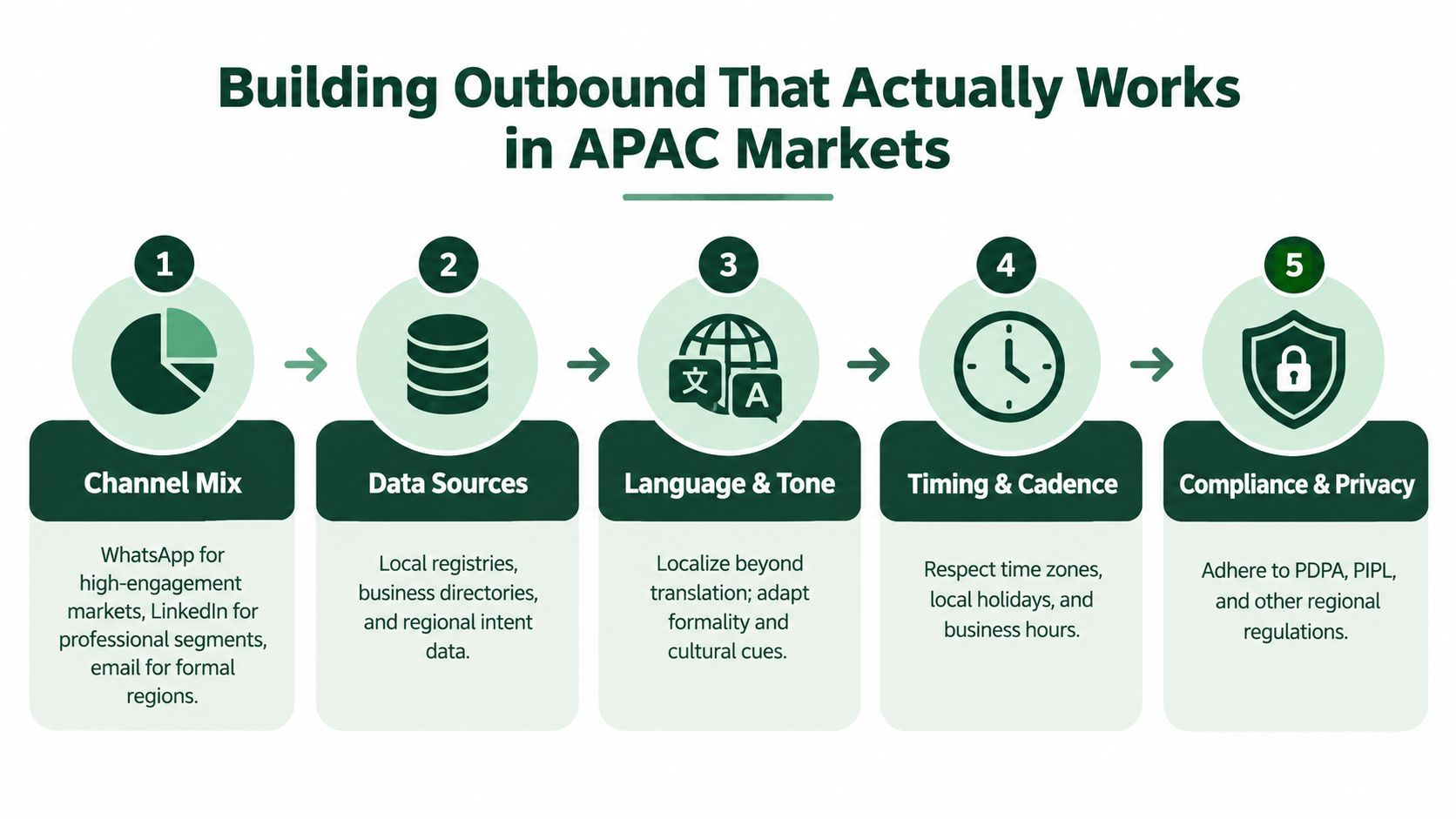
First, choose channels based on the audience and local expectations. LinkedIn may suit professional outreach; email remains useful where formal business communication fits; WhatsApp may suit high-engagement conversations when the recipient and context make it appropriate. Tools such as HeyReach for LinkedIn outreach and Respond IO for WhatsApp automation can support channel operations, but automation doesn't decide whether a message is welcome or compliant.
Second, verify that your data sources represent the local market. Apollo can support enrichment, while country-specific directories, registries, and regional sources may be needed to check company details and roles. Keep a record of where data came from and when it was verified. For email sequencing and deliverability workflows, Instantly can help operate campaigns, but it doesn't replace sender authentication or legal review.
Build compliance into the workflow
Google's requirements have applied to senders emailing Gmail accounts since February 1, 2024. Google generally defines bulk senders as those sending close to 5,000 or more messages to personal Gmail accounts within a 24-hour period. Bulk senders must configure SPF, DKIM, and DMARC, align their sending domain with the SPF or DKIM organizational domain, and provide one-click unsubscribe for marketing and promotional messages. Google says reported spam rates should stay below 0.1% and warns against reaching 0.3% or higher (Google's email sender requirements). Treat authentication, suppression, and complaint monitoring as core operating controls.
Australia adds a concrete localization requirement. The Australian Communications and Media Authority says commercial electronic messages generally need consent, sender identification, and a clear unsubscribe mechanism. Unsubscribe requests must be honored within 5 working days, and the unsubscribe method must remain functional for at least 30 days after sending (ACMA's guidance on avoiding spam). Capture evidence of consent and pass suppression updates between the client and any vendor. For context on staffing distributed sales operations, Virtustant Jobs' remote sales insights can inform how teams think about remote roles, but local process and buyer trust still require market-specific decisions. Review the outbound marketing agency overview when assessing whether an agency can handle those operational responsibilities.
Buying Groups Are the Real Target, Not Individual Replies
A reply is an interaction, not proof that an account is ready to buy. In complex B2B sales, the work is to understand who must evaluate, approve, use, or block a purchase, then coordinate outreach and evidence across that group.
Demandbase reports that 72% of B2B purchases involve complex, multi-stakeholder groups and that the average group for complex solutions has grown to 8.2 stakeholders, up 21% since 2015 (Demandbase's State of the B2B Buyer Report). That changes the unit of measurement. A single positive reply can hide a missing economic buyer, a technical concern, or a procurement process that hasn't started.
Map the account by role: economic buyer, end user, technical evaluator, champion, blocker, and procurement. Then give each person a role-specific reason to engage that still supports one consistent account narrative. If a champion replies but can't reach the budget owner, the next action should help build internal consensus, not just add another meeting to a dashboard.
A better success question: Which important roles in this account have engaged, and what evidence or action would help the group move forward?
Buying-group coverage needs account-level ownership and reporting. Track which roles have been reached, what they care about, what signals prompted outreach, and which next step is assigned. Intent information from Whitewhale can inform account prioritization, while content from Outrank and Narrareach can help provide useful materials for different stakeholder questions. Tools should serve a coverage plan, not become a list of disconnected channels.
A B2B buyer persona guide can help teams make role hypotheses explicit. The key is to test those hypotheses against real conversations, then update the account plan when a new evaluator, blocker, or decision-maker appears. More contacts in a sequence won't fix a buying group strategy that has no shared account context.
How to Evaluate and Compare GTM Consulting Providers
A polished deck doesn't prove a provider can build a working motion. Ask each shortlisted firm the same operational questions, then compare the evidence and handover terms rather than relying on presentation quality.
Start with ICP rigor. Can the provider explain which accounts should be excluded, not just which ones look attractive? Ask for a sample of how it prioritizes accounts and handles conflicting signals. Then inspect evidence of execution: what did the provider build, what did its team operate, and how did it distinguish a qualified meeting from an unproductive conversation?
Use a practical provider scorecard
Pipeline evidence: Ask for examples of how the provider attributed meetings and opportunities to accounts, messages, and channels. Confirm what it can substantiate, and don't accept activity counts as a substitute for pipeline evidence.
Ownership transfer: Request sample playbooks, workflow documentation, and a clear explanation of which infrastructure and data your team retains.
Data governance: Ask how the provider verifies records, documents data sources, manages suppression, and handles consent across target markets.
Reporting detail: Check whether dashboards show progression and data quality, not just sends and replies. CRM use is already common among larger businesses, but adoption isn't the same as reliable operations: a compilation reports 91% CRM use among businesses with more than 11 employees in 2021, compared with 12% in 2008, and regional adoption of 83.6% in North America, 85.6% in Europe, and 75.9% in Asia-Pacific (CRM adoption figures).
Market fit: Ask for practical experience with your sales environment and regions. A provider should be able to explain how its process changes when it enters a new market, rather than treating localization as copy editing.
Check that the team can work with the tools you'll use after handover. For example, SearchAtlas may fit technical SEO work that supports inbound discovery, while Manychat may fit social DM or comment automation when those channels are part of the buyer journey. Neither should be bolted on without a clear owner and purpose.
Send the same scorecard to each candidate and ask for sample dashboards, sequences, and data-quality reports. A provider that welcomes scrutiny is easier to trust with an operating system your team needs to own.
A 30-Day Decision Plan for Choosing GTM Consulting Services
Don't begin by comparing vendor websites. First decide what the business needs an outside operator to solve, and who will own the system after the engagement.
Start with three internal questions: Do we own our ICP? Who operates the system after handover? Which markets are we committing to? If the answers are unclear, write down the open decisions before requesting proposals. Otherwise, vendors may recommend different scopes because they're solving different problems.
Before you sign
Ask shortlisted providers for practical artifacts, not only credentials. Request a sample dashboard, a sample sequence, and a sample data-quality report. Check how each candidate defines qualified pipeline, which records and infrastructure you retain, how it documents compliance, and what happens when early outreach underperforms.
Once you select a provider, agree on the operating owner and decision rights. Then confirm the initial account criteria and target markets, and set up a shared record of message variants, outreach outcomes, and next actions. Those foundations make performance reviews useful because the team can trace a result back to the inputs that produced it.
A system build can be live in about three weeks, with early meetings possible within the first month, according to The Social Search's described delivery model. Treat that as a practical expectation to discuss during planning, not a guarantee of qualified pipeline or closed revenue. The engagement should leave your team with infrastructure, documentation, and playbooks it can operate, rather than a permanent dependence on outside help.
The decision to make this week is straightforward: identify the broken handoff in your current motion, choose who will own the fix, and ask providers to show how they'll build and transfer the solution. Compare their answers against your actual operating gaps, not the number of tactics in their proposal.
The Social Search builds and operates outbound systems for B2B teams selling into APAC and global markets, connecting ICP, data, messaging, channel operations, and reporting. If you're choosing between a one-time build and ongoing fractional GTM support, visit The Social Search to discuss the operating model your team needs.
