Is ChatGPT an AI Agent? the Definitive 2026 Guide
Is ChatGPT an AI agent in 2026? Learn how ChatGPT differs from a true AI agent, what makes it agentic, real examples, and the limits that matter for GTM teams.
Standard ChatGPT is a conversational model, not an AI agent. It only becomes agentic when it's wired to goals, tools, permissions, and an iterative action loop.
So, is ChatGPT an AI agent? The useful answer depends on what sits around the model. If you ask it to draft an outbound email, summarize account research, or suggest a follow-up, you're using an interactive assistant. If it can inspect live data, choose a next step, call tools, update systems, evaluate the result, and continue toward a defined outcome, you're operating an AI-agent system.
That distinction matters for GTM teams because “AI-powered” doesn't tell you whether a system can safely change a CRM, send a message, or route a qualified reply. The question is whether the system can act, under what permissions, and with which human controls.
Table of Contents
What This Article Will Answer and Why It Matters
Standard ChatGPT behaves as a conversational model, not an autonomous agent. Agentic behavior appears only when the model is connected to an objective, external tools, and a perceive-reason-act loop, a boundary consistent with the OECD's discussion of agentic AI concepts.
The distinction is simple to state but easy to miss in a GTM workflow. A salesperson can ask ChatGPT to personalize an email, and ChatGPT can produce a useful draft. That doesn't mean it found the account, checked the prospect's role, selected a sending channel, delivered the message, monitored the reply, and updated the CRM. Those additional steps require orchestration, tools, state, and permission.
The practical question behind the label
This article uses a production-minded test:
Objective: Does the system have a defined outcome, such as qualifying an account or routing a reply?
Action: Can it perform work in external systems rather than only generate text?
Autonomy: Can it select and sequence actions without a human specifying every step?
Control: Can a person review risky actions before they become irreversible?
The answer to “is ChatGPT an AI agent” is therefore conditional. The basic product experience is primarily an assistant. A configured deployment with browsing, code execution, APIs, memory, computer control, permissions, and supervision can operate as an agent component.
For outbound teams, this changes how you evaluate software. Don't ask whether a vendor uses ChatGPT. Ask whether the workflow can enrich a record, explain why a prospect matches the ICP, draft a message, wait for approval, send through the correct channel, interpret the response, and log what happened. Each capability belongs to a different layer of the system.
Defining What an AI Agent Actually Is
An AI agent is best understood as a system that pursues a goal by deciding and taking actions, rather than merely producing an answer. Common definitions emphasize three elements: an objective, action-oriented outputs, and some degree of autonomy. The U.S. government's description of AI-agent systems similarly focuses on a generative model combined with software scaffolding and tools for discretionary action.
A GTM analogy makes the difference clearer. Think of a junior SDR who receives a target account list, a qualification objective, access to a CRM, and permission to prepare outreach. The SDR isn't judged only on whether they can write a sentence. They're expected to pursue a goal, use available systems, choose actions, and escalate uncertain situations.
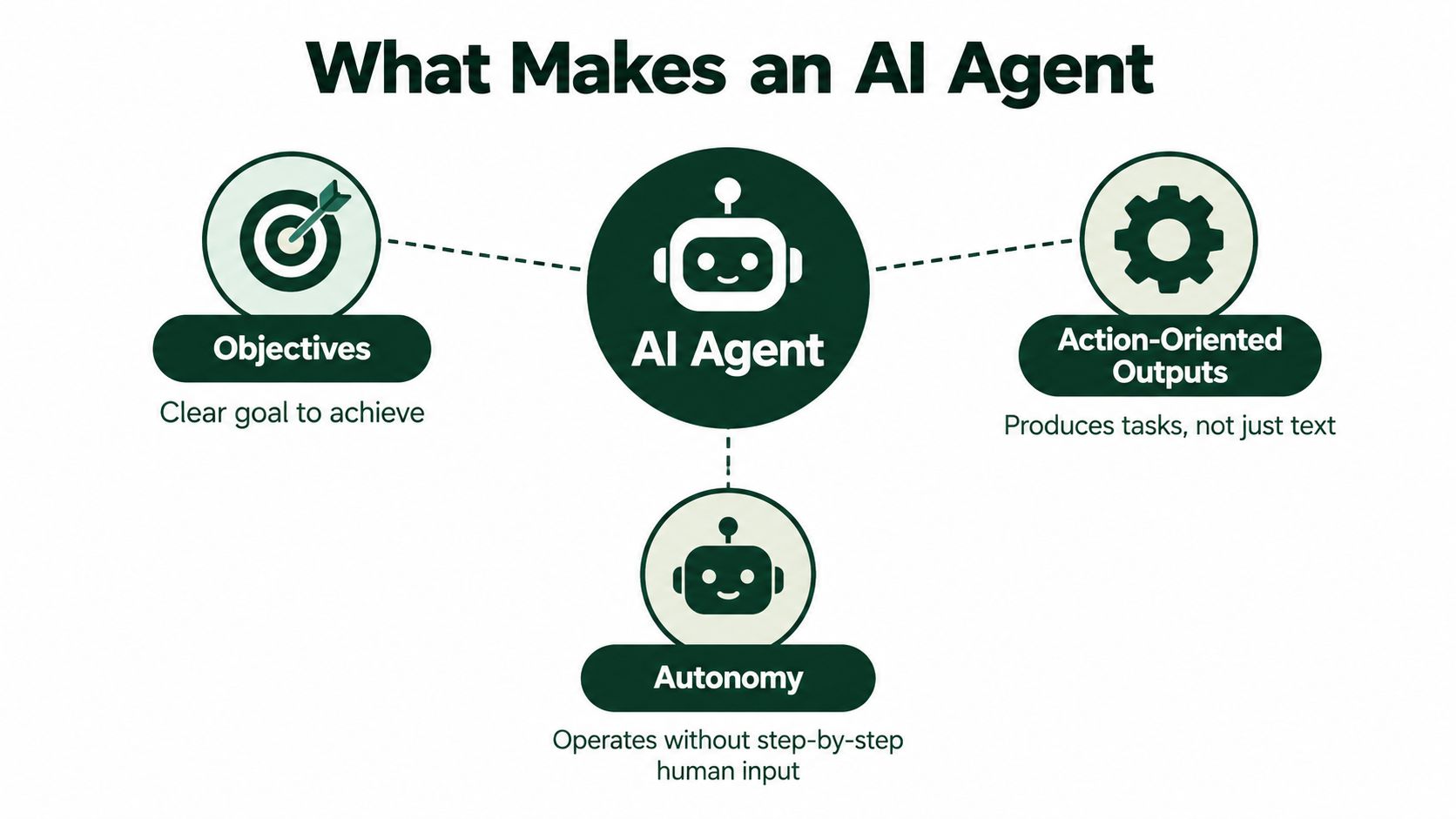
The three-part test
Objectives give the system something to pursue. “Write an email” is a narrow instruction. “Identify qualified APAC SaaS accounts, prepare relevant outreach, and route interested replies” is a workflow objective with several connected outcomes.
Action-oriented outputs change the nature of the result. A paragraph is an output. Creating a task, querying a data source, adding a qualification label, or submitting a draft for approval is an action-oriented output.
Autonomy determines how much step-by-step direction the system needs. A model that waits after every sentence is an assistant. A system that decides whether to search a company site, inspect a CRM record, request enrichment, and escalate a mismatch shows a greater degree of autonomy.
For a broader marketing perspective, see how AdCrunch explains AI agents. The same checklist also helps separate agentic AI from generative AI in a practical GTM environment, rather than relying on product naming.
A useful internal reference is this guide to what agentic AI means compared with generative AI. The key point is portable: apply the test to any platform. If the system only generates content after a prompt, call it an assistant. If it can pursue a goal through tools and controlled actions, call the whole deployment agentic.
ChatGPT vs AI Agent on a Decision Matrix
The easiest way to answer the question is to compare the workflow behavior, not the interface. A chat window can sit on top of a simple completion model or a much larger system with tools, memory, and approvals.
Capability | Standard ChatGPT | Agentic ChatGPT or AI Agent |
|---|---|---|
Objective setting | Responds to the user's stated prompt | Maintains a workflow objective across multiple steps |
Memory and state | Uses the available conversation context | Stores and retrieves relevant task state across actions |
Tool use | May explain what a tool or process should do | Selects and invokes approved tools, APIs, or software |
Planning | Produces a response or suggested sequence | Decomposes a goal into actions and evaluates progress |
Autonomy | Waits for further user direction | Continues within defined permissions and escalation rules |
Error recovery | The user identifies a problem and prompts again | Detects a failed step, retries, changes approach, or escalates |
CRM impact | Drafts a note or recommends an update | Reads, creates, or edits records through an authorized connector |
Human oversight | Human directs nearly every meaningful step | Human approves selected actions and reviews exceptions |
The table doesn't mean that every agent must run without people. Autonomy is a degree, not an on-or-off switch. A system can research an account independently, then pause before sending outreach. It remains agent-like because it handled the intermediate planning and actions.
The GTM consequence of each row
A standard chat completion can produce a personalization draft, but it can't prove that the account fact is current unless it has an appropriate information source. An agentic workflow can retrieve data, compare it with the ICP, and attach evidence to the draft, though the result still needs validation.
Likewise, a model can recommend changing a CRM stage. An agent can make that change through a connector. The second capability creates operational risk because an incorrect action now affects reporting, routing, and rep behavior.
That's why “ChatGPT can do X” is incomplete. The accurate statement describes the model plus its surrounding system, including connectors, permissions, state management, monitoring, and approval gates.
How ChatGPT Becomes Agentic
ChatGPT becomes agentic when it can move through a task rather than stop at a response. OpenAI's description of ChatGPT agent shows this pattern through browsing, code execution, analysis, editable documents, and interaction with a virtual computer.

The capability stack
Browsing lets the system inspect current web information instead of relying only on the prompt. In GTM, that might mean checking a company's product page, hiring activity, or public expansion signal before preparing account research.
Code execution lets it transform data, run calculations, validate fields, or process a list. A model can describe a segmentation rule in plain text, but code can apply that rule consistently to actual records.
API connectors connect reasoning to operational systems. A CRM, enrichment provider, calendar, sequencing platform, or internal database can become part of the workflow. Resources such as hosted MCP for ChatGPT illustrate the broader direction of connecting models to external capabilities.
Memory and state preserve what has already happened. Without state, an account workflow may repeat research, lose the approval status, or forget why a lead was disqualified. With state, the system can maintain the task history and resume intelligently.
Computer use allows interaction with graphical interfaces. OpenAI's Computer-Using Agent research preview describes a system that processes screen pixels and operates a virtual mouse and keyboard. The practical loop is observable: inspect the screen, reason about the next step, click or type, inspect the result, and continue.
For a foundation on conversational systems before adding these layers, see this practical guide to chatbots. A GTM team doesn't always need every capability. It needs the smallest reliable stack that can complete the intended task.
A GTM Example With and Without Human Checks
Consider a B2B company expanding into APAC. The team wants to identify suitable accounts, understand each company's buying context, prepare relevant outreach, and route replies to the right representative.
In a controlled agentic workflow, ChatGPT receives an account objective and a defined ICP. It checks approved sources, enriches missing context, identifies possible buying signals, and drafts a message that explains why the account may be relevant. The system then places the draft in an approval queue, sends only after a human review, classifies incoming replies, and writes the outcome to the CRM.

What the human checkpoint changes
The person reviewing the draft isn't repeating every research step. They're checking whether the account fit is real, whether the personalization is defensible, whether the offer is appropriate, and whether the proposed channel is allowed.
That division of labor is useful. The agent handles repetitive investigation and routing. The revenue team owns judgment, positioning, compliance, and relationship context.
A conversational model alone might generate the email once the operator supplies the facts. The agentic version can gather the facts, connect them to the account record, and prepare the next operational action. The system becomes more capable, but it also gains more ways to make a costly mistake.
The unchecked version
Remove the approval gate and the same workflow can become dangerous. The system may infer a company detail that isn't supported, apply the wrong qualification rule, select an unsuitable contact, and send outreach at scale. It might also write an incorrect status to the CRM, causing later routing decisions to build on bad data.
The problem isn't that the model intended harm. The problem is that an automated action converted an uncertain inference into an external event. For channels such as WhatsApp, the same principle applies, which is why teams evaluating WhatsApp AI chat agents should define escalation and consent rules before deployment.
A useful design is human approval for irreversible actions, automated handling for reversible preparation. Research, drafting, scoring, and queueing can often proceed automatically. Sending messages, changing customer records, and committing spend deserve stronger controls.
Real Limitations and Required Safeguards
Agentic behavior adds capability, but it doesn't remove model limitations. A system may invent a plausible account fact, select the wrong tool when the instruction is ambiguous, lose relevant context during a long task, or consume more resources as the chain of reasoning grows.
OpenAI's own ChatGPT overview supports the basic distinction between generating a response and operating through tools. The practical lesson is that language generation alone doesn't guarantee accurate research, correct tool selection, or safe side effects.

Non-negotiable rule: Never let language-model output become an irreversible action without a human checkpoint.
Controls for a GTM deployment
Approval gates: Require review before sending outreach, changing lifecycle stages, deleting records, or committing budget.
Tool allowlists: Give the agent access only to the connectors required for its task. A research workflow shouldn't have permission to alter billing data.
Field-level validation: Check required fields, evidence, contact role, and account fit before writing to the CRM.
Audit logs: Record the prompt context, tools called, returned data, proposed action, approver, and final outcome.
Bounded retries: Let the system recover from a temporary failure without retrying a risky action indefinitely.
Escalation rules: Route ambiguous intent, sensitive accounts, and conflicting data to a human rather than forcing a decision.
The strongest implementation treats the agent as an operator with restricted permissions, not as an unsupervised employee. It can move work forward, but the system decides where it must stop.
Deciding What Your Workflow Actually Needs
Start with the task, not the product label. Ask whether the workflow has a clear objective, needs external data, requires multiple steps, can tolerate an incorrect action, and needs an audit trail.
Use plain ChatGPT when the work is primarily drafting, analysis, summarization, brainstorming, or guided research. You can keep a person in the loop for every meaningful action because the output remains advisory.
Choose an agentic build when the task repeats across systems and benefits from controlled autonomy. Account research, lead routing, reply classification, and structured CRM preparation may fit, provided the permissions and checkpoints are explicit.
Choose a dedicated GTM system when deliverability, data quality, channel rules, reporting, or compliance are central to the outcome. ChatGPT can provide reasoning and personalization, but it shouldn't replace purpose-built infrastructure by default.
A short decision checklist:
Define the outcome. What must be true when the workflow finishes?
Map the actions. Which systems must the workflow read or change?
Classify risk. Which steps are reversible, and which affect prospects or customers?
Set supervision. Where must a person approve, inspect, or intervene?
Measure the workflow. Can you tell which signal, message, and action produced the result?
This guide to AI tools for business automation is useful when comparing a general model with specialized systems. The right choice is often a stack, not a single tool.
Where ChatGPT Fits in a Modern GTM Stack
ChatGPT works well as a reasoning, research, and drafting layer. It can help interpret account information, turn signals into messaging angles, classify replies, and suggest next actions. The surrounding GTM stack should handle the operational details that require stable execution, permissions, deliverability controls, and reporting.
For cold email and sequencing, teams can evaluate Instantly. For LinkedIn outreach, HeyReach is a relevant specialist option. Apollo can support data enrichment, while Whitewhale fits workflows built around intent signals.
SEO teams may use SearchAtlas for technical SEO and Outrank for SEO content. For WhatsApp workflows, Respond.io is relevant, while Manychat applies to social media DMs and comments. For content creation, Narrareach can sit alongside the drafting and review layer.
You can also browse ChatGPT integration options when assessing how models connect to external services. The important design decision is not whether ChatGPT replaces the stack. It's whether the model is assigned the right job inside a system that has clear ownership, data boundaries, routing, and measurement.
The Social Search builds and operates outbound systems that connect ICP definition, data, messaging, channel execution, routing, and reporting for B2B teams selling into APAC and global markets. Its AI chat agent setup for businesses fits teams that need the reasoning layer connected to a documented, client-owned GTM workflow.
If you're deciding whether ChatGPT belongs in your outbound process, The Social Search can map the workflow, define the approval points, and connect the right tools around it. Visit the team to build an agentic GTM system that advances research and routing without giving unverified model output unrestricted control over your pipeline.
