8 B2B Sales Email Templates for Better Outreach
Explore 8 b2b sales email templates for cold outreach, follow-ups, meetings, and APAC localization, with subject lines and practical performance tips.
Most advice about B2B sales email templates is backwards. Teams obsess over clever copy before they've nailed ICP, buying triggers, and whether the email should start a conversation, revive one, or route the buyer to the right next step. A template is a structure. It isn't a substitute for research.
That matters more now because broad B2B cold campaigns typically sit in the 3% to 6% reply-rate range, with 5% often treated as the mark that says a template is working well. If you're building outbound seriously, pair sequencing and deliverability with Instantly early, and use Apollo to enrich role, company, and trigger data before anyone writes first lines. Good structure on bad data still loses.
The more useful way to organize B2B sales email templates is by job. One email needs to create awareness. Another needs to frame a costly problem. Another needs to use a warm path, a live trigger, or a relevant proof point. That's also where APAC context starts to matter. In some markets, a very direct ask works. In others, the same wording lands better if you anchor it to local expansion, channel complexity, regional hiring, or a practical business constraint.
You'll find eight templates below, built around the job each email has to perform. I'll also show where subject-line personalization changes outcomes, when follow-up matters more than the first send, and how to localize wording without turning the email into corporate mush. If your list quality is shaky, fix that first with B2B email validation for SaaS.
Table of Contents
1. AIDA Model
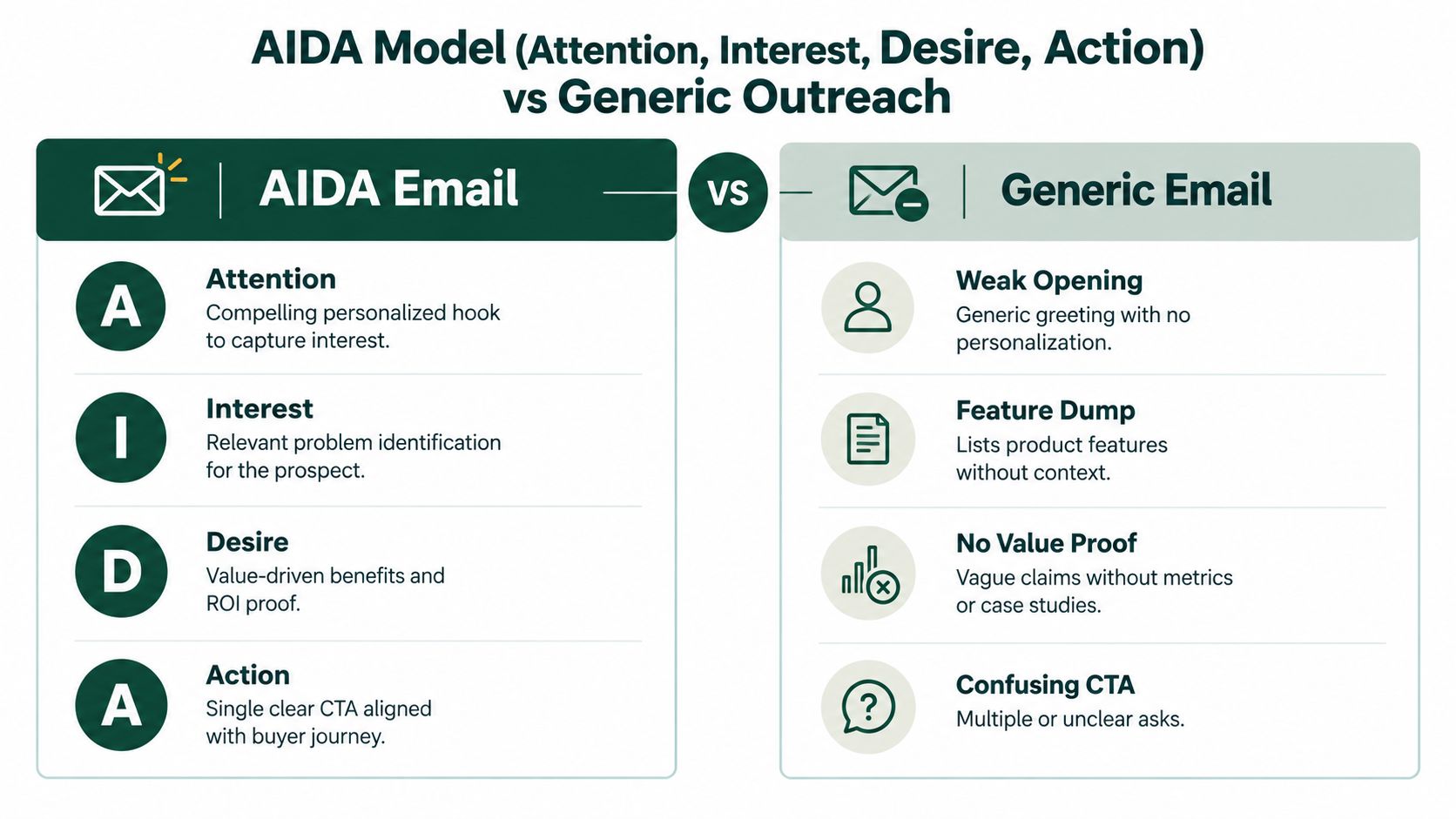
AIDA still works when the market already knows the category but hasn't prioritized your solution. It gives the email a clean motion. Get attention with a relevant trigger, build interest with a business problem, create desire with a believable outcome, then ask for one small next step.
Enrichment matters. If the attention line is generic, the whole structure collapses. Subject-line and first-line personalization can materially lift performance. One benchmark reported personalized subject lines at 46% opens versus 35% for generic subject lines, while reply rate rose from 3% to 7% after personalization in a 5.5M-email benchmark summarized here.
A practical AIDA version
A SaaS seller targeting a Head of Revenue Operations in Singapore might write:
Subject: reducing handoff friction at [Company]
Hi Priya, noticed your team is hiring across sales and CS.
That usually makes lead routing and stage ownership messier before it gets better.
We help RevOps teams tighten qualification, routing, and follow-up logic so pipeline doesn't stall between teams.
Worth a short look at how you're handling inbound and outbound handoffs today?
The best AIDA emails don't over-explain the product. They move the buyer one step forward.
Where teams get this wrong
Weak attention: Leading with "we help companies like yours" isn't attention. A hiring trigger, product launch, market expansion, or workflow change is.
Bloated desire: Don't dump every feature into the desire section. Pick one business outcome.
Hard CTA too early: If the buyer doesn't know you, "book 30 minutes" is often too much. A softer ask usually works better. For more on shaping that ask, see this guide on what is a call to action.
AIDA is especially useful for mid-market outreach where the buyer understands the category but hasn't attached urgency to fixing the issue yet.
2. The Problem-Agitate-Solve Email Template
PAS is not a default cold email formula. It earns its place when the email has one clear job: surface a problem the buyer already owns, make the operational cost feel current, and offer a credible next step.
That makes it useful for accounts with strong ICP fit and a visible trigger. A regional rollout, new distributor model, ERP migration, hiring spike, or channel expansion gives you something concrete to write against. Without that context, PAS turns vague fast.
Template benchmarks cited earlier support keeping this format in the mix, but only for the right situations. The pattern works because the buyer can recognize the pain immediately, not because the acronym itself is persuasive.
A tighter PAS example
For an operations consultancy selling into APAC manufacturing:
Hi Marcus,
regional teams often lose visibility when procurement, warehousing, and local distributors all report differently.
That usually leads to slower decisions, reactive firefighting, and manual reconciliation across markets.
We help ops leaders standardize reporting and surface exceptions earlier. If that's relevant at [Company], happy to share how we'd assess the current setup.
Good PAS copy stays close to the workflow. It names the bottleneck, then the business effect. It does not overplay the drama.
Practical rule: Agitate the operational consequence. Keep the tone measured.
That matters even more in APAC. Senior buyers in Singapore, Australia, Japan, and much of Southeast Asia usually respond better to process risk, coordination gaps, and reporting friction than to emotionally loaded copy. "Growth is hard" says very little. "Country teams are following different handoff rules, so forecast confidence drops at quarter end" is specific enough to earn a reply.
Sequence also changes how hard you can press the pain. On a first touch, keep the agitation light and tied to an observable trigger. By the second or third email, after a website visit, content engagement, or category-level intent signal, you can be more direct about cost, delay, or leakage. Whitewhale is one option for spotting accounts already researching the problem, which makes PAS copy feel timely instead of assumptive.
You can also sharpen this structure with buyer psychology if your team writes like a product sheet. This breakdown of persuasion techniques is useful for shifting from features to consequences without slipping into hype.
The trade-off is simple. PAS can produce strong reply quality when the pain is real, but it also creates more friction if your targeting is loose or your domain reputation is weak. If deliverability is shaky, or the account barely fits the ICP, a direct problem statement can read harsher than intended. In those cases, soften the wording, narrow the claim, and ask for validation instead of jumping straight to a diagnosis.
3. The Curiosity-Driven Pattern Interrupt Email
Curiosity emails fail when they try to be clever. They work when they surface a plausible issue the buyer is already close enough to recognize.
That makes this template a job-specific tool, not a default opener. Use it when you have a real signal but not enough evidence to write a direct problem email yet. Good fits include new regional hires, country expansion, a pricing page for multiple markets, partner recruitment, or signs that pipeline ownership is split across regions or functions. Loose targeting ruins this format faster than weak copy because the whole email depends on one believable observation.

What useful curiosity sounds like
"Quick question" creates no tension because it says nothing.
"Why is APAC pipeline split across three teams?" gives the reader a reason to check your note. It points to a specific operational condition, which is the whole point of a pattern interrupt. The email earns attention by sounding observed, not mysterious.
A workable version for a sales consultancy:
Hi Elena,
noticed your team is running outbound, partner-sourced pipeline, and country-led demand as separate motions across APAC.
Was that an intentional design choice, or did it develop market by market?
We usually see that create slower lead routing and inconsistent reporting once volume picks up. If helpful, I can send the 2 or 3 failure points that show up first.
This wording does three jobs. It interrupts the usual cold-email rhythm, anchors the message in something concrete, and gives the prospect a low-friction way to reply without accepting a meeting.
Where this pattern fits in the sequence
On first touch, keep the claim narrow. Curiosity works best early, before you've earned the right to diagnose too hard.
If the account visits your site, opens multiple messages, or matches a strong buying signal, the follow-up can answer the implied question directly. That second email is where substance matters. If the first note asks, "Is routing fragmented?", the next note should explain what fragmented routing usually breaks, who feels it first, and whether that matters in their setup.
This is also where ICP quality changes the wording. A clean-fit account can handle more specificity. A marginal fit needs softer language and more room for correction. For enterprise APAC teams, I usually avoid loaded phrasing and write toward coordination risk instead: country teams, handoff rules, response SLAs, CRM ownership, or HQ reporting gaps. That tends to travel better across Singapore, Australia, Japan, and Southeast Asia than overly playful hooks.
How to keep it from backfiring
Use a trigger you can defend: Hiring, territory expansion, new channel motion, leadership changes, or a visible GTM restructure are stronger than generic firmographic guesses. Apollo is one source for pulling those signals before writing the hook.
Match the subject line to the claim: Sparse, unusual subjects can help, but only if the body delivers on them. If the subject says "APAC routing question," the email should explain why you asked.
Protect inbox placement: Pattern interrupts often use shorter copy and sharper subjects, which means weak sending infrastructure gets exposed quickly. Instantly is one option for managing sequencing and inbox distribution.
Localize the follow-up: In APAC, directness is fine when the observation is factual. What hurts reply rates is sounding careless about regional structure, especially when HQ, local country teams, and partners all touch revenue.
If your team keeps writing curiosity emails that get opens but not replies, the problem is usually not intrigue. It is the missing handoff between the first question and the second-touch explanation. This guide to a cold emailing guide to get more replies is useful for tightening that transition before you scale the pattern.
4. The Social Proof Case Study Email Template
Case-study emails are often used too early.
If the prospect does not yet recognize the problem, a customer story feels like a shortcut to credibility. It rarely works that way. This template performs a different job. It reduces perceived risk once the buyer already has some context, either from your first email, a visible trigger, or a known operating issue inside that ICP.
The case study also has to match the account you are writing to. Similar industry helps, but operating model matters just as much. A regional distributor, multi-country sales team, channel-led motion, or HQ-to-local reporting structure will change which proof feels believable. APAC buyers are usually quick to spot when the reference account sounds like a US playbook pasted onto Singapore, Malaysia, or Indonesia.
A version that fits that reality:
Hi Farid,
noticed your team is managing growth across multiple local entities.
We recently worked with a regional distributor that had inconsistent stock reporting between country teams and HQ. They tightened inventory visibility and exception handling, which made handoffs and regional reporting easier.
If that issue is showing up in your operation, I can send the workflow they changed and where the rollout got messy.
That last line matters. A polished success story can sound generic. A brief nod to implementation friction makes the email sound like it came from someone who has been through the work.
Use this template by job, not by habit:
Job 1: Prove similarity. Reference a customer with a comparable buying environment, not just a recognizable logo.
Job 2: Make the change concrete. "Improved efficiency" says nothing. "Standardized lead routing across country teams" gives the buyer something to map to their own process.
Job 3: Lower reply effort. Offer the workflow, lesson, or rollout detail. Do not force a meeting ask in every case-study email.
Sequence matters here. This email usually works better as touch two or three, especially when the first touch established a problem or referenced a buying signal. If ICP quality is weak, social proof will not save the sequence. It just makes an irrelevant email look more polished.
For segmentation, map one proof point to one cluster of accounts. A manufacturing case study for ANZ enterprise buyers will often need different wording from a distributor example sent to Southeast Asia mid-market teams. The closer the match on region, scale, sales motion, and reporting complexity, the more credible the message feels.
5. The Strategic Value Proposition Executive Email Template
Senior executives reply to relevance, not enthusiasm.
This template has one job. Show that you understand a live business priority, tie it to an operational risk they likely care about, and give them an easy way to engage without forcing a calendar link into the first touch. It works best when the account is already qualified and you have a real trigger to reference, such as regional expansion, a partner-led push, a restructuring, or a new revenue target.
Here is the short version:
Hi Daniel,
noticed you're expanding distribution across Southeast Asia.
That often creates two issues early. Lead quality starts to vary by market, and follow-up slows once inquiries move between country teams or channel partners.
We help B2B teams tighten routing, ownership, and market-level messaging during expansion. If that is in your remit this quarter, happy to share what usually breaks first.
The wording matters. "Compare notes" or "share what breaks first" often gets better executive response than a hard meeting ask, especially in APAC where senior buyers may prefer a lower-commitment first reply.
A few operator rules make this template stronger:
Lead with the initiative, not your product category.
Name one or two downstream consequences the executive would recognize.
Keep the value proposition narrow enough to feel credible.
Write for the seniority level. A country manager, regional VP, and founder will not react to the same framing.
If the positioning still sounds broad, fix that before scaling this template. A weak pitch gets exposed fastest in executive outreach. This guide to writing a clear unique value proposition for B2B outreach is a useful checkpoint.
Sequence changes the outcome here. This is rarely the best opener for a cold, weak-fit list. It performs better when intent is already present, or when an earlier touch established the operating problem and this email reframes it at the executive level. If ICP quality is loose, the email will read polished but irrelevant.
For APAC accounts, tone usually matters as much as content. Dial down broad transformation language. A message like "we help expansion teams avoid channel conflict and delayed follow-up across markets" reads more credibly than inflated claims about growth acceleration.
6. The Mutual Connection Warm Introduction Email Template
A warm intro is not just a nicer cold email. It does a different job. It transfers relevance before you make the ask.
That only works if the connector gives you a real reason to contact the account. Name recognition alone is weak. Useful intros carry one piece of operating context, one reason now, and enough specificity that the buyer can place you in their world.
Teams that treat warm paths as a channel usually build them from account mapping, not luck. HeyReach is useful for structured LinkedIn outreach and intro workflows when founders, advisors, regional leaders, or investors already overlap with the accounts you want.
Here is the difference in practice.
Weak intro request to the connector
“Can you introduce us to Amanda?”
Usable intro request to the connector
“Can you introduce us to Amanda? We help regional sales teams fix partner and direct routing conflicts. You mentioned her team is working through that across APAC.”
The second version gives the connector something to carry forward. It also improves ICP discipline. If the mutual contact cannot explain why the intro makes sense, the account usually was not qualified well enough.
A referral email that uses the trust well
Hi Amanda,
Sarah Lim suggested I reach out. She mentioned you're tightening partner and direct-sales coordination across APAC, especially where ownership gets unclear after first touch.
We've been helping B2B teams clean up routing and handoff rules so the same account does not get worked twice by different motions.
Worth comparing notes?
Short is usually better here. The connector already did part of the work. Your email should confirm context, show you understood the problem, and ask for a low-friction next step.
Warm intros also need different sequencing. I would not bury this inside a standard cold cadence. If the connector has already made the introduction, send the email quickly while the context is still fresh. If they only gave permission to mention their name, use that in the first line, then follow up with one short proof point or one concrete observation from the target account.
A few failure modes show up repeatedly:
The connector makes a generic intro with no buying context.
The seller over-pitches and turns a warm note into a product dump.
The account is a weak fit, so the mutual connection creates curiosity but not momentum.
The follow-up ignores local buying style and pushes for a full meeting too early.
APAC changes the wording more than many US teams expect. In Singapore, Australia, and Hong Kong, a direct but measured ask often works. In Japan or parts of Southeast Asia, the same email may need more formality and a softer CTA, especially if the connector is senior. “Worth comparing notes?” or “Happy to send a short summary first” usually travels better than a hard calendar push.
This template works best when the job is access, not education or executive positioning. Use it when the relationship path is real, the ICP is tight, and the connector can explain why you should be in the conversation now.
7. The Educational Value-First Email Template
This template is for buyers who aren't ready for a direct pitch but will engage with a sharp framework, teardown, or diagnostic. It works well when you're selling expertise, process change, or category education.
Follow-up behavior matters a lot here. One benchmark says follow-up emails generate 42% of all campaign replies, while 48% of reps never send a second email, and two-email sequences can outperform longer cadences. Value-first emails often get saved, then answered on the second touch.

A version that works
Hi Jason,
we've been seeing the same issue in regional GTM teams. Messaging gets localized, but lead qualification rules don't.
That creates inconsistent follow-up and noisy reporting by market.
I put together a short framework on how teams are handling ICP, routing, and country-level ownership. Happy to send it over if useful.
This works because the value is concrete. A framework, teardown, checklist, or assessment beats generic "thought leadership."
Support the email with visible expertise
If you're sending educational outreach, your public content should back it up. That's where SearchAtlas and Outrank fit. SearchAtlas is practical for technical SEO and content infrastructure. Outrank is useful for scaling supporting SEO content around the problems your outbound emails mention.
Field note: Educational emails are strongest when the asset helps the buyer think better, not just learn more.
For APAC accounts, localized examples help. A framework framed around regional channel mix, distributor models, multilingual teams, or cross-market ownership tends to feel more useful than a generic global playbook.
8. The Personalized High-Research Email Template
High-research emails are usually overused on the wrong accounts and underused on the right ones. They do not fix weak targeting. They work when the account is a real fit, the trigger is current, and the potential deal value justifies 10 to 20 minutes of prep.
I save this template for named accounts, expansion plays, strategic hires, and complex APAC sales motions where one relevant insight can earn a reply that a standard sequence will not.
Analysts at Woodpecker found stronger reply rates for cold emails that referenced specific, relevant research in their cold email benchmark. That matches what outbound teams see in practice. A precise email to the right account can outperform a broad sequence. A weak account with a heavily researched email still stays weak.
What real personalization looks like
Useful personalization ties a public signal to a likely operational problem:
a new country launch that creates handoff or routing complexity
a leadership hire connected to GTM, RevOps, partnerships, or regional expansion
a post, interview, or earnings comment that reveals a priority
a job opening that hints at process gaps, tooling changes, or reporting issues
repeat engagement around a known pain, category, or initiative
Low-value personalization does not carry enough weight to earn a reply:
first name
company name
job title
“saw your website”
generic praise with no business angle
Research quality matters more than research volume. One accurate signal is enough. Three weak ones make the email feel manufactured.
For inputs, use your data sources and social signal tools to confirm fit, then write from the trigger instead of stuffing every detail into the first paragraph. If the account does not match your B2B buyer persona criteria, skip the custom email and put that time into a better prospect.
A high-research example
Hi Nina,
I saw your post on consolidating distributor reporting ahead of regional expansion.
That often creates a second problem. Country teams keep different qualification rules, so reporting gets cleaner on paper while pipeline handling stays inconsistent underneath.
We help B2B teams standardize routing and follow-up without forcing every market into the same workflow. If helpful, I can send a short audit outline I would use to review lead qualification, handoff points, and country-level ownership across the region.
This template changes with account quality and region. For a high-fit enterprise account in Singapore or Australia, direct language and a clear operational hypothesis usually work. For Japan or Korea, a softer ask, more context, and proof that you understand local ownership structures often gets better results. In many APAC markets, the follow-up cadence also needs more patience. Fewer emails, better timing, and cleaner relevance beat pressure.
AI can speed up the prep work, but it should not write unchecked assumptions into the email. These GPT-4 prompts for SDRs are useful for turning rough account notes into a first draft. A human still needs to verify every detail before send.
Accuracy decides whether this template works. One stale funding note, wrong reporting line, or misread expansion signal is enough to lose trust.
B2B Sales Email Templates, 8-Point Comparison
Template | Core Focus ✨ | Target Audience 👥 | Quality / Reply ★ | Value Proposition 🏆 | Scalability / Cost 💰 |
|---|---|---|---|---|---|
AIDA Model (Attention, Interest, Desire, Action) | 4-stage persuasive flow: hook → problem → value → single CTA | SDRs & mid-market SaaS, methodical APAC buyers | ★★★★☆ | Predictable nurture path, easy to automate & A/B test | 💰 Low, templatable, automatable; needs strong ICP & subject lines |
Problem-Agitate-Solve (PAS) | Lead with problem, amplify cost/risk, present solution (50–75 words) | Intent-driven prospects, mid-to-senior decision-makers | ★★★★☆ | Creates urgency & high-intent replies when paired with signals | 💰 Medium, depends on accurate intent data (e.g., Whitewhale) |
Curiosity-Driven / Pattern Interrupt | Unusual opener, delays benefit reveal to spark clicks | Crowded inboxes, early-touch outreach, marketing-saturated verticals | ★★★☆☆ | Breaks through clutter, memorable opener for multi-touch | 💰 Medium, needs personalization + deliverability tools (Instantly) |
Social Proof / Case Study | Lead with customer result, logos & quantified outcomes | Risk-averse mid-market & enterprise APAC buyers | ★★★★☆ | Reduces perceived risk, accelerates decisions & deal size | 💰 Medium, needs relevant case studies & targeting (Apollo) |
Strategic Value Proposition / Executive | Outcome-first, board-level impact, concise executive tone | C-suite & exec sponsors in enterprise accounts | ★★★★☆ | Positions as strategic advisor; shortens large-deal cycles | 💰 High, deep research required; low scale without resources |
Mutual Connection / Warm Introduction | Reference mutual contact or intro, casual trusted tone | Accounts with network paths; relationship-driven APAC buyers | ★★★★★ | Highest open/reply rates, quicker conversions, bypasses gatekeepers | 💰 Medium–High, network-dependent; scale via HeyReach/LinkedIn |
Educational / Value-First | Share insight/framework or 1‑pager before any ask | Research-focused buyers, consultative engagements, agencies | ★★★★☆ | Builds thought-leader credibility, nurtures long-term pipeline | 💰 High, content creation + SEO support (SearchAtlas/Outrank) |
Personalized / High-Research | Deep verifiable personalization (news, role, signals) | High-value enterprise targets, senior execs | ★★★★★ | Feels 1:1; highest-quality meetings when research is accurate | 💰 High, time-intensive; needs Apollo, Trigify/Whitewhale for scale |
Turn Templates Into a Repeatable System
The right template depends on buyer awareness, account value, and signal quality. If the buyer already feels the pain, PAS is usually a cleaner starting point than AIDA. If the account is strategic and the trigger is live, go straight to the high-research version. If you have a credible warm path, use it before sending another "quick question" cold email.
The subject line and first sentence deserve more attention. That's where relevance gets proven. A personalized opener tied to a hiring push, local expansion, leadership change, or channel complexity will usually outperform generic compliments and vague benefit statements. That's especially true in APAC, where a little local business context can make the outreach feel grounded instead of imported.
Then verify everything. Personalization only helps if it's accurate. If the role changed, the office isn't regional, or the prospect never posted the thing you're referencing, the email loses credibility immediately. This is one reason I prefer smaller, cleaner segments over giant prospect lists with weak data.
The next lever is sequencing. Follow-ups matter because buyers miss things, deprioritize them, or need a second touch with a different angle. Another benchmark found the first email had the highest per-step reply rate at 0.59%, yet follow-up emails collectively generated 58.6% of all replies. That doesn't mean you should hammer inboxes. It means each sequence should have a reason for every touch. One email introduces the problem. Another adds proof. Another reframes timing or ownership.
Deliverability sits underneath all of this. If you're sending volume, complaint rates have to stay disciplined. Gmail and Yahoo bulk-sender requirements introduced in February 2024 treat 0.3% as the enforcement ceiling, while operators should stay below 0.1% in practice. Clean domains, authentication, sane list building, and thoughtful frequency aren't optional.
Measure qualified replies, not opens alone. Opens can be useful directional data, but reply quality tells you whether the template, segment, and offer fit. If one segment responds but doesn't convert, the issue may be your ICP. If replies are polite but unqualified, the issue may be the message. If nobody replies, it could be either. That's why outbound works best as a system, not a copywriting exercise.
For teams that need help building that system end to end, The Social Search is a relevant option. They work across ICP definition, data, messaging, sending infrastructure, routing, reporting, and outbound execution for teams selling into APAC and beyond. If you're also expanding your outreach beyond email, a good direct message template library can help align LinkedIn and other channels with the same messaging logic.
If your B2B sales email templates aren't producing qualified replies, the issue usually isn't just copy. It's the system around the copy. The Social Search helps B2B teams build and run outbound systems that connect ICP definition, data, messaging, deliverability, routing, and reporting, especially for APAC-focused growth.
