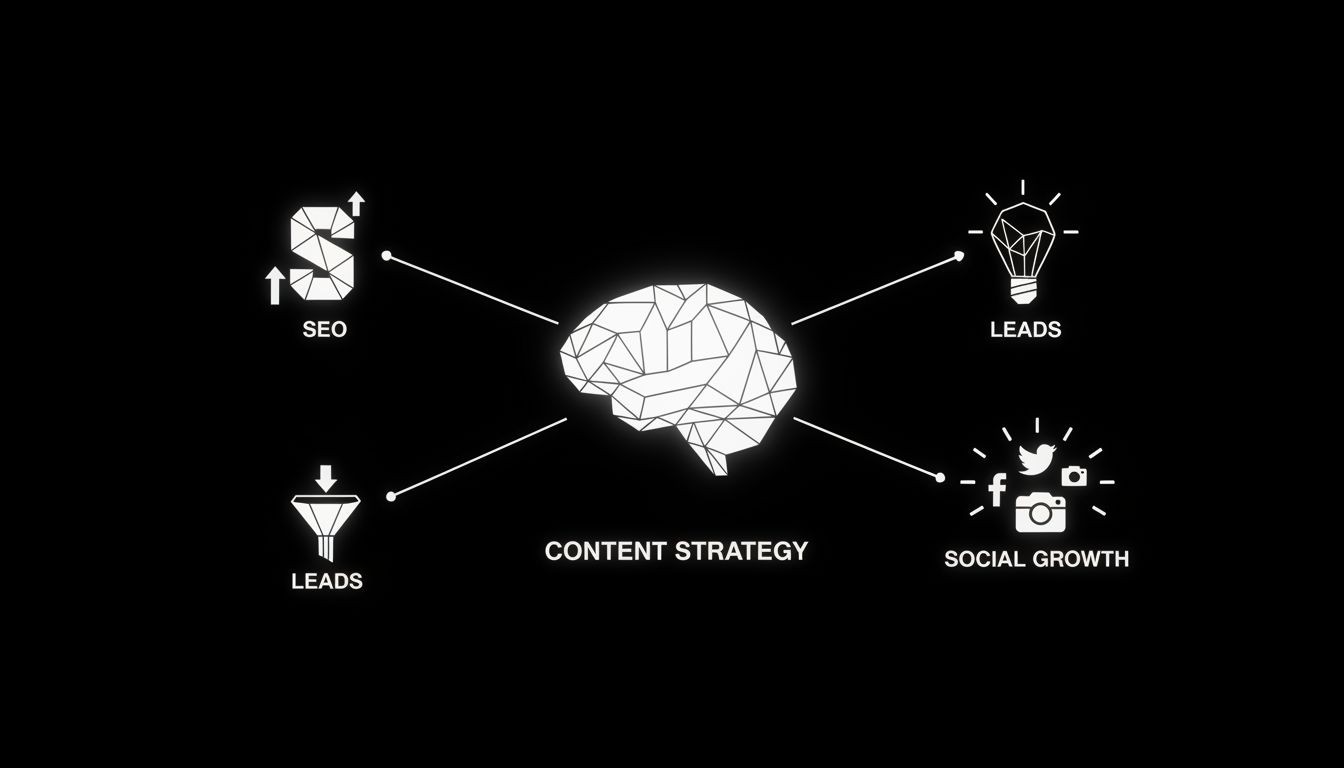
Content Strategy Guide: How to Build a System That Drives SEO, Leads, and Social Growth
Learn how to build a content strategy that drives SEO, leads, social growth, AI chat engagement, and paid ad results across every channel for modern teams.
A strong content strategy is what turns publishing into a growth system. Instead of chasing random blog ideas or posting just to stay busy, it gives SEO, social media, AI chat agents, email nurture, and paid campaigns one clear purpose: attract the right people, earn trust, and move them toward a lead. Google recommends people-first content that is useful, reliable, and created for an existing audience, while Content Marketing Institute notes that strategy should come before editorial planning so the right content reaches the right people at the right time. (developers.google.com)
That matters because content is not just about traffic anymore. The best content strategy supports search visibility, conversion paths, and sales conversations all at once. Google’s SEO guidance says compelling, useful content matters more than a page built mainly to chase rankings, which is why strategy has to lead the work. (developers.google.com)
What content strategy really means
Content strategy is the operating plan behind what you create, who it is for, why it exists, where it appears, and how you measure whether it worked. In practice, it brings together audience research, message positioning, channel selection, governance, and measurement. CMI describes strategy as getting the right content to the right people at the right times for the right reasons, and Google’s people-first guidance asks whether your content is useful to an intended audience and leaves them feeling satisfied. (contentmarketinginstitute.com)
A content calendar helps you execute the plan, but it is not the plan itself. HubSpot notes that an editorial calendar looks at the bigger picture, while a content calendar organizes the individual posts inside that time frame. Strategy sets direction. Calendars keep the work moving. (blog.hubspot.com)
A good content strategy also helps you avoid wasted production. If a topic does not support a business goal, a search intent, or a sales conversation, it does not belong in the pipeline yet. That discipline is what keeps content useful instead of noisy.
Build the foundation before you create anything
Start with one business outcome per campaign. For some teams, that means booked calls. For others, it means demo requests, qualified chat conversations, newsletter sign-ups, or retail sales. If your brand already has strong customer data, our guide to CRM in marketing is a useful next read because it shows how lifecycle information can sharpen messaging and automation.
Next, map the audience you actually want, not just the audience you imagine. Look at sales notes, support questions, chatbot transcripts, comments, and keyword data to learn what people ask before they buy. That gives you cleaner content ideas and better hooks for every channel.
Then do a content audit before you publish more. Semrush says a content audit helps you see whether your content still supports your goals, and it recommends inventorying pages, evaluating quality, measuring performance, checking SEO alignment, and finding gaps. It also advises doing the audit at least once a year, or more often in fast-moving industries. (semrush.com)
The real value of the audit is focus. You may find pages that already rank, topics that need a refresh, or assets that could be merged into stronger hub pages. Sometimes the fastest way to grow is not to create more. It is to improve what is already there. (semrush.com)
The 7-part content strategy framework

1. Set one primary goal
Every asset should have one main job. A blog post may aim to rank. A landing page may aim to capture a lead. A video may aim to open a new audience. When a single piece tries to do everything, it usually does nothing well. Keep the goal simple, then support it with one measurable action.
2. Find the questions behind the keyword
Good content starts with the language customers use, not the language teams invent in a meeting. Search queries, support tickets, discovery calls, and social comments reveal the real pain points. Those questions can become blog posts, FAQ pages, comparison pages, case studies, and chatbot answers.
3. Build content pillars and funnel stages
Use pillars to group related topics, then map each topic to the funnel. Top-of-funnel content should educate. Mid-funnel content should compare, explain, or qualify. Bottom-of-funnel content should reduce friction and prove value. That structure makes content easier to scale because every new idea fits somewhere useful.
4. Choose the format that fits the message
One idea can become a long-form guide, a short video, a carousel, an email, a landing page, a testimonial clip, or a chatbot response. Not every message belongs in a blog post. If a point needs persuasion, a case study or ad creative may work better. If a question needs speed, a knowledge-base answer or AI chat flow may be the right format.
5. Create a calendar and governance rules
HubSpot’s guidance makes a useful distinction between editorial calendars and content calendars, and CMI argues that content governance is essential if strategy is going to work in the real world. That means assigning owners, approvers, update dates, brand rules, and retirement rules so content stays accurate and on-message. (blog.hubspot.com)
Governance is especially important when several people create content across blog, social, ads, and sales enablement. Without it, tone drifts, pages get outdated, and nobody owns the refresh work. (contentmarketinginstitute.com)
6. Distribute on purpose
A strong content strategy is never only a publishing strategy. Hootsuite says a social calendar brings structure to your content strategy, keeps you aligned with larger marketing goals, and helps you spot gaps. Its strategy guide also recommends using analytics and UTM parameters so you can see which posts drive traffic and conversion. (blog.hootsuite.com)
This is where your distribution mix matters. Organic social, email, partners, communities, creator collaborations, and paid placements all play a role. If you want a systemized way to run that layer, see our Automated Social Media service and our Paid Ads Management service.
7. Measure, then refine
Track the metrics that match the goal. For SEO, that may be organic traffic, keyword rankings, and conversion rate. For social, it may be reach, engagement, and clicks. For lead gen, it may be booked meetings, cost per lead, or chat-to-lead conversion. The point is not to collect every metric. The point is to know which numbers tell you whether the strategy is working.
Semrush’s audit guidance also makes this clear. Performance data is what shows whether a page should be kept, updated, consolidated, or retired. The best content strategy treats measurement as a loop, not a report. (semrush.com)
How to adapt the strategy for SEO, social, AI chat, and paid ads

SEO: build around search intent
SEO works best when the page solves a real search need with enough depth to satisfy the reader. Google says helpful content should be created for people first, not to manipulate rankings, and its SEO starter guide says compelling, useful content can influence search visibility more than any shortcut. (developers.google.com)
That means you should target intent, not just keywords. Build topic clusters, use internal links to connect related pages, and refresh outdated assets before writing another post on the same topic. If SEO is a major growth channel, our Automated SEO service can help turn that process into a repeatable system.
Social media with AI: speed up production, not judgment
AI is useful when it saves time on ideation, repurposing, and variation. Google says AI-generated content fits its approach when it is useful and created for people first, not as a manipulation tactic. Hootsuite’s publishing tools also show how calendars, scheduling, and analytics can keep content moving without losing control. (developers.google.com)
The practical move is simple. Use AI to turn a strong article into caption ideas, hook variations, carousel outlines, and short-form video scripts. Then have a human polish the voice, verify the claims, and make sure it still sounds like your brand. If you want to build that workflow into your stack, our Automated Social Media service is built for exactly that kind of repeatable output.
AI chat agents: turn content into conversations
AI chat agents work best when they are trained on content that already answers buying questions. Your blogs, FAQ pages, pricing pages, case studies, and comparison pages can become a conversational layer that qualifies leads, routes visitors, and reduces friction before a sales call.
That is why content strategy and chat strategy should be built together. If your content answers objections clearly, your assistant can surface the right next step faster. For a deeper look at that layer, see our Automated AI Chat Agents page.
Meta and TikTok ads: amplify what already works
Paid social should not guess. Meta says ad performance improves with strong creative, enough budget and duration, and multiple placements across Facebook, Instagram, Messenger, and WhatsApp. TikTok’s best-practice guidance leans toward native-feeling, human content, vertical formats, and continuous testing. (facebook.com)
That means your content strategy should create ad-ready angles from the start. A good blog post can become a retargeting ad. A customer quote can become a conversion creative. A product demo can become a TikTok hook or a Meta lead ad. If you want help turning those angles into campaigns, our Paid Ads Management service is a practical next step.
Common content strategy mistakes
The fastest way to waste time is to confuse activity with strategy. Google warns against creating content mainly to attract search visits, CMI says governance is what makes strategy usable at scale, and Hootsuite emphasizes testing because social performance changes over time. (developers.google.com)
The biggest mistakes are easy to spot:
Publishing without a business goal
Writing only for search engines
Ignoring what sales and support already hear from customers
Creating content that has no follow-up path
Failing to update old pages
Launching on every channel without a distribution plan
Using AI to mass-produce instead of improve quality
If a piece does not support discovery, trust, or conversion, it probably needs a better place in the system.
A simple 30-day content strategy starter plan
Use the first week to define one business goal, run a content audit, and pick three audience problems worth solving. Use the second week to build a topic list, map intent, and decide which formats belong on SEO, social, email, and paid channels.
In week three, create one pillar page, one short-form social series, one lead magnet, and one conversion asset such as a case study or landing page. In week four, publish, distribute, and measure. Use UTM parameters, social analytics, and lead data to see which pieces bring the best traffic and the best conversations. Hootsuite recommends using analytics and UTM tracking to see exactly which social posts drive website traffic, and Semrush notes that ongoing audit data should guide what you keep, update, or remove. (hootsuite.com)
If you want the whole system to keep working after launch, content strategy needs a follow-up layer. That is where Lead Generation and Marketing Automation becomes important, because it helps connect traffic, nurturing, and sales handoff.
A solid content strategy does not try to be clever for its own sake. It creates useful content, places it where people actually look, and measures whether it moves the business forward. Do that consistently, and content stops being a cost center. It starts becoming a pipeline engine. (developers.google.com)