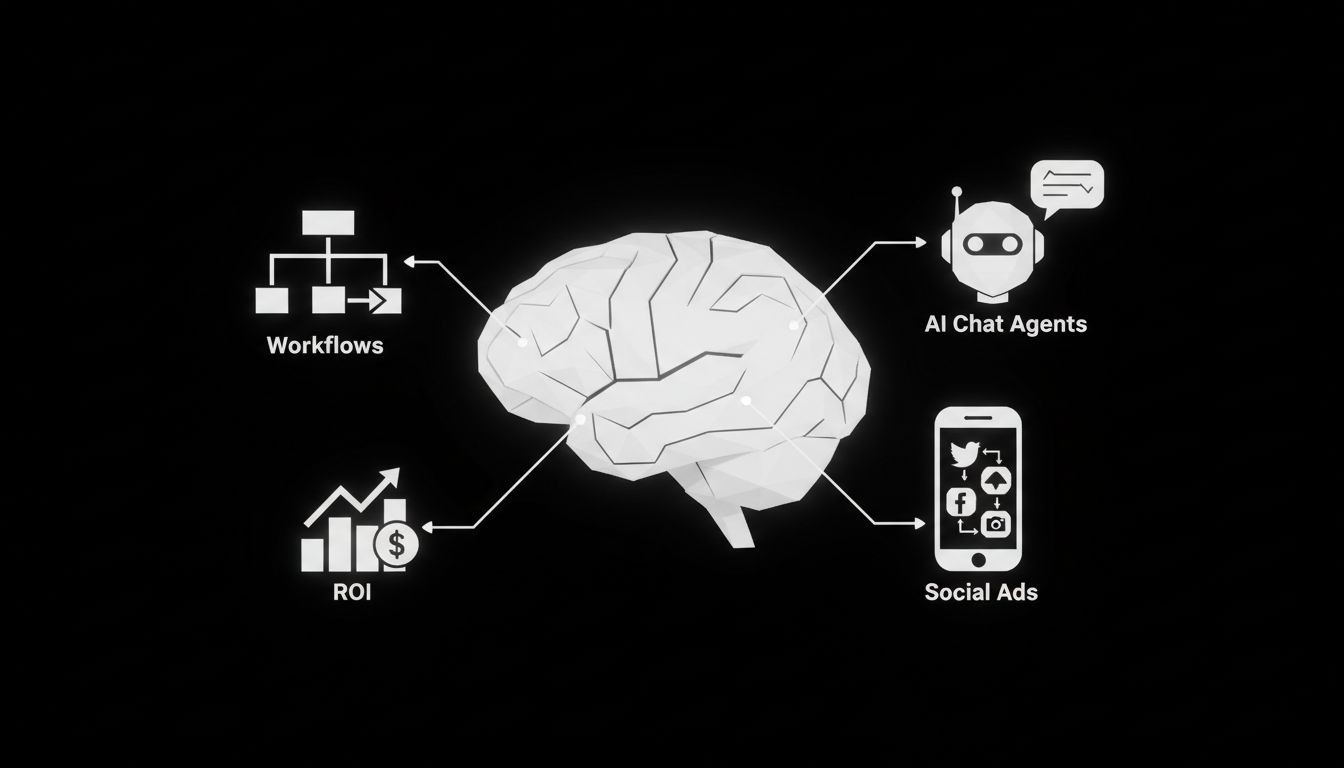
What Is Marketing Automation: A Practical Guide to Workflows, ROI, AI Chat Agents, and Social Ads
Learn what is marketing automation: practical workflows, ROI math, industry use cases, and advanced tactics for AI chat agents, social media, and Meta and TikTok ads for growth.
Marketing automation is the engine that lets your marketing team turn repetitive tasks into consistent, measurable processes that scale. At its core it connects customer behavior, channel triggers, and tailored messages so you capture leads, nurture them with relevant content, and hand off sales-ready prospects to your team without manual busy work.
This guide answers the question what is marketing automation with practical examples, workflow templates, ROI math, industry-specific use cases, and advanced tactics for AI chat agents, social media automation, and running ads on Meta and TikTok. Read on to get a step-by-step playbook you can use today.
How marketing automation works

Marketing automation uses rules, triggers, and data to move contacts through a repeatable sequence of actions. Typical components include data collection, segmentation, rules or triggers, action steps like sending email or triggering an ad, and analytics to measure outcomes.
A simple flow looks like this:
Capture lead via web form, chat, or ad click
Tag lead by interest or campaign source
Add lead to an automated nurture sequence based on tag
Score lead over time using behavior signals
When lead score crosses a threshold, notify sales or trigger a demo booking
Triggers are event-driven, for example when a user opens an email, visits a pricing page, or engages with an AI chat agent. Actions include email sends, SMS, push notifications, CRM updates, API calls to ad platforms, and webhook events.
Why this matters for lead generation
Marketing automation turns one-off efforts into consistent conversion paths. Instead of manually emailing new leads, every lead gets the same thoughtful welcome and the highest-intent prospects get fast sales outreach. If your focus is automated lead generation, an integrated automation stack makes scaling predictable. See how a full lead generation service ties into automation in Automated Lead Generation - The Social Search.
Key features and capabilities
Automation platforms vary, but most offer these core features:
Visual workflow builders with if-then logic
Email automation and drip campaigns
Behavioral segmentation and dynamic lists
Lead scoring and qualification rules
Multi-channel messaging: email, SMS, push, social, and chat
CRM integration and data sync
Analytics, dashboards, and attribution reporting
A/B testing and campaign optimization
Platforms may also include prebuilt connectors for ad platforms so you can automate audience syncs between your CRM and Meta or TikTok campaigns. For automated social posting and ad creative scheduling, explore Automated Social Media - The Social Search.
Benefits of marketing automation
Time saved: Automate repetitive tasks so your team focuses on strategy and creative work
Personalization at scale: Send the right message to the right person at the right time
Faster lead qualification: Score and route sales-ready prospects automatically
Better ROI: Automation optimizes conversion paths and reduces cost per lead
Data-driven decisions: Track performance across channels to improve campaigns
Companies often see measurable lift once automation is in place. Use cases range from welcome funnels that double engagement to retargeting sequences that cut cost per acquisition.
Getting started with marketing automation
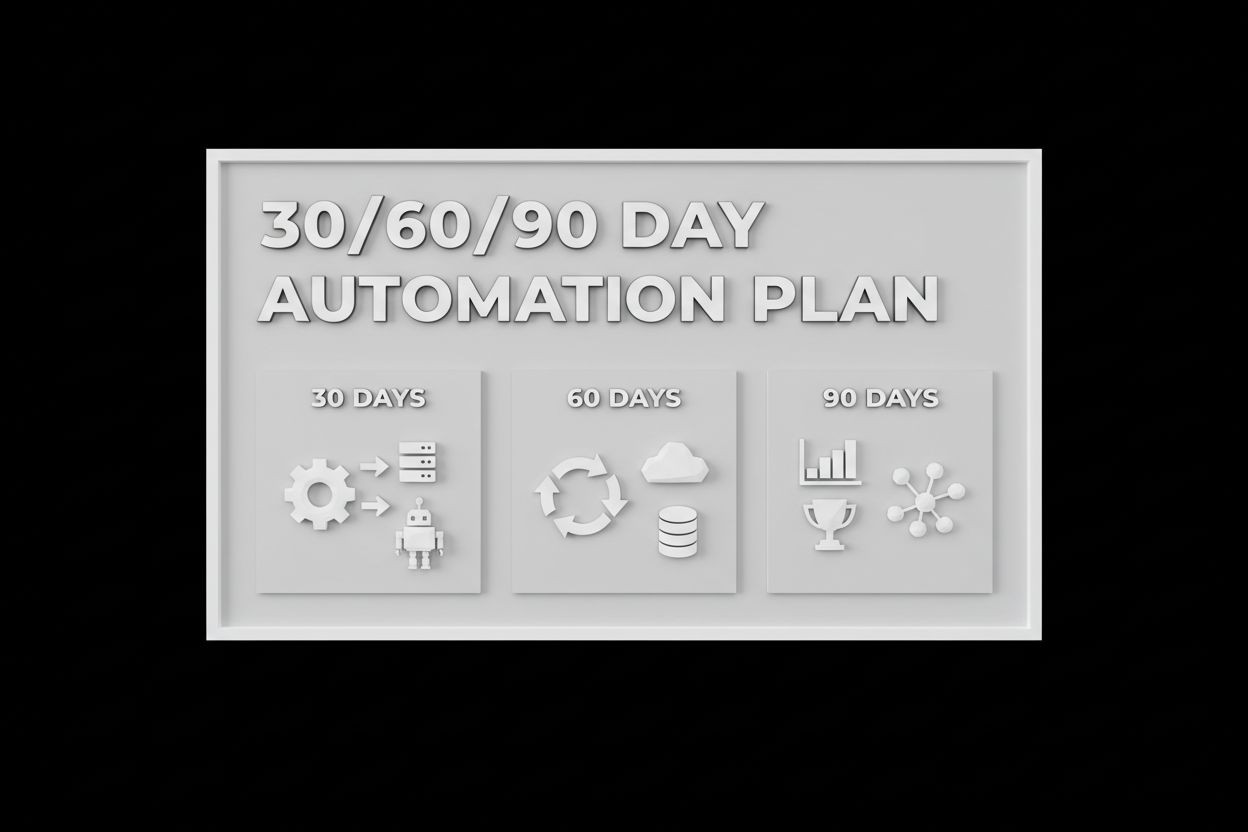
Start small, measure, then scale. Here is a practical 30/60/90 day rollout plan.
30 days - Foundations
Clean and segment contact lists. Remove duplicates and confirm consent.
Define two starter workflows: a welcome series and a lead-nurture flow for a top campaign.
Connect your CRM and website forms to the automation platform.
Set basic metrics: leads captured, email open rate, conversion rate.
60 days - Build and Optimize
Add lead scoring based on page visits, content downloads, and ad clicks.
Integrate an AI chat agent to capture and qualify leads outside business hours. For ideas and tools, see Automated AI Chat Agents - The Social Search.
Sync audiences with Meta and TikTok for retargeting and lookalike campaigns.
Start A/B tests on subject lines and landing pages.
90 days - Scale and Expand
Expand workflows: cart abandonment, upsell, VIP reengagement.
Implement multi-channel journeys that mix email, SMS, and targeted social ads.
Create reporting dashboards with multi-touch attribution for key flows.
What to automate first
Welcome series for new subscribers
Lead nurture for top-of-funnel ads
Cart or checkout recovery
Reengagement for inactive customers
Ad audience syncs for retargeting
If you run paid ads on Meta or TikTok, start by automating the sync of leads to custom audiences. For managed ad strategies, see Paid Ads Management - The Social Search.
Practical workflow templates you can copy
Below are five repeatable workflows you can implement right away. Each template lists triggers, actions, and key metrics.
Welcome series for new leads
Trigger: Form submission or new contact added
Steps: Send welcome email immediately, follow-up with value email after 3 days, send case study after 7 days, apply lead score for engagement
Metrics: Open rate, reply rate, content click-through, lead-to-opportunity rate
Lead nurturing for SaaS free trial
Trigger: Trial signup
Steps: Day 1 onboarding email, Day 3 tips email, Day 7 product use prompt, Day 14 sales outreach if high score
Metrics: Trial-to-paid conversion, weekly active users, churn during trial
Cart abandonment for ecommerce
Trigger: Items in cart, no purchase after 2 hours
Steps: Email reminder at 2 hours, SMS if no purchase at 24 hours, dynamic ad to cart abandoners on Meta and TikTok at 48 hours
Metrics: Cart recovery rate, incremental revenue, CPA
AI chat agent qualification flow
Trigger: Chat conversation starts or after business hours
Steps: Collect intent and contact info, qualify with scoring questions, if high intent create CRM task and send meeting link, if low intent add to long-term nurture
Metrics: Leads captured via chat, meeting bookings, response time
Social ad retargeting pipeline
Trigger: Page view or video engagement
Steps: Tag user by interest, add to a 7-day retargeting audience, show sequence of creative assets, move to broader lookalike audience after 14 days
Metrics: Click-through rate, ROAS, conversion lift
Each of these can be implemented with standard triggers and actions in most automation platforms. For a combined strategy that blends social scheduling with automation, check Automated Social Media - The Social Search.
Advanced strategies beyond basics

Once you have core flows running, explore these advanced tactics.
Predictive lead scoring
Use behavioral and firmographic signals combined with machine learning to predict conversion probability. Feed signals like product usage, page visits, campaign source, and ad engagement into a model and use the score to route leads.
Account-based marketing automation
For B2B, automate multi-touch campaigns that coordinate email, ads, and sales outreach for target accounts. Sync account lists to ad platforms and trigger personalized creative when key contacts engage.
Multi-touch attribution
Implement an attribution model that credits multiple interactions. This helps you understand the role of social ads, AI chat agents, and email in the conversion path.
Creative optimization for Meta and TikTok
Automate creative testing by rotating ad creatives, measuring performance, and pausing underperformers. Use automation to scale variations and feed winning combinations into lookalike audience builds.
Behavioral segmentation beyond basics
Segment not only by demographics and firmographics but by micro-behaviors like video watch percent, feature adoption, and recent content interactions.
If you want to align automation with CRM strategy and AI, read What Is CRM in Marketing: A Complete Guide to Strategy, Automation, AI, and Growth - The Social Search.
Integration and technical considerations
A stable integration architecture ensures automation is reliable. Key elements to plan for:
Data schema and canonical contact ID across systems
API limits for ad platforms and CRM
Webhooks for real-time events like form submits or purchases
Error handling and retry logic for failed calls
Single source of truth for consent and preference data
Practical tips
Map fields early: match CRM fields, custom properties, and ad platform parameters before you build flows.
Use webhooks for real-time triggers and batch syncs for non-urgent data.
Monitor API usage and set alerts to avoid throttling.
Compliance and data hygiene
Automation depends on accurate and permitted data. Prioritize these controls:
Consent capture and storage, including timestamp and source
Double opt-in for high-risk regions
Easy unsubscribe and preference center options
Data retention policies and regular list cleaning
Audit logs for data changes
Regulations like GDPR and CAN-SPAM require clear consent and the ability to delete personal data on request. Build workflows that respect opt-outs across channels.
Cost, ROI, and a simple calculator
Costs to consider
Platform subscription and per-contact fees
Integration and setup costs
Creative and ad spend
Team time for management and optimization
ROI framework
Calculate baseline: current monthly leads and conversion rate
Estimate lift: expected increase in qualified leads after automation, expressed as a percent
Multiply expected qualified leads by average deal size and conversion rate to estimate incremental revenue
Subtract ongoing costs to get net gain
Example
Baseline leads per month: 500
Current conversion to customer: 4 percent
Average order value: $2,000
Expected lift in qualified leads after automation: 30 percent
Platform and operational costs per month: $2,500
Current monthly revenue from leads = 500 * 0.04 * $2,000 = $40,000
New leads = 500 * 1.30 = 650
New revenue = 650 * 0.04 * $2,000 = $52,000
Incremental revenue = $12,000
Net incremental after costs = $12,000 - $2,500 = $9,500
This simple framework helps justify investment. For a full lead generation service that integrates automation and paid ads, see Automated Lead Generation - The Social Search.
Team readiness and change management
Who should be involved
Marketing owner or campaign manager
CRM owner or ops lead
Sales leader for SLA and lead routing
Data or engineering for integrations
Creative resources for content and ads
Skill gaps to address
Workflow design and testing
Basic SQL or reporting for analytics
Ad platform audience management
Prompting and oversight for AI chat agents
Change management tips
Start with pilot projects and document wins
Create clear SLAs for lead follow-up
Train sales on lead scoring and what qualifies as sales ready
Benchmarks by industry
Numbers vary but these are common ranges to set expectations. Use your own data to refine.
SaaS: trial-to-paid 3 to 8 percent, lead-to-opportunity 5 to 12 percent
Ecommerce: cart recovery 5 to 12 percent, email open rates 15 to 25 percent
Real estate: lead-to-consult 8 to 18 percent, response time under 1 hour improves conversion
Healthcare and nonprofits: higher consent sensitivity, email open rates 20 to 30 percent
Your benchmarks will depend on channel mix, creative quality, and list health.
Best practices and common mistakes
Do
Segment early and personalize messages
Test subject lines, creative, and send times
Monitor deliverability and clean lists
Align sales and marketing with clear lead definitions
Do not
Automate everything without review - personalization still matters
Use outdated lists or ignore consent
Set and forget workflows without regular optimization
For a deeper look at lead generation and marketing automation strategies, this guide is useful: Lead Generation and Marketing Automation Guide for 2026 Success - The Social Search.
FAQ
Q: What is the fastest thing to automate for immediate impact?
A: A welcome email sequence for new leads and a cart abandonment flow typically deliver fast results.
Q: Can marketing automation work with AI chat agents?
A: Yes. AI chat agents can capture leads, qualify them, and trigger workflows in automation platforms. Integrate via webhooks or native connectors.
Q: Is marketing automation only for large companies?
A: No. Small and mid-market teams benefit from automation because it saves time and improves conversion consistency.
Q: How do I measure success?
A: Track lead volume, lead quality, conversion rates, cost per acquisition, and revenue attributed to automated flows.
Q: What are the top integrations to prioritize?
A: CRM, website forms, ad platforms like Meta and TikTok, and analytics tools.
Q: How often should I audit workflows?
A: Quarterly checks are minimum. High-volume flows merit monthly reviews.
Q: Do I need a technical team to implement automation?
A: Basic flows can be built by marketers. Complex integrations and predictive scoring require engineering or vendor support.
Q: How does automation affect privacy compliance?
A: Automation must respect consent and include mechanisms to manage preferences and data deletion.
Next steps and resources
If you want help connecting automation to your paid ads, chat agents, and social strategy, consider managed solutions. For hands-on AI chat agent setup, see Automated AI Chat Agents - The Social Search. To combine automation with paid ad strategies on Meta and TikTok, Paid Ads Management - The Social Search can help scale campaigns efficiently.
Automation converts activity into predictable outcomes when you build clean data flows, focused workflows, and continuous optimization. Start with one high-impact flow, measure results, and expand from there. If you want a free consultation to map your first 90 days, reach out to a provider who can assess your systems and recommend priorities.