Business Development vs Sales: Key Differences, KPIs, and When Each Role Matters
Business development vs sales explained with examples, KPIs, handoffs, and hiring tips for B2B teams building a stronger revenue engine in 2026 and beyond.
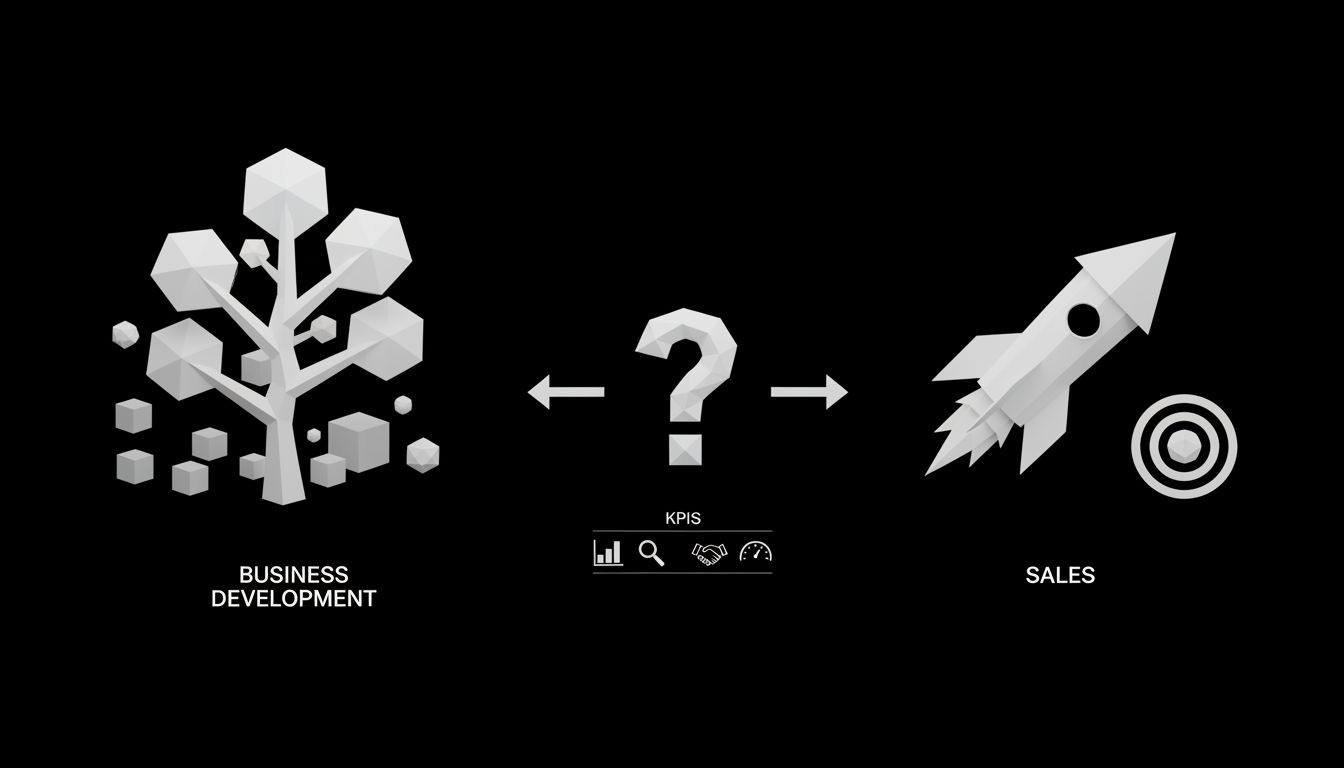
If you’ve ever heard people use business development and sales as if they mean the same thing, you’re not alone. The two roles sit close together, share a CRM, and care about revenue, but they solve different problems. Business development opens new doors. Sales turns the right doors into signed deals.
For teams building automated lead generation systems, running Meta or TikTok ads, or using AI chat agents to qualify inbound interest, the difference is practical, not academic. A clear split between the two can improve response time, lead quality, forecasting, and the way your team scales.
Business development vs sales at a glance
Area | Business development | Sales |
|---|---|---|
Primary goal | Create new growth opportunities | Convert opportunities into revenue |
Time horizon | Long-term | Short-to-medium-term |
Main output | Meetings, partnerships, market access, pipeline creation | Closed deals, quota attainment, renewals |
Buyer interaction | Earlier stage, often strategic stakeholders | Deeper, more frequent conversations with buyers |
Core question | Where can the company grow next? | How do we win this deal now? |
Typical examples | Partnerships, channel development, market expansion | Discovery, demo, proposal, negotiation, closing |
The simplest way to think about it is this: business development creates opportunity, while sales converts opportunity into revenue. In real companies, the work overlaps, but the owner of each stage should still be clear.
What business development actually does
Business development is about creating future revenue. That can mean finding a new audience, opening a partner channel, testing a new market, or building relationships that make future deals easier. It is less about closing one transaction and more about expanding the company’s addressable market.

In a SaaS company, a business development rep might research target accounts, find the right decision-makers, and start conversations that can turn into demos. In an agency, BD might build referral relationships with complementary service providers. In manufacturing or enterprise services, it may mean distributor deals, channel partnerships, or strategic alliances.
Business development often includes:
researching markets and identifying whitespace
prospecting high-value accounts
building referral and partner networks
qualifying early interest
collecting market feedback that informs positioning
creating a pipeline that sales can later convert
If your team uses automated social media to stay visible, BD gets a warmer first conversation. A prospect who already recognizes your name is easier to start a dialogue with than a cold account that has never seen your brand.
What sales actually does
Sales takes the opportunity and turns it into a decision. That usually means discovery, demos, objection handling, proposal work, negotiation, and closing. In many companies, sales also handles renewals, upsells, and account expansion after the first deal lands.
A strong sales rep is not just a closer. They are part diagnostician, part communicator, and part project manager. They have to understand what the buyer needs, explain the value in plain language, and keep the deal moving without losing trust.
Sales responsibilities usually include:
running discovery calls
presenting the product or service
handling objections
coordinating stakeholders
building proposals and quotes
negotiating terms
closing deals and forecasting revenue
The key difference is timing. Sales is working on revenue that is closer to the finish line, while business development is often creating the conditions for future wins.
How the handoff works in real life
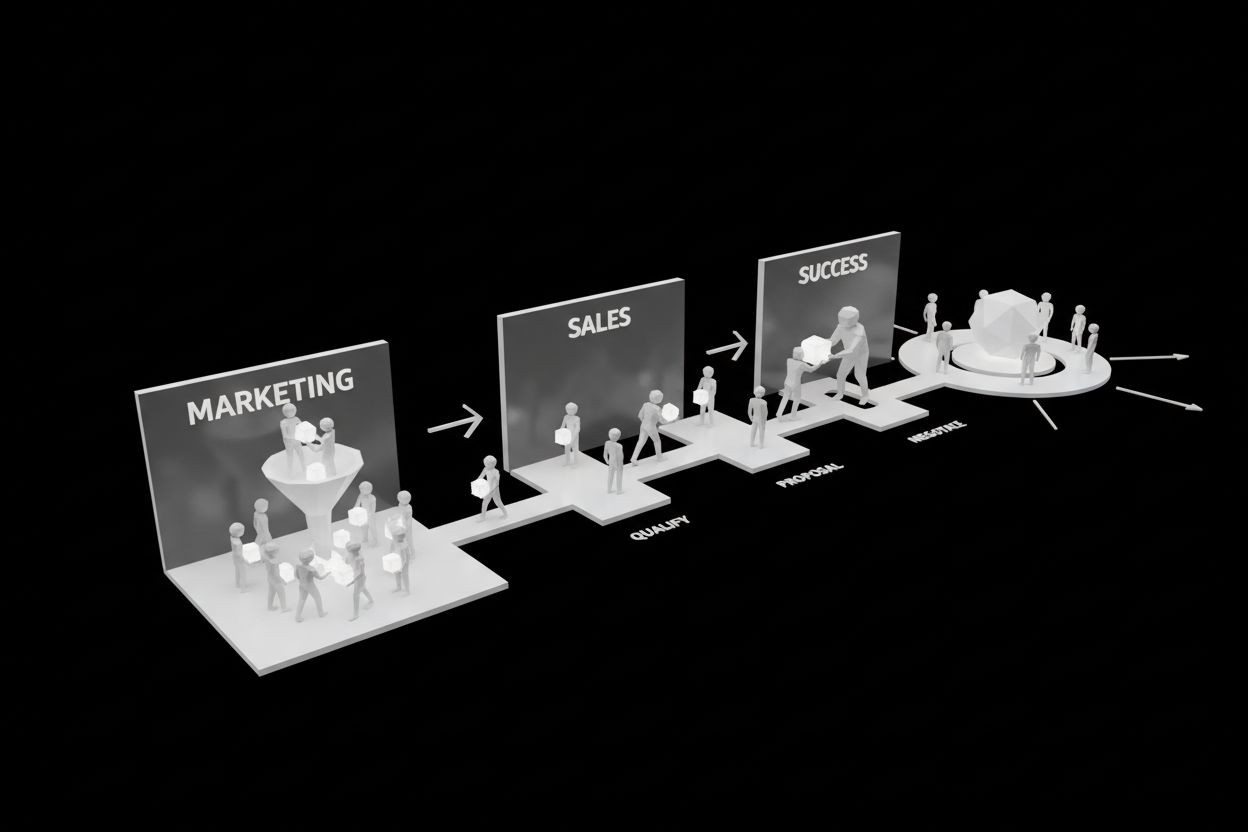
The cleanest revenue engines usually have a clear handoff from marketing to business development and then to sales. Marketing attracts attention. Business development qualifies and expands the conversation. Sales turns buying intent into a contract.
That handoff can happen in several ways. An inbound form fill might go straight into a CRM, where an AI chat agent asks a few qualification questions before booking a meeting. A referral partner might send an intro to BD first, then sales steps in once the use case is confirmed. A prospect from a trade show might need a sequence of touchpoints before anyone is ready to talk pricing.
A well-built marketing and sales automation setup helps here because it keeps leads from falling through the cracks. The right workflow can assign owners, trigger follow-ups, and give each rep the context they need before they respond. If your team is still managing handoffs manually, the delay usually shows up as lower response rates and weaker conversion.
It also helps to treat your CRM as the shared source of truth. If the note history is incomplete, the next rep starts cold even though the lead is warm. That is why many teams pair this process with what is CRM in marketing thinking, not just as software, but as a way to keep the entire customer journey visible.
Business development creates the conversation. Sales finishes the conversation.
When business development matters most
Business development becomes especially important when the company is still defining where growth will come from. If you are entering a new market, launching a new offer, or trying to build trust in a category that buyers do not understand yet, BD does a lot of the heavy lifting.
It matters a lot in these situations:
you need strategic partnerships or channel relationships
you are entering a new geography or niche
the sales cycle is long and trust has to be built early
the product is new, custom, or high-ticket
the company needs pipeline sources beyond inbound leads

This is also where paid media and BD often work together. If you are testing market demand, paid ads management can create fast signal, while BD turns that signal into actual conversations. Likewise, lead generation and marketing automation can keep early interest organized so your BD team is not chasing unqualified names.
In companies that depend on relationships, BD can be the difference between slow growth and scalable growth. It creates introductions, not just clicks.
When sales matters most
Sales matters most when there is already demand to capture. If buyers understand the offer, leads are coming in, and the main problem is conversion, then stronger sales execution usually has the biggest immediate impact.
This is the right focus when:
you already have qualified inbound leads
the offer is proven and repeatable
the team needs better close rates
deal volume is high enough to require structure
you are trying to improve forecast accuracy or shorten the cycle
In this stage, speed matters. A lead who waits too long for a reply may buy from someone else. That is why many teams add automated AI chat agents to capture the first response, then let sales take over once intent is clear.
Sales also becomes more important when the product is standardized and the buying process is mostly about fit, price, and timing. The more repeatable the offer, the more sales can optimize conversion.
KPIs that tell you whether each role is working
One reason the business development vs sales debate gets confusing is that people measure both roles with the wrong metrics. If you judge BD only by closed revenue, you miss the value it creates upstream. If you judge sales only by activity, you may miss whether those activities actually generate money.
Business development KPIs often include:
meetings booked with target accounts
strategic partnerships signed
referral relationships created
qualified pipeline generated
new market penetration
opportunities influenced rather than fully closed
Sales KPIs usually include:
quota attainment
win rate
average deal size
sales cycle length
forecast accuracy
conversion rate from demo to close
expansion or upsell revenue
The best teams connect both sets of metrics to the same growth goal. BD should create better opportunities. Sales should turn those opportunities into more revenue. If either side is missing, the funnel breaks somewhere.
Skills, tools, and daily workflow

The skill sets overlap, but they are not identical.
Business development leans on:
market research
strategic thinking
networking
relationship building
partner management
patience and persistence
Sales leans on:
discovery
listening
objection handling
persuasion
negotiation
forecasting and prioritization
The tools overlap too. Most teams rely on a CRM, email sequencing, call notes, and some form of dashboard tracking. Many also use what is CRM in marketing processes to keep audience data, lead status, and handoff history in one place. That becomes even more important when the business is using marketing and sales automation to move leads faster through the funnel.
A typical BD day may include account research, outbound messages, partner conversations, and internal alignment with marketing. A typical sales day may include discovery calls, follow-up emails, demos, proposal revisions, and forecast updates. Both roles can be busy all day, but they are busy with different kinds of progress.
Career path and compensation
For many people, sales is the more obvious entry point because it teaches you the mechanics of selling, objection handling, and pipeline discipline quickly. Business development can be a strong next step, especially for people who like strategy, research, and relationship-led growth.
The path is not always linear, though. Some professionals start in BD and move into account executive roles. Others start in sales and move into partnerships, revenue operations, or leadership. In smaller companies, one person may do both from day one.
Compensation also tends to reflect the job design. Sales roles often have a larger variable component because they are tied directly to closed revenue. Business development compensation can vary more widely depending on whether the role is focused on partnerships, pipeline creation, or strategic accounts. In some companies, BD is mostly salary and bonus. In others, it includes commission-like incentives for deals or partnerships that move the business forward.
The important part is not which title sounds bigger. It is whether the role is built around creating growth or closing it.
Which role should you hire first?
The answer depends on where the business is today.
If you already have demand and need help converting it, hire sales first. If the product is proven but the company still needs to open new doors, hire business development first. If you have both enough demand and enough market opportunity, you probably need both, along with a clear process for handoff and follow-up.
A simple rule of thumb:
early-stage startup with little market signal, prioritize BD
company with steady inbound leads, prioritize sales
partnership-driven business, prioritize BD
high-volume digital funnel, prioritize sales plus automation
enterprise B2B growth, build both sides together
This is also where lead generation and marketing automation can save a lot of time. If your team is generating leads through content, ads, and social, automation helps BD and sales spend more time on conversations and less time on admin.
Common misconceptions about business development vs sales
A few myths keep showing up in this conversation.
Myth 1: Business development is just sales.
Not quite. BD may create sales opportunities, but it often includes partnerships, market expansion, and strategic growth work that does not look like classic selling.
Myth 2: Sales only means closing.
Modern sales is broader than that. It includes discovery, education, trust-building, and account management.
Myth 3: BD and marketing are the same thing.
Marketing creates awareness and demand. BD converts that momentum into relationships, opportunities, and strategic openings.
Myth 4: The titles always mean the same thing across companies.
They do not. In one company, BD may mean outbound prospecting. In another, it may mean partnerships. In a third, it may be a catch-all title for both.
The title matters less than the outcome. Ask what the person owns, what they are measured on, and where they sit in the revenue process.
Frequently asked questions
Is business development part of sales?
Usually it is adjacent to sales, and in some companies it sits inside the broader revenue team. The difference is that BD is often focused on creating future opportunities, while sales is focused on converting them.
Is business development higher than sales?
Not automatically. Seniority depends on scope, responsibility, and company structure, not just the title. A senior sales leader can be more senior than a BD manager, and the reverse can also be true.
Can one person do both?
Yes, especially in small teams. Many startups ask one person to prospect, qualify, build relationships, and close. That can work early on, but most companies eventually split the roles for efficiency.
Which role is better for someone starting out?
Sales is often the faster way to learn the mechanics of revenue generation. Business development can be a better fit if you are strong at research, networking, and long-term relationship building. The best choice depends on your strengths and the kind of work you want to do.
At the end of the day, business development creates the market opportunity and sales turns that opportunity into revenue. The strongest teams do not treat them as competing functions. They build a clean system where BD, sales, marketing, and automation all support the same growth engine.
That is why companies that invest in automated lead generation, automated AI chat agents, paid ads management, and smart CRM workflows usually move faster. The technology does not replace either role. It gives both teams more qualified conversations to work with, and that is where the real growth happens.