What Is in a Marketing Strategy? The Core Elements Every Business Needs
Learn what is in a marketing strategy, including audience, positioning, goals, channels, KPIs, budget, and a practical template to use.
If you have ever looked at a successful campaign and wondered why it works, the answer usually starts before the ads, posts, or emails ever go live. A strong marketing strategy gives the business direction, defines who it is talking to, explains why the offer matters, and sets the rules for how success will be measured. In practice, it is a long-term framework for reaching the right people with the right message, while a marketing plan turns that framework into specific actions. (salesforce.com)
What is in a marketing strategy?
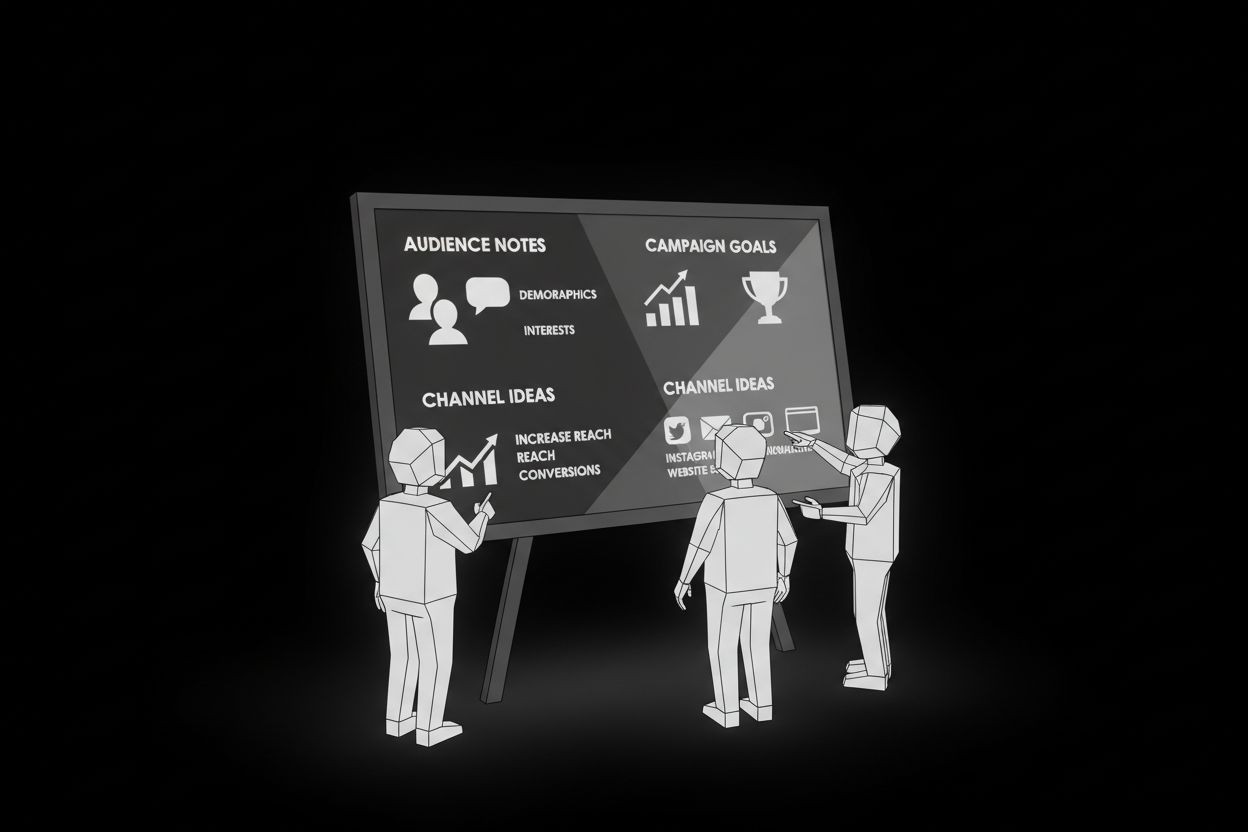
If you want the short answer, what is in a marketing strategy is a mix of audience insight, positioning, goals, research, channel selection, messaging, budget, timeline, and KPIs. The most useful strategies also show how those pieces connect, so the team knows what to do first, what to test next, and what result to aim for. (salesforce.com)
Here is the quick checklist many teams use:
Component | What it answers |
|---|---|
Target audience | Who are we trying to reach? |
Positioning and value proposition | Why should they choose us? |
Goals and objectives | What result are we trying to achieve? |
Research and competitor analysis | What is happening in the market, and what are competitors doing? |
Messaging | What should we say, and how should we say it? |
Channels and content | Where will we show up, and what will we publish? |
Budget and resources | What can we realistically fund and execute? |
KPIs and measurement | How will we know if it worked? |
Timeline and ownership | Who owns each part, and when does it happen? |
A good strategy also stays flexible. Salesforce describes marketing strategy as a living document that should be revisited as customer data and market conditions change, which is exactly how most teams should treat it. (salesforce.com)
The pieces that every strong strategy should include
1. Target audience and segmentation
This is the foundation. A strategy should clearly define who you are marketing to, what problems they are trying to solve, and how different segments behave. Salesforce’s STP framework, segmentation, targeting, and positioning, is a useful way to think about this because it helps you narrow the market, choose the best-fit audience, and tailor your messaging to that group. (salesforce.com)
For lead generation, this part matters even more. If your audience is too broad, your ads, landing pages, and follow-up messages will feel generic. If your audience is well defined, you can build tighter campaigns around a specific pain point, job title, industry, or buying stage. That is where tools and systems like Automated Lead Generation become more effective, because the strategy tells the system exactly who to attract and qualify.
A strong audience section usually includes:
Core customer segments
Buyer personas or ICPs
Pain points and motivations
Buying triggers
Objections and barriers
Preferred channels and content formats
2. Positioning and value proposition
A lot of strategies talk about the audience, but not enough make positioning the centerpiece. Positioning is the answer to a simple question, why should a customer choose you instead of another option? Salesforce and HubSpot both emphasize defining a value proposition and competitive advantage as part of the strategy itself. (salesforce.com)
This is where your differentiation lives. It is not just a slogan. It should show up in your website copy, ad creative, sales scripts, social posts, and lead nurture messages. A clear value proposition makes your marketing easier to scale because every channel is reinforcing the same promise.
A practical positioning section should cover:
What problem you solve
Who you solve it for
What makes you different
Why that difference matters
The proof that backs it up
3. Goals and objectives
Every strategy needs a destination. HubSpot recommends setting SMART marketing goals, and Salesforce notes that marketing strategy should align with broader business objectives. In other words, your strategy should not just say you want growth, it should say what kind of growth you want and how you will measure it. (blog.hubspot.com)
For example, a strategy for a B2B lead generation business might focus on booked meetings, qualified demo requests, or cost per lead. A DTC brand might care more about repeat purchases, conversion rate, or return on ad spend. The goal should match the business model.
Good goals are specific, measurable, and tied to a timeframe. Examples include:
Generate 300 qualified leads in 90 days
Lower cost per lead by 20 percent
Increase organic traffic from search by 35 percent
Improve conversion rate from landing page visits to form fills
Grow retained customers by 15 percent in six months
4. Research and competitor analysis
Marketing strategy should never be built on guesswork. A strong one includes market research, competitor analysis, and a clear look at the landscape your brand is entering. Salesforce and HubSpot both point to competitive analysis as a core part of strategy because it shows where the opportunity is, what the market already looks like, and where your message can stand out. (salesforce.com)
This section should not be a huge report that nobody reads. Keep it simple and useful. Ask:
What are competitors promising?
Which channels do they dominate?
What content formats do they use most?
Where are they weak?
What keywords, offers, or audiences are underserved?
That research becomes especially valuable if your business invests in search visibility. A service like Automated SEO works best when the strategy identifies the search topics, audience intent, and conversion pages that matter most.
5. Messaging and content strategy
Once you know the audience and the positioning, the strategy should explain how the brand will communicate. That includes the key messages, the tone of voice, the content themes, and the offer structure.
Think of messaging as the bridge between your business and your buyer. It should answer the questions that appear at every stage of the journey:
What is this?
Why does it matter now?
Why should I trust you?
Why should I act?
Content strategy belongs here too. Your strategy should specify the kinds of content that will support awareness, consideration, and conversion. For some brands, that means educational blog content. For others, it means short-form video, founder-led posts, case studies, webinars, or product demos. If you want the content engine to stay consistent, Automated Social Media can support the execution, but the strategy still has to define the message first.
6. Channel mix and media strategy
A marketing strategy is incomplete if it does not say where the brand will show up. Channel strategy is where you decide how to distribute your message across owned, earned, and paid media.
This is especially important today because the same audience may discover you in search, meet you on social media, and convert through a retargeting ad or chat flow. Meta’s lead ad formats can collect leads through forms, messaging, or calls, and Meta Advantage+ uses AI and automation to optimize audience, placement, and budget. TikTok for Business also frames strong social strategy as a mix of organic content, paid campaigns, and ongoing analysis. (facebook.com)
That means your strategy should not just say “run ads” or “post on social.” It should say:
Which channels support awareness
Which channels generate leads
Which channels nurture interest
Which channels close conversions
Which channels support retention and loyalty
If paid media is part of your growth model, the strategy should also define how budget is split between prospecting and retargeting, which creatives will be tested first, and how platforms like Meta or TikTok fit into the funnel. That is where Paid Ads Management becomes useful, because the operational work only performs well when the strategy is clear.
7. Budget, resources, and ownership
Many businesses skip this part, then wonder why the strategy never gets executed properly. A real marketing strategy should include how much time, money, and team capacity are available. It should also identify who owns what.
This section may include:
Monthly or quarterly budget
Internal team responsibilities
External vendors or partners
Creative production capacity
Approval flow
Deadlines and review cadence
Without this, the strategy becomes a document that looks good but does not move. A practical strategy is honest about what can be done consistently.
8. KPIs, measurement, and optimization
HubSpot and Mailchimp both emphasize that marketing strategies need KPIs and measurement so teams can see what is working and where improvements are needed. A strategy should define the metrics before the campaign starts, not after. (blog.hubspot.com)
The exact KPIs depend on your objective, but they usually include:
Reach and impressions
Website sessions
Click-through rate
Conversion rate
Cost per lead
Cost per acquisition
Revenue or pipeline contribution
Retention or repeat purchase rate
Measurement should also include a testing plan. What will you A/B test first? Headlines, offers, landing pages, creative angles, or audience segments? A strong strategy does not assume the first version will be the best version. It builds room for learning.
Marketing strategy vs. marketing plan
This is where many people get stuck, but the difference is simple. The strategy is the why and the what. The plan is the how. Salesforce explains that the strategy sets the overall direction and competitive positioning, while the marketing plan turns that direction into time-bound tactics, budgets, timelines, and execution steps. (salesforce.com)
So if the strategy says, “We want to win more qualified leads from small businesses,” the marketing plan might say:
Run Meta lead ads for founders and operators
Publish weekly SEO content around lead generation topics
Use an AI chat agent to qualify inbound traffic
Retarget warm visitors with testimonials and case studies
Review performance every Friday
In short, strategy guides decisions, and the plan carries them out.
How a marketing strategy works across the funnel
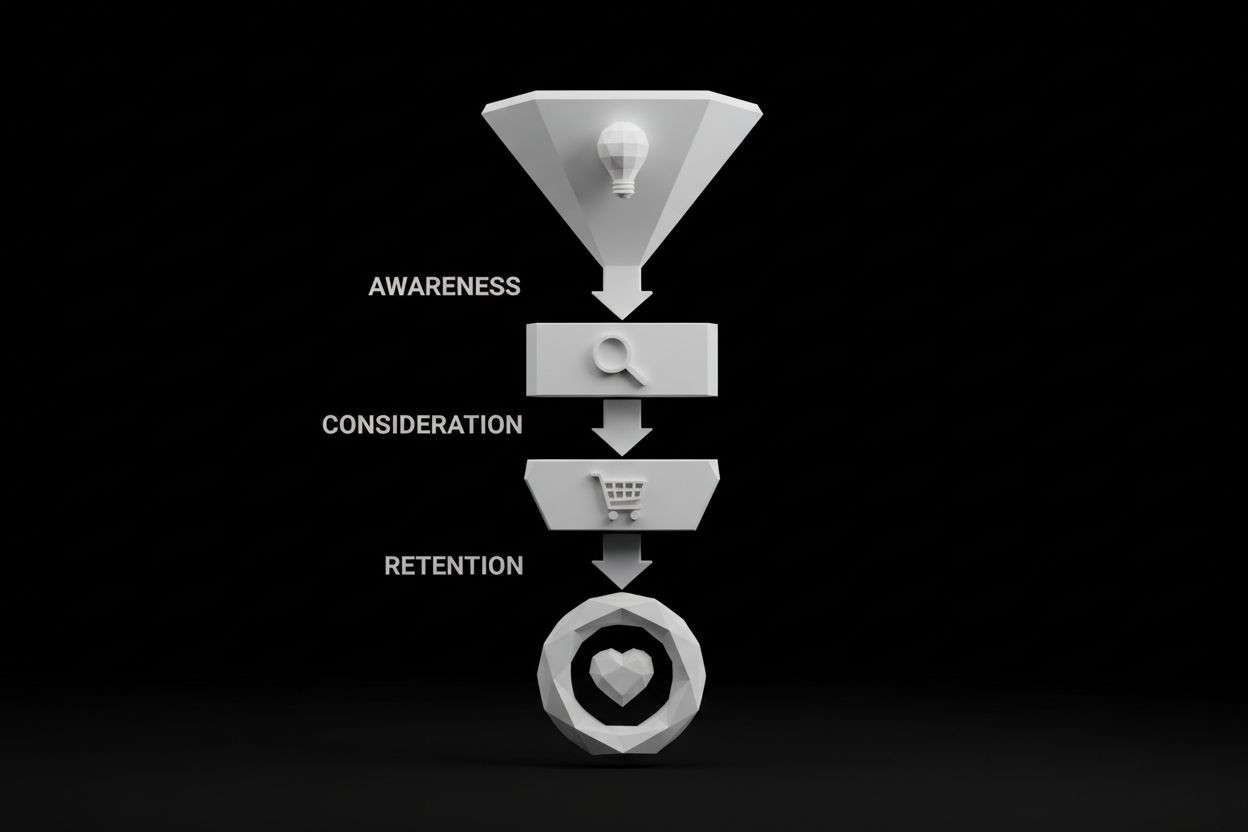
A modern strategy should map to the customer journey, not just to channels. That means it needs to explain what happens at each stage of the funnel and how the message changes as the buyer gets closer to action.
Awareness
At the top of the funnel, the goal is visibility. You want the right people to notice the problem, the opportunity, or the brand. This is where SEO, short-form content, social posts, and educational ads often do the heavy lifting.
Consideration
In the middle of the funnel, the buyer is comparing options. Here, your strategy should support trust building through comparison pages, case studies, product demos, nurture emails, and helpful social proof.
Conversion
At the bottom of the funnel, the goal is action. That could be a demo request, a lead form, a consultation, or a purchase. If you use an AI assistant or chatbot to qualify inquiries, route prospects, or answer common questions, that role should be part of the strategy, not an afterthought. A service like Automated AI Chat Agents fits best when the strategy defines the handoff between conversation, qualification, and sales.
Retention
A lot of brands stop too early. The best strategies also include retention, upsell, and referral. That means thinking beyond the first conversion and planning for repeat revenue, customer education, and loyalty.
This is where a modern stack can combine content, automation, and data. HubSpot’s AI-era marketing thinking is built around expressing the brand clearly, tailoring messages to the audience, amplifying across channels, and evolving in real time. That is a useful way to think about strategy in 2026 and beyond. (hubspot.com)
A simple marketing strategy template you can copy

If you want to build your own strategy, use this structure:
Business goal
What business outcome are we trying to create?Target audience
Who do we want to reach, and what matters to them?Positioning
Why should they choose us over other options?Core message
What is the main message we need to repeat consistently?Channels
Where will we reach the audience, and why those channels?Offer and conversion path
What should the audience do next, and what friction needs to be removed?Budget and resources
What do we have the capacity to execute well?KPIs
How will we measure success?Timeline and ownership
Who does what, and when will it happen?Optimization plan
What will we test, review, and improve each month?
If you are building a marketing engine around content, ads, and automation, it helps to keep the strategy and the system aligned. That means your content engine, media buying, and conversion tools should all support the same goal. For a broader operational view, you can also look at Lead Generation and Marketing Automation Guide for 2026 Success as a complement to this framework.
Common mistakes that weaken a marketing strategy
Even a good product can underperform if the strategy is fuzzy. These are the mistakes that show up most often:
Trying to speak to everyone at once
Focusing on channels before defining the audience
Confusing tactics with strategy
Skipping competitor research
Setting vague goals that cannot be measured
Ignoring budget and team capacity
Not defining the next step after someone clicks
Reviewing performance too late to make changes
The fastest way to improve a strategy is usually to tighten the audience, sharpen the offer, and make the conversion path simpler.
Example of what is in a marketing strategy for a lead-generation brand
Here is what a simple strategy might look like in practice:
Business goal: Generate qualified leads for a service business.
Target audience: Owners and marketing managers at small to midsize companies.
Positioning: We help businesses attract leads faster with a system that combines SEO, paid social, and AI-assisted follow-up.
Channels: SEO for intent-driven traffic, Meta ads for lead capture, TikTok for awareness, email nurture for follow-up.
Content: Educational posts, founder-led social content, lead magnets, case studies, landing pages, and retargeting ads.
Conversion tools: Forms, chat, booking pages, and an AI assistant to qualify inquiries.
KPIs: Cost per lead, lead quality, booked calls, conversion rate, and pipeline created.
That is what is in a marketing strategy when it is built for actual growth. It is not a slogan document. It is a decision-making system.
Final thought
When people ask what is in a marketing strategy, they are usually looking for more than a definition. They want to know what pieces matter, how those pieces fit together, and how to turn them into leads, sales, and steady growth. The best strategies are clear about the audience, honest about the market, focused on the offer, and specific about measurement. They also leave room for channel mix changes, AI tools, social content, and paid media testing as the business grows. (salesforce.com)
If you build the strategy first, execution gets much easier. And when the strategy is right, everything from SEO to Meta ads to AI chat support starts pulling in the same direction.