What Is a Marketing Campaign? Definition, Types, Examples, and How to Build One
Learn what a marketing campaign is, how it differs from strategy, and how to plan, launch, and measure results across email, social, and ads.
If you searched for what is marketing campaign, the simplest answer is this: it is a coordinated set of actions built to achieve one measurable marketing goal within a set timeframe. Campaigns can combine organic social, paid ads, email, content, landing pages, and follow-up automation. They are used for things like lead generation, brand awareness, product launches, and retention, but the real value is focus. A good campaign gives every channel the same job instead of asking random tactics to do everything at once. (salesforce.com)
What is a marketing campaign?

A marketing campaign is not just a social post, a newsletter, or a paid ad. It is a planned effort with a clear objective, a specific audience, a message, a channel mix, and a measurable outcome. Salesforce describes campaigns as strategic actions designed to promote a brand, product, or service, while also stressing the importance of choosing the right channels and tracking performance so the work can be improved over time. (salesforce.com)
The easiest way to think about it is this: a campaign is a short, focused sprint inside a larger marketing system. It may last two weeks, one quarter, or a full product launch cycle, but it still has a beginning, a middle, and an end. That is what separates it from general day-to-day marketing activity, which is often broader and ongoing.
A strong campaign usually answers these questions:
What result do we want?
Who is this for?
What should they do next?
Where will they see the message?
How will we know it worked?
If the answers are vague, the campaign will usually be vague too. That is why planning matters more than volume. One well-structured campaign can outperform a scattered mix of posts and ads.
Marketing campaign vs marketing strategy vs advertising campaign
A lot of people use these terms interchangeably, but they are not the same thing.
Marketing strategy
A marketing strategy is the long-term approach that explains how marketing will support business growth. It sets direction, positioning, and audience priorities. In simple terms, strategy decides where you want to go and why. (asana.com)
Marketing plan
A marketing plan turns the strategy into an actionable roadmap. It usually includes channels, budgets, timelines, target audiences, and KPIs. Asana and Shopify both describe the plan as the tactical layer that organizes execution around a specific goal. (asana.com)
Advertising campaign
An advertising campaign is usually the paid-media slice of a broader marketing campaign. If you are running Meta or TikTok ads, the campaign objective tells the platform whether you want awareness, traffic, leads, or sales. That makes advertising campaigns highly tactical, while marketing campaigns can include paid, owned, and organic work together. (facebook.com)
A simple way to remember it is:
Strategy = the direction
Plan = the roadmap
Campaign = the focused execution
Ads = one possible channel inside the campaign
That difference matters because teams often fail when they try to build campaigns without a real strategy or launch ads without a proper plan.
The core elements of a strong marketing campaign
Every effective campaign has the same basic ingredients, even if the creative looks very different. The most important elements are one clear objective, one primary audience segment, one main offer or call to action, a channel mix that fits the goal, a budget, a timeline, and a measurement plan. Salesforce and HubSpot both emphasize segmentation, funnel thinking, and tracking, because broad messaging and weak attribution waste budget quickly. (salesforce.com)
Simple campaign framework: Goal > Audience > Message > Channel > Asset > Launch > Measure
Here is what each part does:
Goal: the business result you want, such as demo requests, purchases, or signups.
Audience: the people most likely to care about the offer.
Message: the promise, angle, or value proposition that makes them pay attention.
Channel: where the message will show up, such as Meta, TikTok, email, search, or organic social.
Asset: the ad, video, landing page, form, email, or post that carries the message.
Launch: the moment the campaign goes live, usually with tracking in place.
Measure: the KPI or KPIs that show whether the campaign is doing its job.
For lead generation campaigns, this often means a paid social ad, a landing page, a form, and a follow-up sequence. If your business depends on fast response times, Automated Lead Generation can help you capture and route inquiries without making prospects wait. If you want the first touchpoint to answer questions instantly, Automated AI Chat Agents can do a lot of the qualification work before a sales call ever happens.
Common types of marketing campaigns
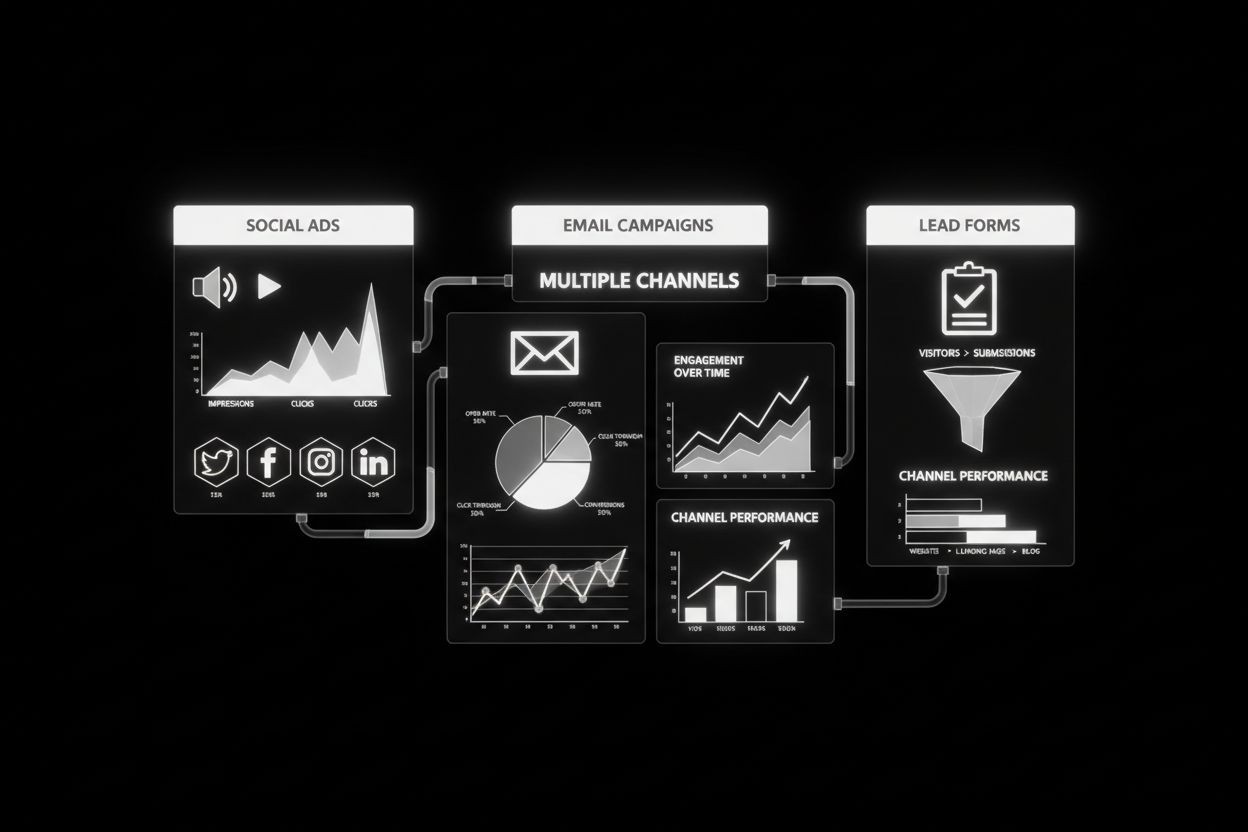
Most campaigns fit into a few repeatable categories. The exact mix depends on the objective, but awareness, traffic, lead generation, sales, and retention are the most common starting points across modern ad platforms and marketing guides. Meta and TikTok both organize campaign setup around objectives, while Salesforce frames campaigns around business outcomes and channel choice. (salesforce.com)
Brand awareness campaigns
These campaigns help more people recognize your brand, product, or category. They are useful when you are launching something new, entering a new market, or trying to stay memorable in a crowded space. Meta’s awareness objective is designed to reach people who are likely to remember your brand, and Salesforce notes that awareness campaigns often combine video, social, and broader reach tactics. (facebook.com)
Traffic campaigns
Traffic campaigns aim to send people to a website, app, or landing page. They are useful when the first job is attention and click-through, not an immediate sale. Meta’s traffic objective and TikTok’s traffic objective are both built around sending people to a destination where they can learn more. (facebook.com)
Lead generation campaigns
Lead generation campaigns collect contact details from interested prospects. Meta supports lead ads through forms, messaging, and calling, while TikTok’s lead generation objective can collect lead information on the platform or on your own website. That makes them strong choices for service businesses, B2B offers, consultations, demos, and quote requests. (facebook.com)
Product launch campaigns
These campaigns build interest before and after a new product or service goes live. They often use a mix of email, social content, paid ads, and landing pages to create momentum fast. A launch campaign works best when the message is simple and the audience knows exactly what problem the product solves.
Retention and upsell campaigns
These campaigns focus on existing customers instead of new ones. They may promote upgrades, renewals, referrals, reorders, or loyalty perks. They matter because keeping customers engaged is usually cheaper than finding new ones from scratch.
Seasonal or promotional campaigns
Holiday sales, flash sales, back-to-school offers, and limited-time discounts all fit here. These campaigns work best when the offer is clear, the deadline is real, and the landing page removes friction quickly.
If social media is part of your campaign mix, Automated Social Media can help you stay consistent with posting, creative variation, and channel coverage while the paid side does the heavy lifting.
How to create a marketing campaign step by step
Good campaigns do not start with a channel list. They start with a business outcome, then turn that outcome into a roadmap with a budget, a timeline, and a metric you can actually track. That is the same structure repeated by Asana and Shopify, and it lines up with how Meta, TikTok, and Google frame campaign objectives, budgeting, and performance tracking. (asana.com)
1. Pick one primary goal
Choose the one result that matters most. Do you want leads, sales, bookings, app installs, or awareness? If you try to optimize for everything, you usually end up optimizing for nothing.
2. Define the audience
Get specific. A campaign for startup founders is not the same as a campaign for local restaurant owners, and a campaign for warm retargeting audiences is not the same as one for cold traffic. The sharper the audience, the clearer the message.
3. Build the offer and the CTA
Your campaign needs something to move people toward. That could be a demo, a quote, a free trial, a checklist, a webinar, or a limited-time discount. The call to action should feel like the next logical step, not a hard sell.
4. Choose the right channels
Match the channel to the goal. Meta and TikTok are strong for reach, video, and lead generation. Email is powerful for nurturing. Search captures intent. Organic social can build trust and keep the brand visible between campaign bursts.
If you need help with the paid side of that mix, Paid Ads Management can be useful when you are testing audiences, creatives, and budgets on Meta or TikTok.
5. Create the campaign assets
This is where the work becomes visible. Write the ad copy, produce the creative, build the landing page, set up the form, prepare the email sequence, and make sure every asset matches the same promise. If the ad says one thing and the landing page says another, conversion usually drops.
6. Set budget and timeline
Budget is not just about spend, it is about resource allocation. Decide how much you can invest, how long the campaign will run, and when you will review performance. Small budgets can still work if the audience is tight and the offer is strong.
7. Launch and optimize
Start the campaign, watch the early data, and make controlled improvements. Do not change everything at once. Test headlines, hooks, thumbnails, audiences, and placements one variable at a time whenever possible.
8. Nurture the leads after the click
A campaign is not finished when someone fills out a form. The follow-up is part of the experience. Lead generation and marketing automation guide can help you think through lead scoring, routing, and nurture flows, while AI chat can answer basic questions and keep prospects moving. The faster your response, the better your odds of turning interest into revenue.
How to measure campaign success

When someone asks whether a campaign worked, the answer should depend on the objective. Google defines CPA as the total cost spent to receive the required action, and its lifecycle reporting also uses CAC. Meta and TikTok both push advertisers to choose objectives that match the result they want, whether that is awareness, traffic, leads, or sales. (support.google.com)
Here is a practical way to think about metrics:
Awareness campaigns: reach, impressions, video views, ad recall, engagement rate
Traffic campaigns: clicks, click-through rate, cost per click, landing page views, session quality
Lead generation campaigns: cost per lead, conversion rate, lead quality, cost per acquisition
Sales campaigns: revenue, return on ad spend, conversion rate, average order value
Retention campaigns: repeat purchase rate, renewal rate, customer lifetime value, churn reduction
If revenue is the end goal, ROAS matters more than raw clicks. Google’s Target ROAS guidance is built around optimizing toward value, not just volume, which is why sales campaigns need a clean connection between spend and downstream revenue. (support.google.com)
The best teams also look beyond platform dashboards. They compare ad platform data with CRM data, email performance, sales outcomes, and funnel progression so they can see the full picture. HubSpot’s funnel guidance and attribution reporting are useful reminders that a campaign often touches several stages before a sale happens. (hubspot.com)
If you use a landing page, a chat layer, and CRM routing together, you can measure not just whether a lead came in, but whether it was actually worth pursuing.
Common mistakes to avoid
A lot of campaigns fail for predictable reasons, and most of them are avoidable.
Trying to target everyone: broad targeting usually weakens the message and wastes spend.
Running without a clear KPI: if success is not defined, optimization becomes guesswork.
Using one creative forever: fatigue shows up fast in paid social.
Ignoring the landing page: even a strong ad will struggle if the page is slow, confusing, or off-message.
Forgetting follow-up: leads that sit untouched tend to go cold quickly.
Chasing vanity metrics: likes and impressions can help, but they do not pay the bills on their own.
A better approach is to keep the campaign simple, test carefully, and improve one layer at a time.
Example: a lead generation campaign in action
Imagine a B2B service company that wants more qualified demo requests.
It starts with one goal, booked demos from qualified decision-makers. The audience is small business owners and marketing managers who are already aware of the problem. The message focuses on saving time and improving response speed. The channel mix includes Meta ads, TikTok traffic ads, organic social, and a landing page with one short form.
The company uses Automated Social Media to keep the brand visible between ad bursts. It uses Automated AI Chat Agents to answer common questions on the landing page and pre-qualify visitors. It uses Automated Lead Generation to route new contacts into the right pipeline instantly. And it uses Paid Ads Management to test creative angles, placements, and budgets without guesswork.
In that setup, the campaign is not just an ad. It is a connected system that moves a person from first impression to booked meeting.
Frequently asked questions
What is the difference between a marketing campaign and an advertising campaign?
A marketing campaign can include paid, organic, and owned media. An advertising campaign is usually the paid part of that effort.
How long should a marketing campaign run?
There is no universal rule. Some campaigns run for a week, others for months. The right length depends on the goal, audience, and buying cycle.
What makes a marketing campaign successful?
A clear goal, the right audience, a strong offer, good creative, the right channel mix, and a measurement plan that matches the objective.
Can a small business run a good campaign on a limited budget?
Yes. In many cases, one offer, one audience, one channel, and one landing page are enough to produce useful results.
Do I need AI to run a marketing campaign?
No, but AI can make campaign execution faster. It can help with content variation, lead qualification, follow-up, and reporting, especially when your team is short on time.
A marketing campaign works best when it is built with intention, not noise. Start with one goal, one audience, and one clear message, then choose the channels that support that goal. If you are aiming for lead generation, the strongest campaigns usually combine paid ads, social content, landing pages, and fast follow-up so interested prospects do not cool off before someone responds.