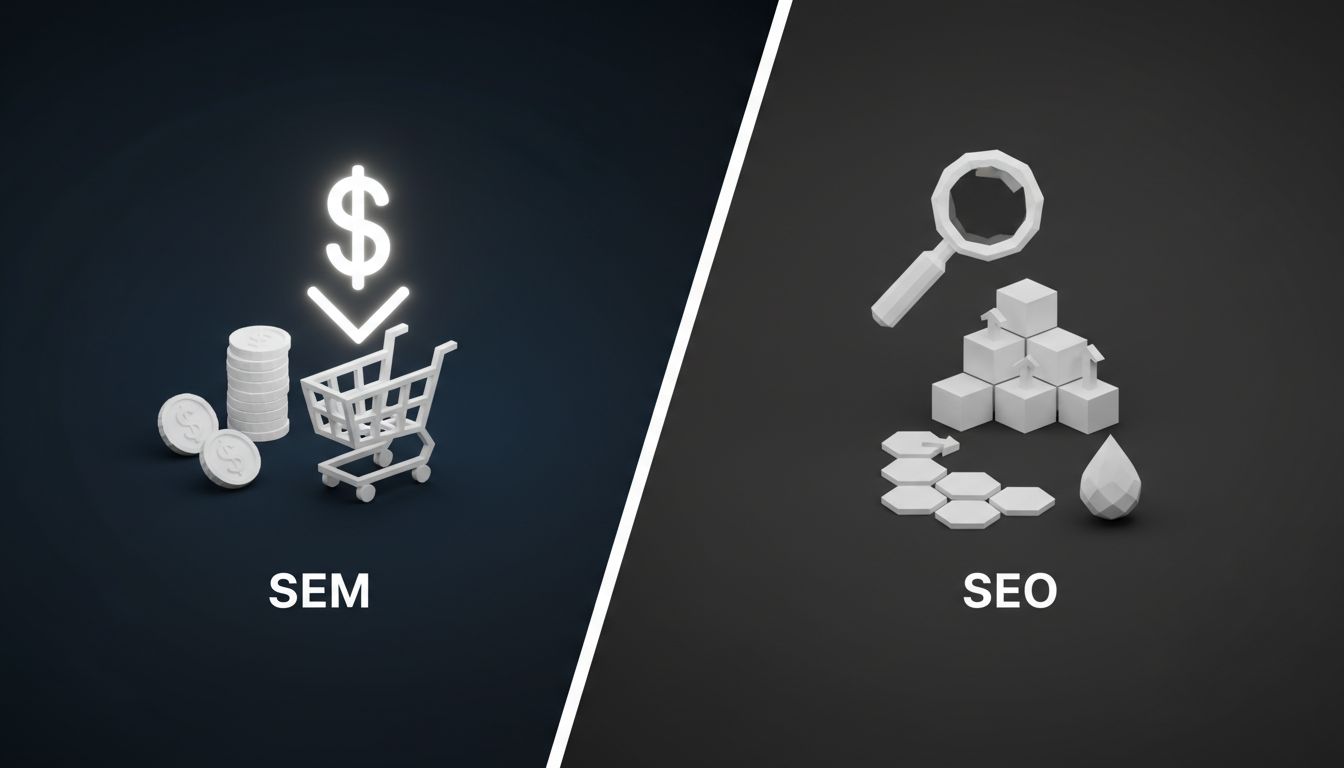
SEM vs SEO: The Real Differences and How to Use Both for More Leads
Compare sem vs seo, learn the key differences, and find out how to combine organic search and paid ads for faster leads and long-term growth that converts.
If you’re trying to bring in qualified leads, sem vs seo is really a timing and budget decision. SEO is about helping search engines understand your content and helping users find your site through unpaid search results, while SEM is paid search visibility on the search results page. For businesses that rely on demo requests, calls, or quote forms, the strongest setup is often a mix of search traffic, a focused landing page, and fast follow-up through Automated Lead Generation. (developers.google.com)
That matters whether you’re launching a new service, promoting an offer, or trying to fill a pipeline that cannot wait months for content to mature. Search ads can show to people actively searching right away, and Google notes that using both search results and ads improves your chances of connecting with customers at the moment they are looking for your product or service. (about.ads.microsoft.com)
Here is the short version.
Factor | SEO | SEM |
|---|---|---|
Visibility | Earned placement in organic search results. (developers.google.com) | Paid ads on search results pages. (about.ads.microsoft.com) |
Cost model | No per-click ad fee, but it still takes content and technical work. (developers.google.com) | CPC or PPC, so you pay when someone clicks. (support.google.com) |
Speed | Changes can take time to show up in search. (developers.google.com) | Campaigns can go live quickly and start reaching searchers. (about.ads.microsoft.com) |
Control | Less direct control over placement. (developers.google.com) | More control over keywords, timing, location, and budget. (support.google.com) |
Measurement | Impressions, clicks, CTR, and average position in Search Console. (support.google.com) | Impressions, clicks, CTR, CPC, conversions, and Quality Score in Google Ads. (support.google.com) |
Best fit | Evergreen content, informational pages, and long-term organic growth. (developers.google.com) | Launches, promos, and high-intent lead generation. (about.ads.microsoft.com) |
The important thing is that both channels live on the same search results page. Search Console tracks organic performance through impressions, clicks, average position, and CTR, while Google Ads tracks paid performance through CPC, conversions, and diagnostics like Quality Score. Google also makes clear that ads appear at the top or bottom with an ad label, not inside organic results. (support.google.com)
What is SEO?

SEO, short for search engine optimization, is the work of helping search engines understand your content and helping users find your site through search. Google’s own starter guide says SEO is about making content easier for search engines to interpret and easier for users to discover and decide whether to visit. It also points out that there is no guarantee any page will rank first, which is why SEO is usually a steady improvement process rather than a quick switch. (developers.google.com)
In practice, SEO usually breaks down into three parts:
On-page SEO, which includes the words on the page, headings, titles, internal links, and how clearly the page matches the search.
Technical SEO, which helps search engines crawl, index, and understand the site.
Discovery and authority, which comes from links, promotion, and the way people find and share your content over time. (developers.google.com)
If you want SEO to become repeatable instead of manual, Automated SEO can help turn content updates, publishing, and optimization into a system instead of a one-off project.
For lead generation, SEO is strongest when the page answers a real question and gives the visitor a clear next step. That might be a form, a booked call, a pricing page, or a resource that warms the visitor before they talk to sales.
What is SEM?

SEM, in the way most marketers use it here, means paid search visibility. Microsoft Advertising describes SEM as placing a URL or ad on the search results page to maximize traffic and visibility, and Google Ads explains that search ads show on search results pages when someone searches for related terms. SEM often works through keywords, bids, location targeting, and timing controls, which is why it is so useful when you want immediate visibility. (about.ads.microsoft.com)
The mechanics are straightforward:
You choose keywords tied to your offer.
You write ads that match those keywords.
You set a budget and bidding approach.
Your ad can appear when a search matches your target terms. (about.ads.microsoft.com)
Unlike SEO, SEM uses a direct media cost. Google defines CPC bidding as paying for each click on your ads, and PPC is another common name for that model. That makes SEM easy to measure, but it also means the traffic stops when the budget stops. (support.google.com)
If you want help managing that side of the funnel, Paid Ads Management fits naturally here.
For lead generation, SEM is often the fastest way to test a new offer, find out which keywords convert, and learn what message lands before you invest heavily in content production.
SEM vs SEO: the practical differences
The difference is not just that one is free and the other is paid. It is about how each channel earns attention, how much control you get, and how quickly the channel can influence pipeline.
Cost and budget
SEO does not charge you a click fee, but it still requires time, content, technical cleanup, and often promotion. SEM uses CPC or PPC bidding, so each click has a media cost even if the final actual CPC is often lower than the max bid you set. (developers.google.com)
For a lead-focused business, that means SEO is usually the more patient investment, while SEM is the channel you buy when you need traffic or leads now.
Speed and control
Google says changes in SEO can take hours or even months to show up in search results, and Search Central makes clear that organic visibility is something you improve over time. SEM can move much faster because once a campaign is live, it can start showing to active searchers based on your keywords, bids, location, and schedule. (developers.google.com)
That speed is why SEM is so useful for launches, seasonal campaigns, and new offers. If you are testing a product, service, or funnel, it is much easier to get a signal from paid search first.
Measurement and optimization
SEO performance is usually tracked in Search Console, where you see impressions, clicks, CTR, and average position. SEM is measured in Google Ads, where you can track clicks, CPC, conversions, and Quality Score. Google says Quality Score is a diagnostic tool, not a KPI, and it is influenced by expected CTR, ad relevance, and landing page experience. (support.google.com)
That matters a lot for lead generation. If your ad gets clicks but the landing page is weak, Google has already told you where the problem might be. The same logic applies to SEO pages that attract traffic but do not produce enquiries.
Intent and funnel stage
SEO is a strong fit for informational and comparison searches because it helps people find content and decide whether to visit your site. SEM is a strong fit for high-intent searches because search campaigns are designed to reach people actively looking for a product or service. (developers.google.com)
In plain English, SEO is often better for early-stage research, while SEM is often better for bottom-of-funnel demand capture. That is why the best strategy is usually not either-or.
How SEO and SEM work together
The smartest use of sem vs seo is usually to let each one do the job it does best. SEM can test which keywords, headlines, and offers actually drive clicks and conversions, then SEO can turn the winners into longer-lasting pages and content clusters. Google Ads ties keywords to searches and gives you conversion data, while Search Console shows which queries are already bringing organic traffic. (about.ads.microsoft.com)
If you want a deeper framework for combining both channels, SEO vs SEM, choose, combine, maximize ROI is a useful follow-up.
A practical way to combine them looks like this:
Use SEM to validate a message before you spend weeks writing a large SEO page.
Use SEO content to answer questions that people ask before they are ready to buy.
Send paid traffic to a landing page that mirrors the keyword and offer.
Add a fast qualification layer, like Automated AI Chat Agents, so leads get answers and routing without waiting for a human.
If you are also running Meta or TikTok ads, this search layer gives you a way to catch people once they come back to verify, compare, or buy.
Which one should you choose first?

The right choice depends on your timing, budget, and funnel goals. A simple rule is this:
Choose SEO first if you want content that can keep working, you have a longer sales cycle, and you can wait for organic growth to build.
Choose SEM first if you need leads this month, you are launching something new, or you want tight control over spend and targeting.
Choose both if you have enough runway to test paid search while building organic pages that compound over time. (developers.google.com)
A few common business examples make the decision clearer:
Startup or new service
SEM is usually the fastest way to see which messaging and keywords resonate. SEO then becomes the channel you use to expand into guides, comparison pages, and support content.
Local business
Use SEM for high-intent service searches and local urgency, then build SEO pages for service areas, pricing questions, and trust-building content.
SaaS or B2B
SEO can educate the market, while SEM can focus on demo, consultation, or problem-aware searches that are close to conversion.
Ecommerce
SEM is great for promos, launches, and seasonal demand. SEO is ideal for category pages, product education, and comparison content that keeps attracting buyers over time.
For teams that care about booked calls and enquiry volume, it also helps to pair either channel with a clear follow-up process, which is where Automated Lead Generation becomes part of the real growth system.
Common mistakes people make with sem vs seo
One of the biggest mistakes is expecting SEO to behave like an ad campaign. Google is clear that there is no guarantee a page will rank first, and it can take time for changes to show up. Another mistake is running SEM without a strong landing page, even though Google’s Quality Score guidance explicitly includes landing page experience and ad relevance. (developers.google.com)
Other mistakes to avoid:
Measuring clicks without measuring conversions.
Sending all traffic to the homepage instead of a page built for the query.
Treating paid and organic search as separate teams instead of one search strategy.
Writing content without a clear next step for the visitor.
If your traffic is solid but the leads are thin, the problem is often not the channel. It is the message, the page, or the handoff.
FAQ
Is SEM better than SEO?
Not always. SEM is better when you need speed, control, and immediate visibility. SEO is better when you want organic growth that can compound over time. In most cases, the strongest return comes from using both together. (about.ads.microsoft.com)
Is SEO part of SEM?
Definitions vary across the industry. Microsoft Advertising separates SEO from SEM and describes SEM mainly as paid search, while some marketers use SEM more broadly to include both organic and paid search. For practical planning, it is easiest to treat SEO as organic and SEM as paid. (about.ads.microsoft.com)
Which is cheaper?
SEM has a direct click cost because CPC bidding means you pay for each click. SEO does not have a click fee, but it still requires content, technical work, and maintenance. (support.google.com)
Can you run SEO and SEM at the same time?
Yes. Google explicitly says that using both search results and ads can improve your chances of connecting with customers when they are looking for your product or service. (support.google.com)
What should lead generation teams focus on first?
If you need pipeline now, start with SEM and a conversion-ready landing page. If you want lower-pressure, long-term growth, build SEO content around the questions buyers ask before they are ready to talk. The best teams usually do both and connect them with fast follow-up, strong offers, and tools that help qualify the lead before sales takes over.
The real answer to sem vs seo is not choosing one forever. SEO is the long game, SEM is the fast lane, and the best growth comes from using both with a page that converts and a follow-up system that does not let good traffic go cold.