AI Social Media Automation Agency: A Practical Guide to Scaling Social Presence with AI
Discover how an AI social media automation agency builds workflows for content, ads, chat agents, and analytics to scale social growth and drive measurable ROI.
Most brands know social media is essential, but few run it efficiently at scale. An AI social media automation agency turns repetitive tasks into measurable workflows so teams focus on strategy, creative and conversions. This guide walks marketing leaders through the exact services, platform-specific automations, tool stack, compliance steps and ROI calculations you need to evaluate or hire an agency.
Why specialize in social media automation
Specialization matters because social platforms have unique rhythms, content formats and policies. General AI automation firms often leave gaps that harm reach or create compliance risk. An AI social media automation agency focuses only on social workflows: content ideation, scheduling, ads, community response, influencer outreach and reporting.

Business outcomes you can expect
Faster content turnaround: days to hours for campaign series
Higher posting consistency across platforms
More effective ad spend through automated A/B testing
Faster responses and lower community churn via AI chat agents
Attribution-ready reports that prove ROI
These outcomes are what decision makers care about when evaluating an AI social media automation agency.
Core services offered by an AI social media automation agency
An agency focused on social automation should offer an end-to-end set of services. Here are the main categories and what each delivers.
1. Content automation and creative variants
AI-driven content ideation and briefing for reels, stories, carousels and posts
Caption generation with tone and hashtag suggestions
Auto-generate multi-platform variations so one idea fits Instagram, LinkedIn and TikTok
Automated creative testing: swap headlines, CTAs and cover frames to find top performers
Practical tip: ask for a content matrix that maps formats to KPIs. A typical matrix shows primary objective, format, CTA and posting window.
2. Scheduling and distribution workflows
Central calendar with platform-specific publishing rules
Queue management with approval workflows for brand compliance
Time-zone aware scheduling for global audiences
Automations include webhook triggers for publishing, rollback if a post fails moderation and cross-posting rules that preserve native features.
3. AI chat agents and community automation
Smart triage bots that escalate to humans for high-priority queries
Auto-responders for DMs, comments and reviews
Integration with CRM to capture leads and follow-up sequences
For agencies that offer automated chat agents, see a deeper technical implementation in our guide on Automated AI Chat Agents.
4. Ads automation and creative optimization
Campaign templates for Meta, TikTok and LinkedIn
Automated budget reallocation based on CPA and ROAS rules
Creative mix automation: rotate combinations of video, thumbnail, caption and CTA
Combine this with managed paid ads services for full-funnel automation: Paid Ads Management.
5. Listening, sentiment analysis and crisis alerts
Automated keyword and competitor monitoring
Sentiment scoring with alerting for sudden negative spikes
Playbooks that trigger immediate actions and stakeholder notifications
6. Reporting and attribution
Daily dashboards and automated executive summaries
Multi-touch attribution models for social conversions
Scheduled exports to finance or CRM systems
If you need help mapping automation into your current marketing stack, our Automated Lead Generation page shows how lead flows should connect to social automation.
Platform-specific automation examples
Different platforms require different approaches. Below are practical automations for major networks.
Instagram and Facebook
Auto-create stories from long-form video using scene detection
Carousel generator that pulls product images and creates captions with shoppable tags
Auto-boost best-performing organic posts into ad sets
TikTok
Trend detection that suggests sound and editing templates
Hook optimization where the first 3 seconds are A/B tested automatically
Promote pipeline that sends top organic videos into paid discovery campaigns
Content cadence automation for executives with approval flows
Auto-turn blog posts into long-form LinkedIn articles and post series
Automated outreach sequences for B2B lead qualification
Regional platforms (XHS, WeChat)
Localization engines that adapt captions and CTAs for regional users
Compliance rule sets for local platform policies
Building a social media automation stack
A practical stack balances no-code tools and custom integrations. Example components:
Content ideation: OpenAI or a fine-tuned model
Scheduling and publishing: enterprise scheduler with API publishing
Chat agents: conversational AI platform integrated with CRM
Ads automation: API-level access to Meta and TikTok for automated budget rules
Analytics: BI tool or dashboard fed by data warehouse
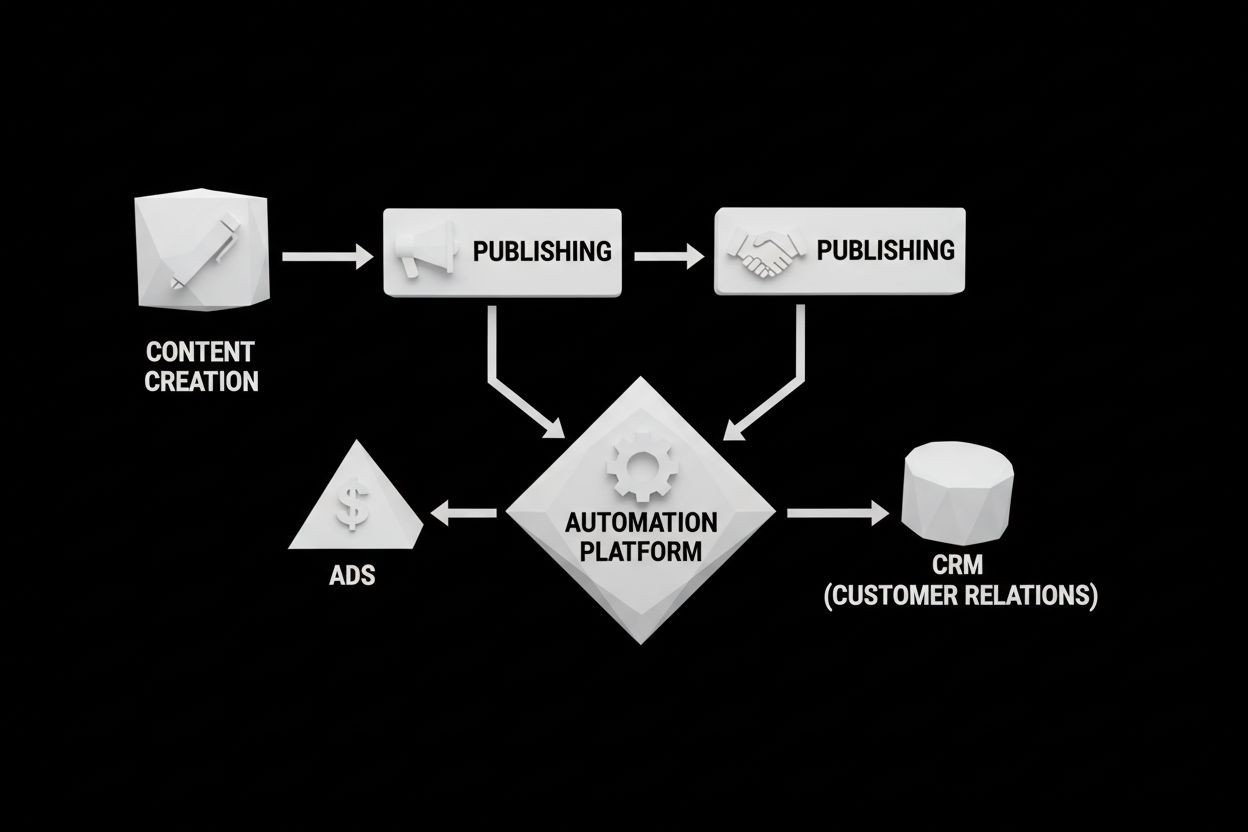
Ask for a clear architecture diagram from any agency you evaluate. It should show how data flows from social platforms to the agency platform to your CRM and analytics tools.
Sample automation workflows you can request
New product launch workflow
Trigger: product brief submitted
Steps: AI generates 20 caption variants, schedule 10 posts across platforms, create 4 short videos, set up ad campaigns, auto-report performance daily for first 14 days
Community triage workflow
Trigger: negative sentiment above threshold
Steps: assign ticket to social lead, pause scheduled posts referencing topic, launch PR response template, escalate to legal if required
Lead capture and nurture
Trigger: DM with lead intent
Steps: chat agent collects details, creates CRM record, sends booking link, notifies sales rep
These workflows turn ad hoc tasks into predictable processes that scale.
Prompt examples for social content and chat agents
Effective prompts reduce back-and-forth. Share these with your agency or use them internally.
Caption generation prompt
“Write five Instagram captions for a sustainable fashion brand launching a recycled denim jacket. Keep tone witty, include 3 hashtags, and a CTA to shop now.”Video idea prompt for TikTok
“Suggest 8 short-form video concepts under 25 seconds for a B2B SaaS product highlighting time savings. Each concept should include a hook, visual idea and CTA.”Chat agent triage prompt
“If user mentions refund or charge, mark intent as refund and gather order number. If sentiment is angry, add priority flag and alert human agent.”
Prompt engineering for social content is iterative. Ask the agency for version control on prompts so you can see what produces the best results.
Compliance and platform policy best practices
Automation can violate platform policies if not configured carefully. Key guardrails:
Always include human approval for high-risk posts
Limit auto-replies that could be considered spam
Preserve user privacy when routing messages to CRM
Respect platform rate limits and posting frequency rules
Request a compliance checklist and a rollback procedure from agencies you evaluate.
Measuring ROI and quick calculations
A practical ROI approach uses incremental lift from automation. Example method:
Baseline: average monthly conversions from social = 200
Target after automation: 260 conversions (30 percent uplift)
Average order value = $80
Incremental revenue = 60 x $80 = $4,800
Cost of agency and tools per month = $2,500
Net incremental = $2,300 per month
An agency should provide a similar projection tied to metrics like impressions, engagement rate, conversion rate and cost per acquisition.
Common mistakes to avoid
Treating automation as a set-and-forget solution
Over-automating human interactions and losing brand voice
Not mapping data to a central analytics system
Ignoring platform-specific creative norms
Choosing tools before defining workflows
Avoiding these mistakes saves time and reduces rework.
How to evaluate and select an agency
Use a scoring rubric across these categories:
Social specialization: experience on Instagram, TikTok, LinkedIn and regional platforms
Technical capability: API integrations, custom scripts and webhooks
Creative process: ability to produce and test variants
Compliance and governance: approval workflows and rollback plans
Reporting and accountability: clear KPIs and reporting cadence
Ask for a 30-day pilot focused on a single workflow, such as automating post-scheduling and caption generation for one product line. A pilot reveals execution ability faster than long proposals.
For more on building automated marketing systems and integrating CRM, see our article on What Is CRM in Marketing.
Case example: automating a holiday campaign
Situation: A retail brand needed quick seasonal content, consistent posting and better ad ROI.
Agency solution:
AI generated 40 caption variations and 10 short videos
Automated schedule across Meta and TikTok with native format adjustments
Auto-boost rule that promoted top 3 posts into ad campaigns
Chat agent handled common shipping questions and created 120 qualified leads
Results in 30 days:
28 percent increase in social conversions
35 percent reduction in manual hours for the marketing team
18 percent improvement in ROAS through automated creative testing
If you want a similar outcome, our service page on Automated Social Media explains typical engagement models.
Pricing models you will encounter
Fixed monthly retainer for end-to-end automation and management
Project-based fee for specific workflows or pilots
Performance-based pricing tied to lead or revenue targets
Ask for a clear scope and measurable deliverables. Pricing should align with the projected ROI example above.
Next steps and checklist for hiring an agency
Define one high-impact workflow to automate first
Request architecture and data flow diagrams
Ask for a 30-day pilot with clear success metrics
Confirm compliance and approval processes
Review prompt and creative versioning practices
Ensure integration with CRM and analytics
If you want help mapping workflows or scheduling a pilot, visit our contact page at Contact The Social Search.
FAQs
Q: Can automation replace social media managers?
A: No. Automation amplifies human effort and reduces repetitive work. Human strategy and creative judgment remain essential.
Q: Will automation affect platform reach negatively?
A: If done poorly, yes. Good agencies follow native formats, maintain creative quality and throttle automation to platform rules.
Q: Which platforms benefit most from AI automation?
A: All platforms benefit, but TikTok and Instagram show quick creative testing gains, while LinkedIn benefits from cadence and targeting automation.
Q: How long before I see results?
A: Expect measurable improvements in 30 to 90 days, depending on campaign complexity and testing velocity.
For a broader view of marketing automation and lead generation strategies, check our guide on Lead Generation and Marketing Automation.
Final thoughts
An AI social media automation agency is not a magic box. It is a partner that standardizes workflows, frees creative capacity and optimizes ad spend through continuous testing. Start with a pilot, insist on measurable outcomes and keep humans in the loop for tone and crisis decisions. Done right, automation turns social media from a cost center into a predictable growth channel.
For practical examples and ongoing insights into social search and strategy, explore our insights and blog at The Social Search and The Social Search blog.
If you are ready to explore a pilot or want an audit of your current social workflows, learn more about our services at Automated Social Media or contact us directly at Contact The Social Search.