AI Paid Ads Optimization: A Practical Guide to Boost ROI Across Meta, TikTok, and Google
Practical guide to AI paid ads optimization: step-by-step implementation, platform playbooks for Meta TikTok Google, prompt library, workflows, and risk checks.
AI is changing how advertisers buy, craft, and scale paid campaigns. This guide walks through an actionable implementation roadmap for AI paid ads optimization, platform-specific tactics for Meta, TikTok, and Google, a maturity model to meet your team where it is, tested prompts and automation recipes, and the risk controls you need to avoid costly mistakes.
Why AI paid ads optimization matters now
Advertisers who adopt AI into their ad stack win time and clarity. AI can surface which creative variants perform, predict budget allocation that improves CPL, and automate routine tasks like bid updates and audience pruning. That reduces manual overhead and shifts focus to strategy and creative direction. For agencies and in-house teams focused on lead generation or e-commerce, the payoff is faster experimentation and tighter feedback loops between ad creative and conversion metrics.
What results to expect
Faster creative iteration and improved CTRs
More efficient budget allocation across channels
Reduced time spent on repetitive campaign tasks
Better signal-driven bidding that can lower CPA
These benefits depend on the data available, the tools chosen, and how you integrate AI into workflows. Later sections explain how to estimate potential ROI and set realistic benchmarks.
AI optimization playbook: 7-step roadmap to implement AI paid ads optimization
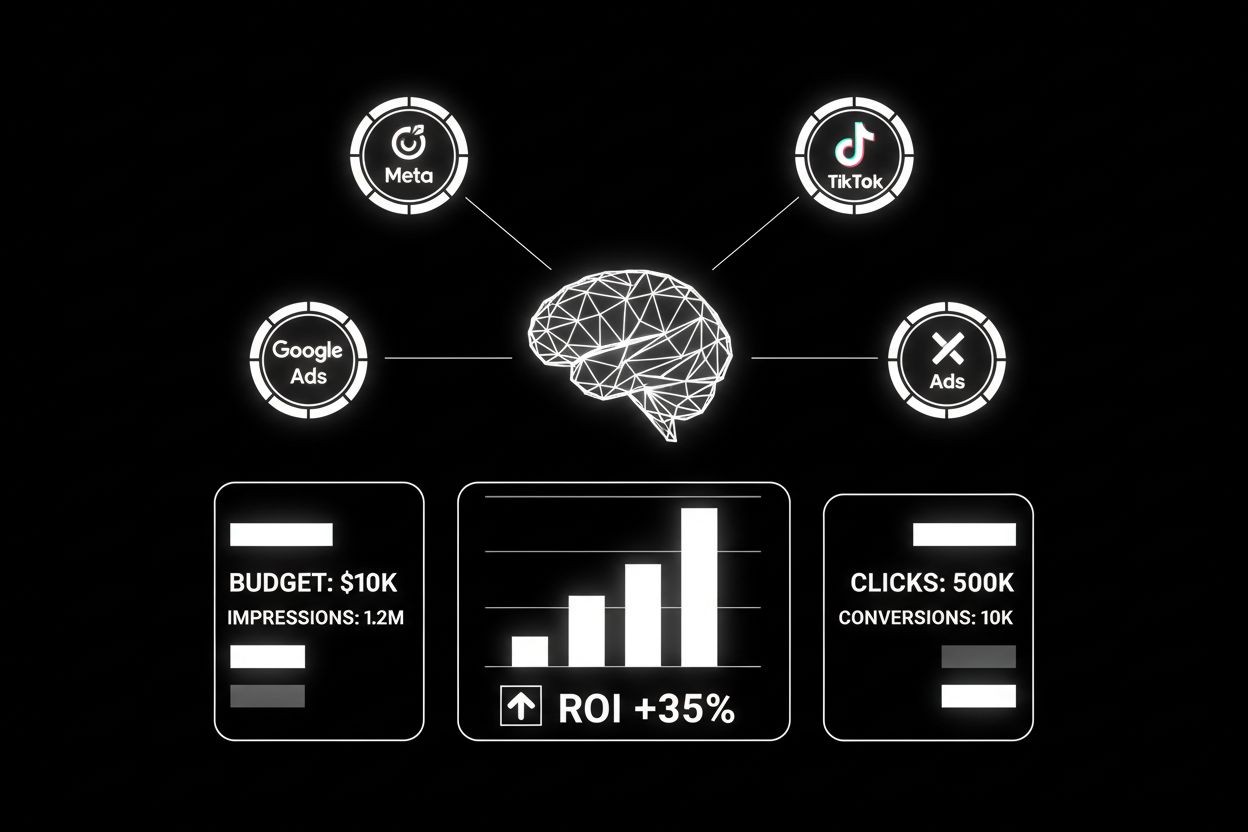
Follow this practical roadmap to move from experimentation to consistent, measurable AI-driven performance.
Audit current state
Inventory platforms, ad accounts, data sources, conversion pixels, and reporting. Note gaps in tracking and consent. Use a spreadsheet to map account IDs to goals.
Assess team skills and tooling. Which people know SQL, analytics, or automation tools like Zapier or Make.com?
Define measurable goals
Choose 2 to 4 KPIs: cost per lead, ROAS, conversion rate, or revenue per visitor. Make sure each KPI maps to a tracking event.
Pick a starter use case
Start small. Good first wins are creative variant testing or automated bid adjustments for a single campaign. Avoid replacing your entire budget allocation process in one step.
Select tools and integrations
Decide between platform-native automation and third-party AI. For example, use native Google algorithmic bidding for search while adding a third-party creative optimizer for Meta and TikTok.
Build automation workflows
Connect ad platforms to analytics and alerting. See the automation recipes section for concrete Zapier examples.
Run controlled tests
Use A B tests and holdout groups to measure lift. Run predictable test windows and document results.
Scale and govern
Expand successful automations, set guardrails for budgets, and develop rollback procedures when automated rules perform poorly.
AI maturity model: where to start based on budget and team size
Level 0: Manual. Small budgets and no automation. Focus on tracking and basic reporting.
Level 1: Assisted. Small to mid budgets. Use AI for creative generation and ad copy drafts. Implement simple automations for scheduling.
Level 2: Optimized. Mid budgets with dedicated analyst. Leverage algorithmic bidding, predictive budget allocation, and creative testing platforms.
Level 3: Autonomous. Large budgets or agencies. Use cross-platform AI agents for autonomous budget reallocation, multi-touch attribution, and end-to-end campaign optimization.
Recommendations:
If spend is under $10k/mo, focus on Level 1 tools that reduce setup time and improve creative.
For $10k to $100k/mo, Level 2 investments yield the best ROI through predictive bidding and deeper analytics.
Over $100k/mo, invest in Level 3 architecture and bespoke agents.
Platform-specific playbooks: Google, Meta, and TikTok
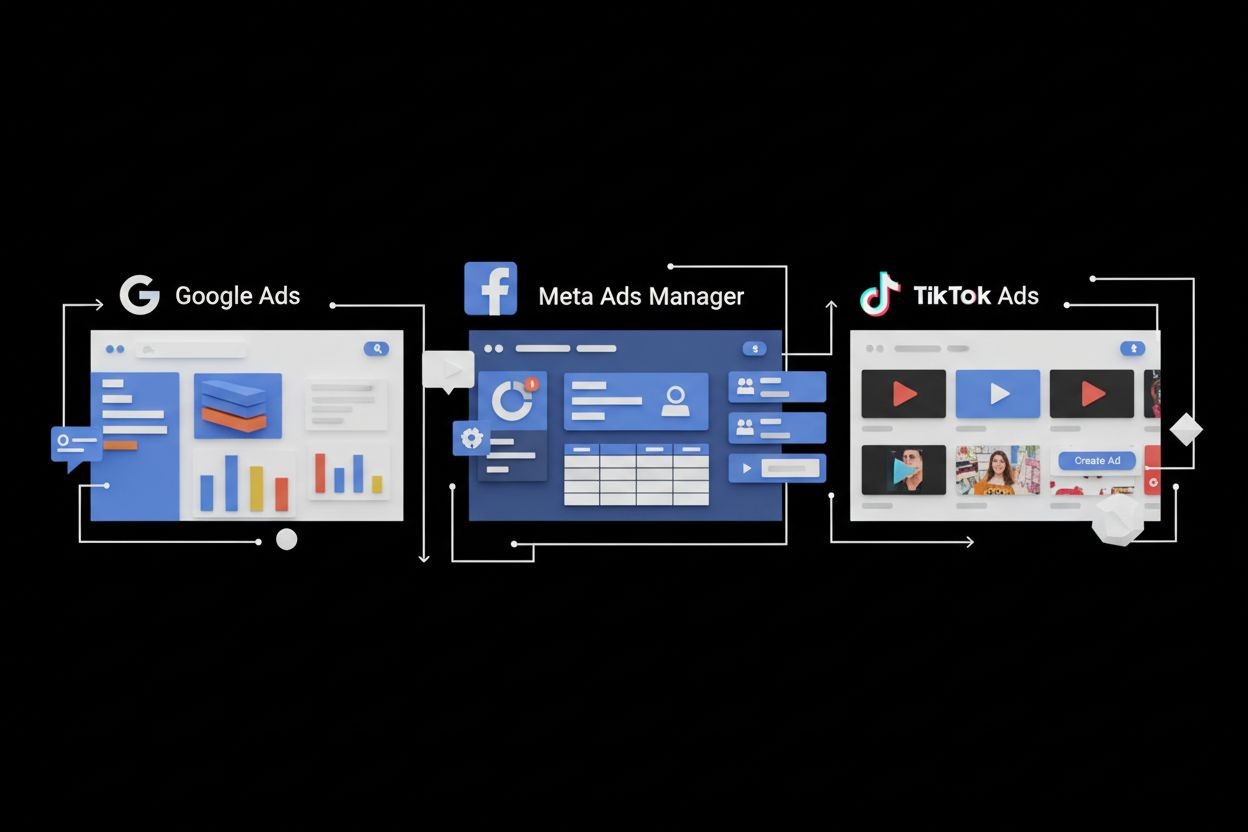
Each channel benefits from AI in different ways. Below are practical tactics you can apply immediately.
Google Ads
Use algorithmic bidding for search campaigns when conversion tracking is solid. Smart Bidding works best with 30+ conversions in the past 30 days per campaign.
Apply responsive search ads plus automated asset testing for headlines and descriptions.
Leverage predictive audience signals and in-market segments for better targeting.
Operational tip: centralize conversion events in a single measurement framework and feed them into your bidding models. If conversions are sparse, consider aggregating similar conversion actions.
Meta (Facebook and Instagram)
AI excels at creative optimization on Meta. Use creative optimization tools that analyze thumbnails, hook text, and aspect ratios to surface top performers.
Test dynamic creative with multiple assets and let the algorithm allocate weight to high-performing combinations.
Use lookalike audiences seeded with high-value customers and enrich signals with site events.
Compliance note: always review generated copy against Meta’s ad policies to avoid disapproved ads.
TikTok
Treat TikTok like a creative-first platform. Use AI to produce short-form variations and test vertical video hooks.
Leverage trending sounds and captions suggested by AI models to improve relevance.
For app install campaigns, use automated app bidding tied to in-app events for better long-term value optimization.
Cross-channel tip: use a centralized creative library with metadata so AI models can recommend best format for each channel.
Tool selection and stacking strategy
Choosing the right mix of tools is about function. Segment tools into these roles:
Creative generation and testing
Bid and budget automation
Attribution and analytics
Fraud and policy safety
Automation orchestration
For agencies and teams building a stack, combine a creative optimizer with a reliable attribution layer and an automation engine. If you provide paid ads as a service, link to your paid ads offering so prospects can try professional implementation: Paid Ads Management - The Social Search.
Prompt library: tested prompts for ad copy, headlines, and experiments
Use these prompts with ChatGPT or Claude to accelerate ad creative and testing ideas. Customize placeholders and audience signals.
Ad headline generator for Meta
Prompt:
“Write 10 short ad headlines for a B2B lead generation campaign selling an AI-powered CRM integration to small SaaS companies. Headlines must be 25 characters or fewer and include a value metric like ‘save X hours’ or ‘boost MQLs.’”
Video hook ideas for TikTok
Prompt:
“Suggest 12 vertical video hook ideas under 5 seconds for a direct-to-consumer skincare brand. Each hook should create curiosity and include a call to action to tap to learn more.”
Landing page variant copy for Google Ads
Prompt:
“Draft 3 versions of above-the-fold copy for a landing page promoting automated lead generation software. Include a concise headline, supporting subheading, and a 2-line benefit list. Keep tone professional and conversion-focused.”
Audience refinement prompt
Prompt:
“Given a list of top 50 customers with fields: company size, industry, spend, and closest competitor, suggest 3 lookalike audience segments prioritizing highest CLV potential. Explain reasoning.”
Bug-check prompt to detect policy risk
Prompt:
“Analyze this ad copy for potential policy violations on Meta and Google. Flag phrases that could trigger medical, financial, or exaggerated claims and suggest safer alternatives.”
Save and version these prompts, and track which prompts produce the highest CTR uplift.
Automation workflows and recipes
Here are practical workflows you can set up today using Zapier, Make.com, or native APIs.
Recipe A: Sync conversions to Slack and Google Sheets
Trigger: New conversion in Google Ads or Meta
Action 1: Append row in a Google Sheet with campaign, cost, conversion value
Action 2: Post summary to a Slack channel if CPA exceeds threshold
This gives alerts and an audit trail without manual reporting.
Recipe B: Pause creative when CTR drops
Trigger: Daily ad performance check
Condition: CTR below baseline for 3 consecutive days
Action: Pause creative and notify creative lead with metrics and screenshot link
Recipe C: Automated creative refresh from high-performing headlines
Trigger: Ad variant reaches top 10 percent of CTR
Action: Use an AI copy generator to expand the headline into three new variations and upload them to the creative library for testing
For agencies, connect your lead forms directly to client CRMs and to your automated lead generation pipeline: Automated Lead Generation - The Social Search.
Measuring impact and quick ROI estimator
A simple estimator helps set expectations. Use this formula:
Estimated incremental monthly value = (Current monthly conversions) x (Expected lift %) x (Average value per conversion)
Example:
Current conversions per month: 200
Expected lift from AI optimization: 15 percent
Average value per conversion: $150
Incremental monthly value = 200 x 0.15 x 150 = $4,500
Compare that to the monthly tool and labor cost to determine payback period. Track actual lift with holdout tests to validate assumptions.
Risk, governance, and troubleshooting
AI systems can fail if left unchecked. Put these safeguards in place.
Set budget guardrails. Never allow autonomous rules to exceed a daily or weekly cap without manual signoff.
Use validation steps for creative. Human review should be mandatory for any ad with claims about health, finance, or safety.
Monitor for hallucinations. Verify any AI-suggested stats or testimonials before using them in ads.
Data privacy and consent. Ensure pixel tracking and data-sharing settings comply with GDPR and local laws.
Conflict resolution. When multiple automation rules overlap, give priority to the most conservative setting and document rule precedence.
Common pitfalls and fixes
Problem: Sudden CPA spike after enabling automated bidding. Fix: Revert to previous bid strategy and run a controlled test. Reassess conversion lag assumptions.
Problem: Creative fatigue with algorithm favoring one high-click asset. Fix: Force rotation and inject new variations weekly.
Problem: Low-quality leads after AI scaling. Fix: Re-evaluate attribution windows and conversion definitions. Consider lead scoring or richer event data.
Advanced ideas for agencies and developers
Build a model to forecast channel spend that incorporates seasonality and creative performance signals. Use it to recommend daily spend allocations.
Create internal AI agents that can triage failing campaigns and propose corrective actions with linked evidence.
Develop API-based integrations that standardize event schemas across clients so analytics and AI models work consistently.
For teams scaling social automation, consider integrating platform-level social scheduling with AI-driven creative rotation: Automated Social Media - The Social Search.
Getting started checklist
Confirm conversion tracking and consent are working
Choose one high-impact use case to automate
Pick a toolset and set budget guardrails
Run A B tests with holdouts for 4 to 8 weeks
Document results and scale successful automations
If you want help implementing these systems or building AI chat agents that triage ads and route leads, learn more about our AI chat agent services: Automated AI Chat Agents - The Social Search. For additional resources on marketing automation and lead workflows, check our guide on lead generation and marketing automation: Lead Generation and Marketing Automation Guide for 2026 Success - The Social Search.
Final thoughts
AI paid ads optimization is not a plug-and-play miracle. It is a set of capabilities that accelerate testing, improve budget efficiency, and free teams to focus on creative strategy. Start with a narrow use case, validate lift with controlled tests, and invest in governance to avoid common failures. If you combine a clear roadmap, the right tool stack, and human oversight, you can sustainably scale paid performance across Meta, TikTok, and Google.
For hands-on support setting up an AI-driven ad stack or migrating your campaigns, contact our paid ads team: Paid Ads Management - The Social Search.