AI Funnel Automation for B2B: A Practical Guide to Build, Integrate, and Scale
Practical guide to AI funnel automation for B2B: build and integrate AI-powered lead gen, chat agents, social ads, and ROI tracking to scale predictable revenue.
Smart B2B growth today depends on removing manual bottlenecks and letting AI handle repetitive, high-volume tasks so teams can focus on deals that matter. This guide explains how to design and run AI funnel automation for B2B that generates qualified leads, nurtures them with precision, and turns intent into predictable revenue.
What is an AI sales funnel and why it matters for B2B
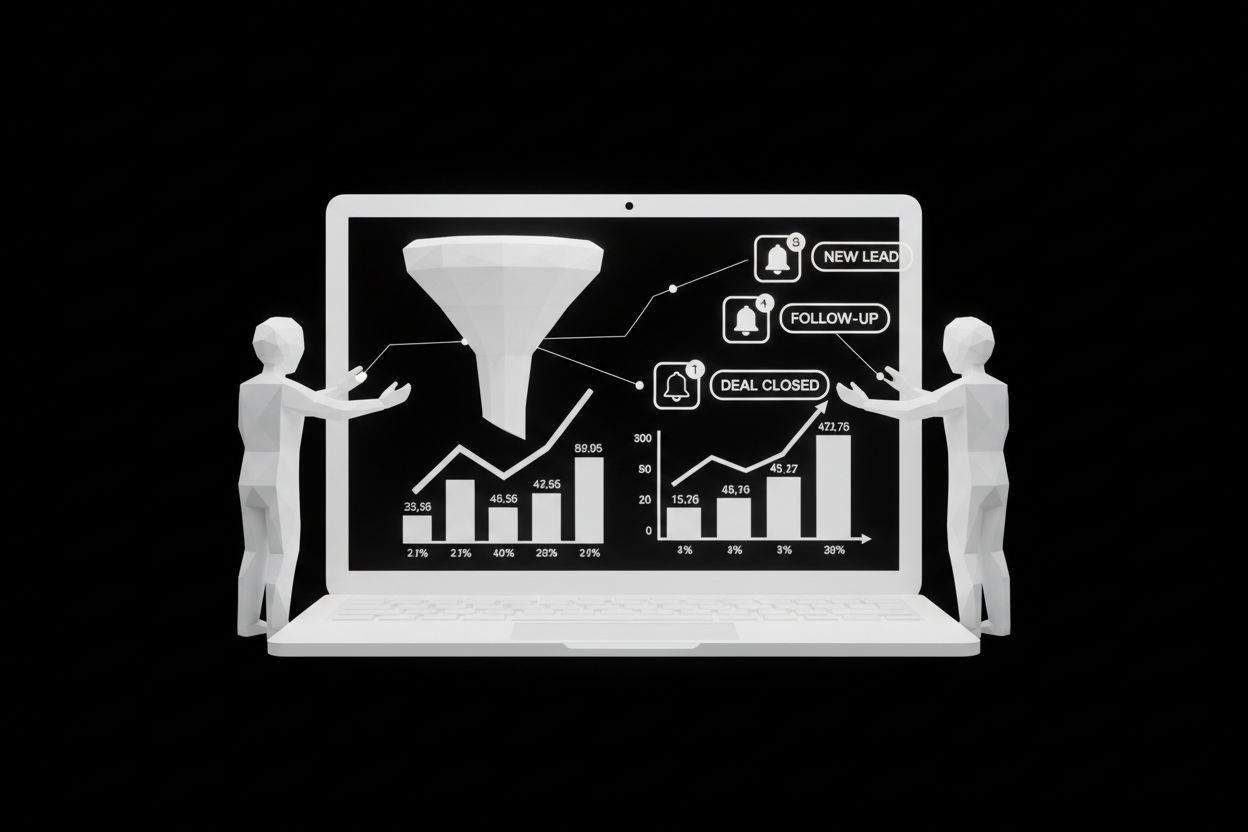
An AI sales funnel uses machine learning, natural language processing, and automation to manage lead capture, qualification, nurturing, and conversion. Unlike traditional automation that follows fixed rules, AI adds prediction and personalization. That creates faster lead qualification, higher conversion rates, and lower acquisition costs.
Key benefits for B2B teams
Improved lead quality through predictive scoring and intent signals
Faster response times using AI chat agents and sales assistants
Personalized outreach at scale across email, LinkedIn, and paid social
Smarter ad spend with AI-driven audience selection and creative testing
Clearer attribution and faster forecasting with automated revenue signals
How AI funnel automation for B2B differs from B2C
B2B funnels are longer and higher value. AI has to manage account signals, multi-stakeholder intent, and offline sales steps. That means integrating account-based data sources, CRM workflows, and human handoffs so automation supports complex decision cycles rather than trying to replace them.
Stage-by-stage breakdown: TOFU, MOFU, BOFU
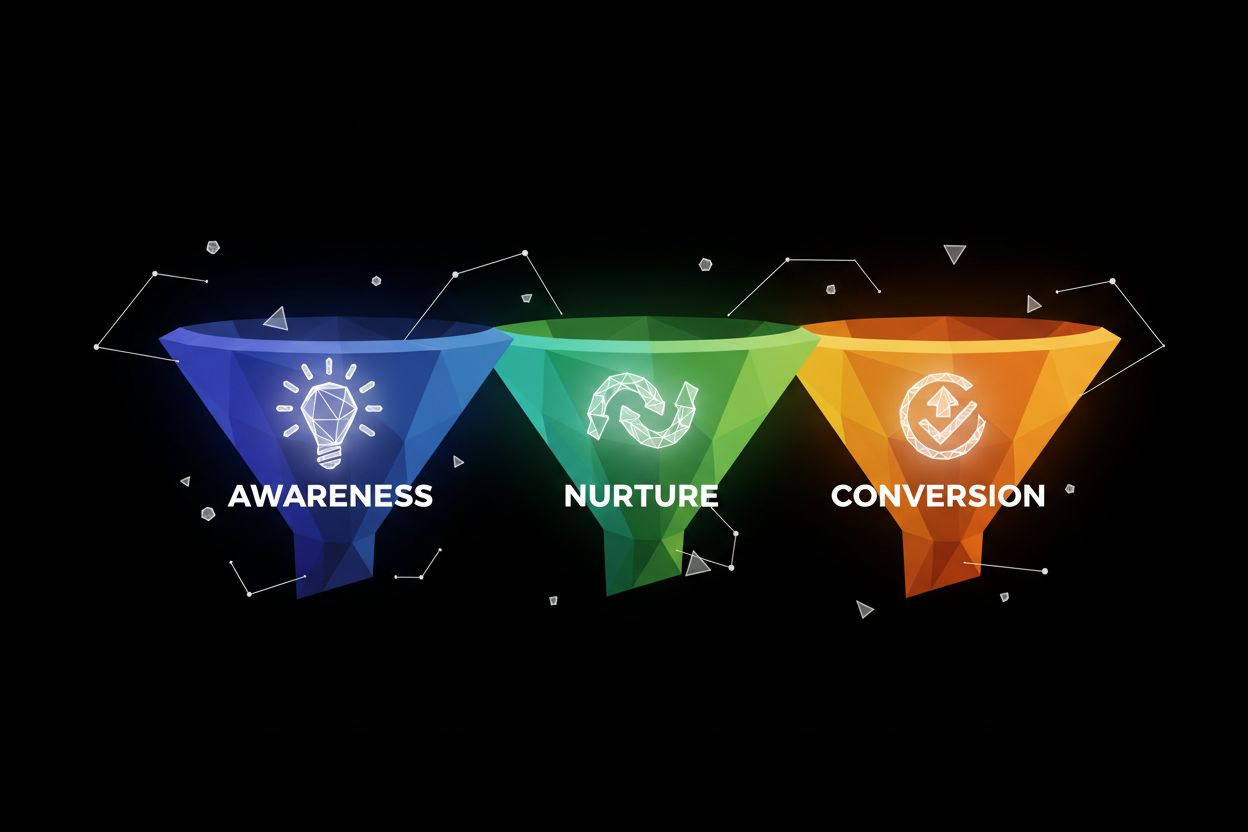
Top of Funnel - Awareness and demand gen
Use AI to scale content distribution and targeting across LinkedIn, Meta, and TikTok. AI finds lookalike audiences, predicts intent from search and social signals, and automates creative variants that match audience segments.
Capture intent with AI chat agents that qualify visitors in real time and route accounts to the right rep.
Combine intent data sources like web behavior, firmographics, and ad interactions to prioritize accounts.
Tactical actions
Deploy lead magnets with conversational forms that pull enrichment data automatically.
Run AI-driven experiments on ad creative and audience combinations. Feed results back into ad platforms for automated optimization.
Use social listening to detect early-stage intent so paid ads and content land at the right time.
Middle of Funnel - Nurture and qualification
Automate personalized email sequences that change based on AI scoring and engagement signals.
Use chat agents and conversational workflows to handle common objections and gather buying criteria.
Enrich leads with third-party data and model purchase likelihood with predictive lead scoring.
Tactical actions
Build multi-channel sequences combining email, LinkedIn messages, and SMS where legal.
Trigger handoffs when AI detects high intent so human sellers step in at the right moment.
Regularly retrain scoring models on closed-won and closed-lost data to improve precision.
Bottom of Funnel - Convert and forecast
Automate proposal generation, follow-ups, and calendar scheduling.
Use AI sales assistants that summarize prospect interactions and recommend next steps.
Feed opportunity signals back into forecasting engines to improve pipeline accuracy.
Tactical actions
Use template-driven proposal automation integrated with CRM and e-sign tools.
Enable sellers with AI briefings before calls so every conversation is informed and efficient.
Track attribution at the account level so you can measure AI funnel automation for B2B end-to-end ROI.
A practical implementation roadmap
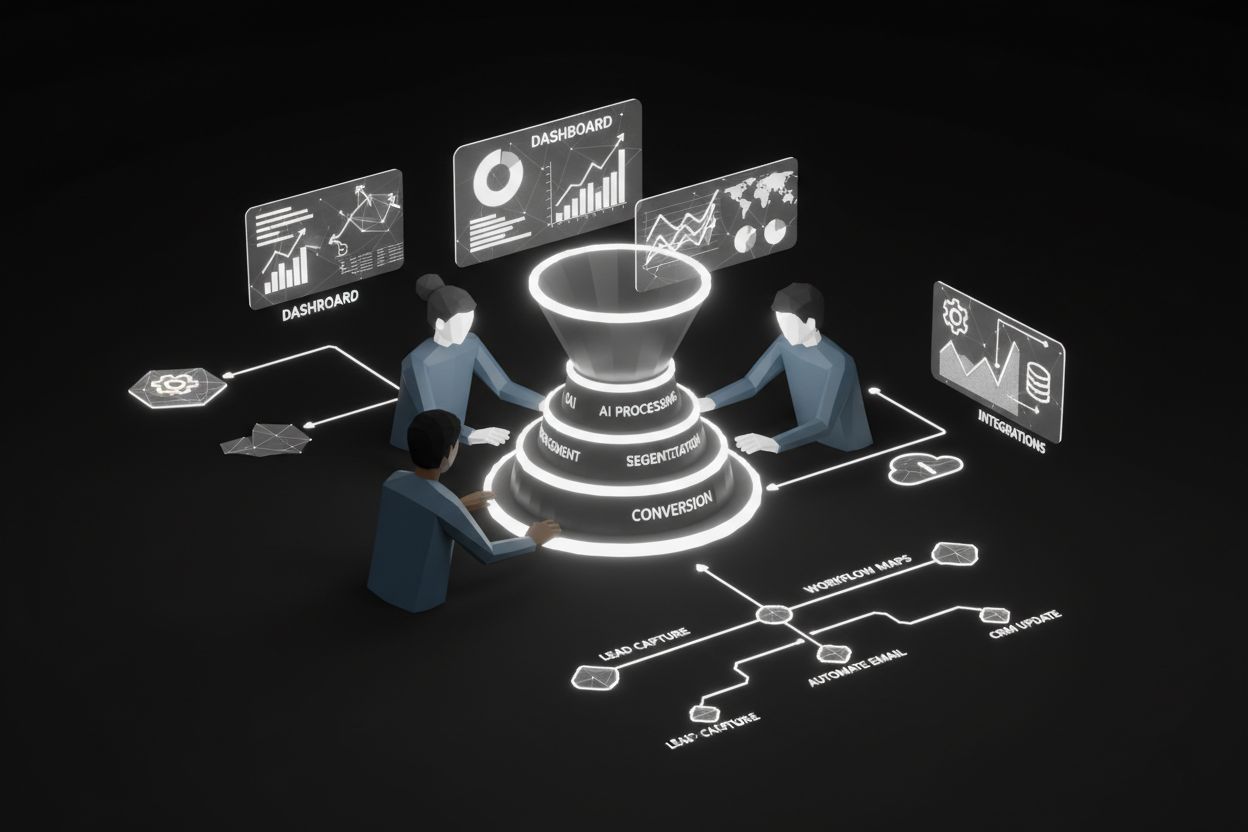
Follow this phased plan to build a reliable AI-enabled funnel without breaking current operations.
Phase 0 - Readiness and data audit (2-4 weeks)
Map current funnel, touchpoints, and conversion rates.
Audit data sources: CRM, marketing automation, ad platforms, enrichment providers.
Identify data gaps and privacy obligations like GDPR or CCPA.
Phase 1 - Quick wins and pilot (4-8 weeks)
Launch an AI chat agent for top-of-funnel qualification on key landing pages.
Run an ad experiment with AI-guided creative and audience optimization on Meta or TikTok.
Implement predictive lead scoring on a subset of accounts.
Phase 2 - Scale and integrate (8-16 weeks)
Integrate chat, email sequences, and ad signals with CRM to automate routing and handoffs.
Add dynamic personalization across email and website content using intent signals.
Implement A/B learning loops so AI models continuously improve.
Phase 3 - Measure and optimize (ongoing)
Build dashboards for conversion rates, cost per qualified lead, average deal size, and sales cycle length.
Run quarterly audits to detect model drift and bias.
Expand to multi-agent orchestration covering research, outreach, and proposal generation.
Timeline expectations vary with complexity, but a focused pilot can show results in 6 to 12 weeks while enterprise rollouts take 4 to 6 months.
Technology stack and tool selection
Choose tools by capability, integration, and compliance. Prioritize vendor neutrality and APIs.
Core components
CRM with open APIs for automation and reporting. See how CRM strategy supports automation in What Is CRM in Marketing.
Conversational AI for chat agents and outbound messaging. A dedicated solution reduces manual handoffs. Learn more about chat agent services at Automated AI Chat Agents - The Social Search.
Predictive analytics and lead scoring engines.
Marketing automation for multi-channel sequences.
Ad management with creative testing and automated bidding. For paid social, consider the capabilities in Paid Ads Management - The Social Search.
Data enrichment and intent providers for firmographics and technographics.
Tool examples you will see in practice
CRM: HubSpot, Salesforce, or monday CRM
Conversation and outreach: Drift, Intercom, Reply.io, or custom LLM agents
Revenue intelligence: Gong, Chorus, or integrated forecasting modules
Enrichment: ZoomInfo, Clearbit
Integration patterns
Event-driven orchestration: use webhooks and middleware to connect ad platforms, chat, and CRM events.
Data lake approach for advanced modeling: centralize signals for training and auditing models.
Multi-agent systems: specialized agents handle research, first outreach, and scheduling while a central conductor manages state and handoffs.
Industry-specific blueprints and KPIs
AI funnel automation for B2B works differently by vertical. Here are condensed blueprints and KPIs to track.
SaaS
Focus: free trial to paid conversion, expansion within accounts.
KPIs: trial-to-paid conversion, time-to-first-value, expansion rate.
Professional services
Focus: thought leadership distribution and meetings with senior stakeholders.
KPIs: meetings booked, proposal acceptance rate, average deal size.
Manufacturing and hardware
Focus: account intent and long lead cycles with technical evaluation.
KPIs: qualified accounts, RFQ conversion, sales cycle length.
Select the blueprint that matches your go-to-market and adapt messaging, AI scoring, and handoff rules accordingly.
Compliance, ethics, and data governance
Ignoring compliance risks your business and your funnel. Add these controls from day one.
Data governance checklist
Map personal data flows and document sources and retention policies.
Implement consent capture on all channels and store consent metadata in your CRM.
Use pseudonymization where possible for model training.
Maintain an audit trail for automated decisions that affect qualification or pricing.
Ethical AI controls
Test models for bias across firmographic segments and industries.
Use explainable AI techniques to surface why a lead scored a certain way.
Provide humans an override and escalation path when AI decisions could materially affect a sale.
Change management and team adoption
Technology alone does not deliver ROI. Plan for people and process changes explicitly.
Stakeholder playbook
Executive sponsorship: find a revenue leader to own the program.
Sales enablement: build training and playbooks so reps trust AI recommendations.
Pilot squad: create a cross-functional team with marketing ops, sales ops, and an analyst.
Feedback loops: set daily or weekly syncs during pilot to iterate fast.
Adoption tactics
Start with augmentation not replacement so sellers see AI as helpful.
Share early wins with metrics like time saved and higher quality meetings.
Provide contextual micro-trainings and bite-sized documentation.
Why AI projects fail and how to avoid common traps
Common failure reasons
Poor data quality and missing identifiers
No clear ownership for AI decisions
Trying to automate complex judgment calls without human oversight
Lack of continuous measurement and model maintenance
How to mitigate
Run a data readiness sprint before model work.
Define ownership and SLAs for automated actions.
Limit automation scope and expand as confidence grows.
Schedule quarterly model audits and a plan for retraining.
Measuring ROI and a simple ROI framework
Key metrics to track
Cost per qualified lead (CPL)
Conversion rate by funnel stage
Average deal size and time to close
Revenue influenced and closed-won attributed to AI-assisted channels
Time saved per rep and resulting capacity for new deals
Simple ROI calculation example
Baseline monthly qualified leads: 200
CPL before AI: $200
CPL after AI: $140
Monthly qualified leads after AI: 260
Incremental value
Monthly spend on lead gen: 200 x $200 = $40,000
Monthly spend after AI: 260 x $140 = $36,400
Direct savings plus extra leads create predictable uplift. Combine this with higher conversion rates and reduced sales cycle to estimate revenue impact.
For a precise forecast, include implementation cost, training, subscription fees, and expected model maintenance in a TCO table.
Post-implementation optimization: 90-day, 6-month, 12-month playbooks
90 days
Stabilize data flows, fix integration errors, and resolve false positives.
Validate lead scoring against closed deals.
6 months
Expand AI automation to additional channels and account tiers.
Start A/B testing advanced personalization and messaging variants.
12 months
Build second-generation models that incorporate new signals and competitor intelligence.
Institutionalize model governance and continuous improvement cycles.
Competitive intelligence and attribution
Use AI to surface competitor signals from job postings, product updates, and content behavior. Feed these signals to account scoring so you prioritize accounts showing movement.
Attribution best practices
Use account-level multi-touch attribution to capture long B2B buying cycles.
Combine deterministic signals from CRM and probabilistic signals from model outputs.
Maintain a revenue waterfall that ties AI-driven activities to closed revenue.
Real-world playbooks and integrations
Automated lead generation: combine intent data, conversational capture, and enrichment to power a steady pipeline. See practical approaches in our Automated Lead Generation - The Social Search service description.
Social ad automation: coordinate creative testing and audience optimization with your ad platform and feed winners into retargeting lists. For social automation capabilities, review Automated Social Media - The Social Search.
Chat agents: deploy AI chat to qualify and book meetings, then sync with CRM to assign to reps. Explore chat agent implementation at Automated AI Chat Agents - The Social Search.
Next steps and operational checklist
Run a 2-week data readiness audit.
Pick one funnel bottleneck to pilot an AI solution: ad optimization, chat qualification, or predictive scoring.
Establish KPIs and reporting cadence before launch.
Plan training sessions and assign ownership for model monitoring.
If you want hands-on support, our paid ad and automation teams can help design experiments and scale successful pilots. Learn about our ad and automation services in Paid Ads Management - The Social Search.
FAQ
How soon will AI funnel automation for B2B show results?
Expect measurable improvements in 6 to 12 weeks for focused pilots. Full platform rollouts typically take 3 to 6 months.
Will AI replace B2B sellers?
No. AI should augment sellers by handling routine tasks and enriching conversations so sellers can focus on complex negotiations and closing.
What data do I need to start?
At minimum you need CRM records with lead and account identifiers, web behavior or ad interactions, and at least one enrichment source for firmographics.
How do I ensure compliance?
Track consent, document data flows, pseudonymize training sets, and include humans in decisions that affect pricing or eligibility.
Where can I learn more about CRM and automation?
A good place to start is the CRM strategy guide at What Is CRM in Marketing.
Final thought
AI funnel automation for B2B unlocks scale when it solves specific friction points and is paired with governance and adoption plans. Start small, measure clearly, and iterate. With the right data, tooling, and change management, you can convert intent into reliable revenue and give your team time back to focus on the deals that matter most.