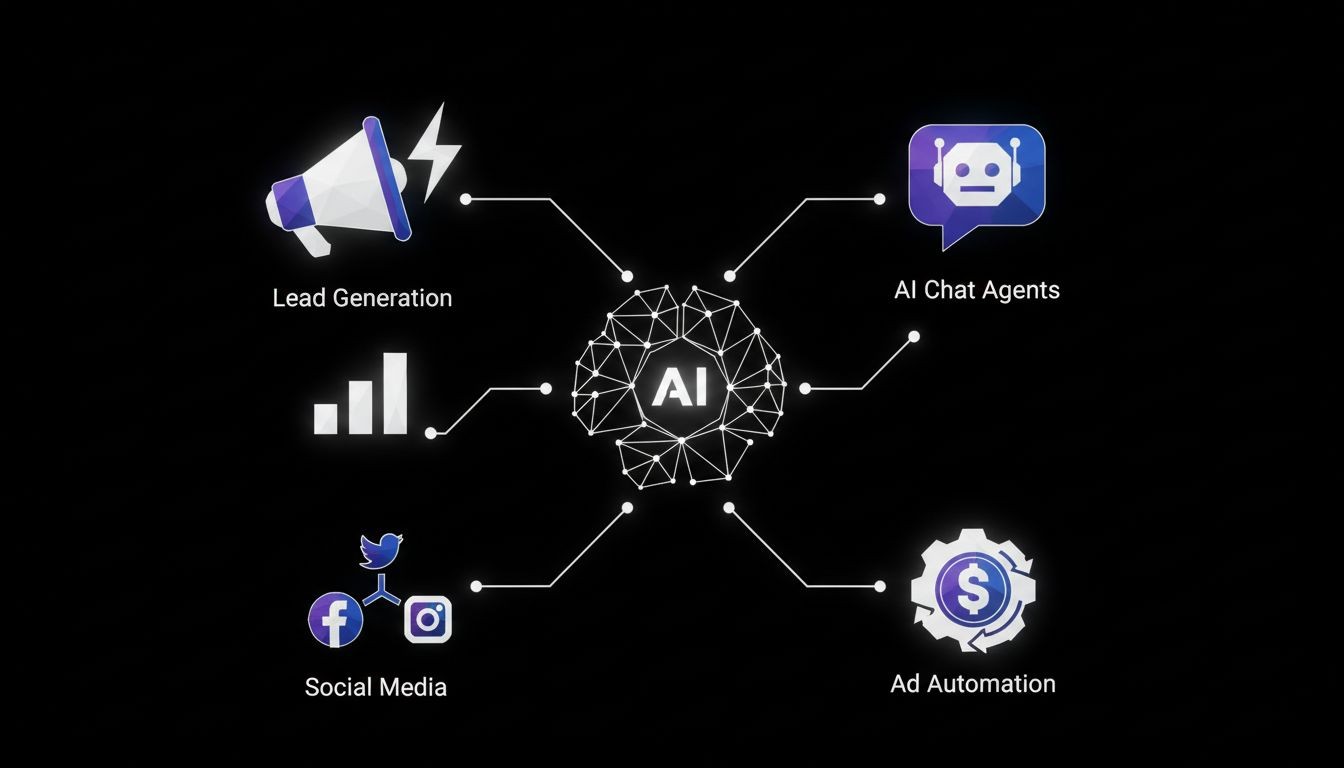
AI CRM Automation Services: A Practical Guide to Lead Generation, AI Chat Agents, Social Media, and Ad Automation
Discover AI CRM automation services that boost lead generation, power AI chat agents, and optimize social and Meta/TikTok ads. Practical setup, ROI metrics, and vendor checklist.
Manual data entry, missed follow ups, and fragmented channels cost revenue and create friction for teams. AI CRM automation services turn CRM systems into proactive sales and marketing engines that capture leads, score prospects, run AI chat agents, and optimize ads across Meta and TikTok. This guide explains what to expect, how to implement, and how to measure success so you can move from manual work to predictable growth.
What is AI CRM, and how does it change the game?
AI CRM combines customer relationship management software with artificial intelligence to automate repetitive tasks, predict outcomes, and personalize engagement at scale. Instead of a passive database, AI CRM becomes an active system that recommends next steps, assigns leads, generates outreach messages, and surfaces churn risks.
Key technologies inside AI CRM include machine learning models for prediction, natural language processing for conversation and email generation, robotic process automation for workflow execution, and integrations through APIs to sync data across systems. Together these components reduce manual friction, free up seller time, and improve customer experience.
What this means in practice:
Your CRM automatically scores incoming leads from forms, ads, and chat, routing high-fit prospects to reps within minutes.
Conversational AI handles frequent questions on your website or social channels, handing off complex issues to humans with context.
Automated sequences nurture leads on email, SMS, and social DMs, with content dynamically personalized by AI.
Predictive models forecast revenue and identify accounts likely to churn, allowing proactive outreach.
This guide focuses on real implementation steps, industry use cases, and ROI metrics, not only platform feature lists. You will find actionable automation recipes, a migration checklist, and a vendor selection framework.
Benefits of AI CRM automation services
AI CRM automation services deliver measurable business outcomes that go beyond novelty. Here are the core benefits and how they translate into revenue and efficiency.
Faster lead response, higher conversion. Studies show response time and personalization increase conversion rates. AI chat agents plus automated routing reduce time to contact from hours to seconds.
Better lead qualification. Automated lead scoring and enrichment save reps time by focusing effort on high-intent prospects. Pair this with Automated Lead Generation to feed your pipeline continuously.
Scalable 24/7 support. AI chat agents manage common queries on websites and social platforms, reducing support tickets and capturing leads outside business hours.
Smarter ad spend. AI can test creative variants, allocate budget to high-performing audiences, and feed CRM outcomes back into ad optimization across Meta and TikTok.
Improved customer retention. Predictive analytics surface accounts that need attention, enabling targeted renewal and upsell campaigns.
Reduced manual work. Automations handle data entry, meeting scheduling, follow ups, and post-sale onboarding tasks.
Real teams report 20 to 50 percent efficiency improvements within months after implementing core automations, depending on scope and readiness.
Must-have features for AI CRM automation services
When evaluating options, look for features that support lead generation, AI chat agents, social integration, and ad optimization.
Intelligent lead capture and enrichment, with connectors for web forms, landing pages, social DMs, and ad platforms.
Lead scoring and predictive intent models that update in real time.
Native AI chat agents with handoff workflows, conversation summaries, and built-in compliance controls. See our Automated AI Chat Agents service for implementation examples.
Multi-channel automation across email, SMS, social, and phone, with unified contact timelines.
No-code automation builder to create sequences, triggers, and conditional logic without engineering.
Open APIs and webhooks for integrations with marketing tools, BI platforms, and ad platforms.
Experimentation and A B testing tools for messaging and ad creative.
Security and audit logs to track model changes, access, and data usage.
Use cases by feature:
Email generation: AI drafts personalized follow ups based on contact history, saving reps 30 to 60 minutes per day.
Conversation intelligence: Calls and chats are transcribed, summarized, and converted into tasks.
Ad optimization: CRM conversions feed back to ad platforms, enabling automated audience expansion and creative testing.
How AI CRM works with social media and ads
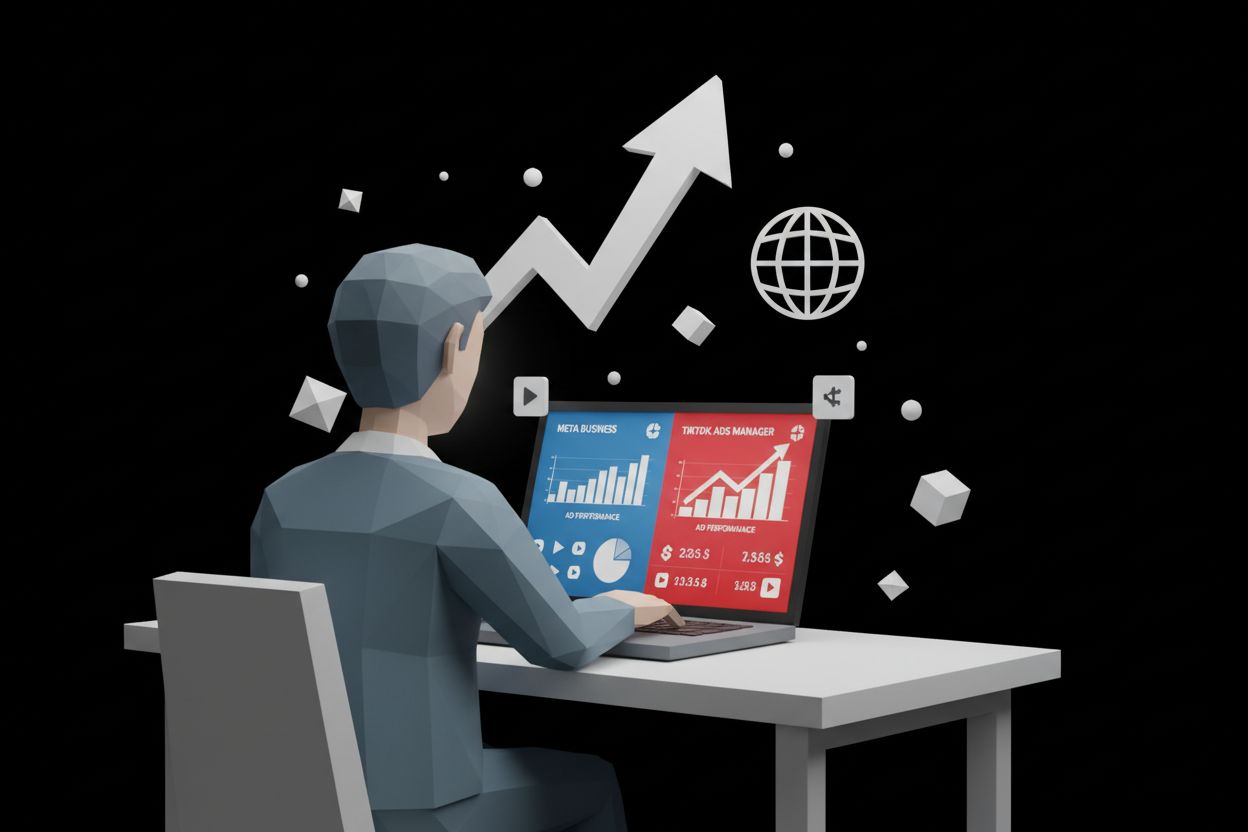
AI CRM automation services are most powerful when they coordinate across channels. A typical flow for social and ads looks like this:
Prospect sees an ad on Meta or TikTok, clicks, and fills a lead form, or messages via Instagram or TikTok DM.
The platform captures the lead, enriches it with third party data, and assigns a dynamic lead score.
An AI chat agent on the landing page sends a qualifying message and schedules a demo if the lead meets thresholds.
The CRM triggers a follow up email and an SMS sequence personalized by AI, while the ad platform adjusts bidding based on CRM-verified conversions.
Best practices for Meta and TikTok campaigns:
Track on-domain conversions to avoid attribution loss from privacy changes.
Use CRM-verified conversion events to train lookalike audiences.
Automate creative testing, letting AI allocate budget to winners.
Capture consent and messaging preferences at first contact, and store them in the CRM for compliant outreach.
For teams running ads, integrating your paid ads management workflow with CRM automation increases ad efficiency and lowers cost per acquisition. Learn how this pairs with Paid Ads Management services to close the loop between marketing spend and revenue.
Implementation checklist and migration strategy

Switching to AI CRM automation services requires planning to avoid disruption. Use this checklist to reduce risk and speed time to value.
Map your current lead sources and data flows. Inventory forms, ad platforms, social channels, and existing CRMs.
Define success metrics before you start, such as lead response time, conversion rate, pipeline velocity, and CPA.
Choose integrations and API requirements. Confirm the vendor offers robust webhooks, bulk import, and custom field mapping.
Clean and deduplicate data before migration to improve model training.
Start with a pilot for one use case, for example lead capture + chat + routing, measure outcomes, then scale.
Train models on your own historical data if possible, to increase relevance and reduce false positives.
Create a change management plan, including training, scripts, and a feedback loop with reps.
Implement governance rules for data retention, access, and model behavior.
Automate monitoring and set alert thresholds for drops in AI accuracy or sudden data skews.
Consider the build versus buy decision. If you need tight control, industry specific models, or proprietary IP, building may make sense. For faster time to value and lower upfront costs, buy a vendor that supports customization, open APIs, and model retraining on your data.
For tactics and examples on aligning marketing automation with lead capture, refer to our guide on Lead Generation and Marketing Automation.
Measuring ROI, accuracy, and performance
Tracking the right metrics separates hype from impact. Focus on both business metrics and AI performance metrics.
Business metrics to track:
Converted leads per channel, cost per lead, and cost per acquisition.
Lead response time and contact rate within first 24 hours.
Pipeline velocity and average deal size for AI-sourced leads.
Customer churn rate and expansion revenue influenced by AI interventions.
AI performance metrics:
Precision and recall for lead scoring models, to understand false positives and false negatives.
Accuracy of intent and sentiment classification for chat and email responses.
Model drift indicators such as drops in precision or sudden distribution changes.
Uptime and latency for chat agents and automation triggers.
Set up dashboards that combine CRM revenue metrics with model-level diagnostics. Use cohort analysis to compare human-only workflows versus hybrid human-AI sequences.
Security, compliance, and governance
AI CRM automation services touch sensitive customer data, so prioritize security and compliance.
Confirm vendor compliance with standards such as GDPR, SOC 2, and local data protection laws. Document data flows and processing agreements.
Use role based access controls and encryption at rest and in transit.
Log model inputs and outputs for high risk automations, to support audits and explainability.
Implement consent capture and preference management, especially for marketing channels.
Test AI agents for biased or risky language before deploying them to customers.
Careful governance preserves trust while enabling aggressive automation.
AI CRM maturity model, a practical roadmap
Adopting AI CRM works best when treated as a progression. Use these stages to plan investments and expectations.
Foundational: Automated data capture, basic lead assignment, rule based workflows.
Operational: Lead scoring, email templates generated by AI, chat agents for FAQs.
Predictive: Forecasting, intent models, multi touch attribution feeding ad optimization.
Autonomous: Agentic workflows that execute multi step tasks, automated renewal campaigns, dynamic pricing suggestions.
Most organizations move from foundational to operational within 3 to 6 months, and reach predictive after 9 to 18 months depending on data maturity.
Automation recipes you can deploy this month
These are practical automations to get immediate impact.
Instant lead responder: Trigger an AI chat or email within 60 seconds of form submission, include dynamic content based on visit behavior.
High intent routing: If lead score exceeds threshold and company size matches ICP, auto assign to senior rep and schedule a demo slot.
Social DM capture: Auto ingest Instagram and TikTok DMs, qualify with a short AI sequence, then push hot leads to CRM.
Ad creative loop: Use AI to generate 3 headline variants and 2 image captions, run a short experiment for 48 hours, then auto scale winners in ad platform.
Post-sale onboarding: Trigger a tailored onboarding email series and in-app checklist based on purchase tier, with AI-generated tips.
If you want tailored playbooks for your industry, review industry-specific automation options or contact our team for a custom plan.
Choosing the right vendor and pricing considerations
Evaluate vendors on these dimensions:
Integration maturity: Does the vendor connect seamlessly to your ad platforms, website, and data warehouse?
Customization and retraining: Can you train models on your data, and how often?
No-code builders: Can non-technical teams maintain automations?
Security and compliance posture.
Pricing model: Per seat, per contact, or consumption based. Estimate total cost including ad spend, data storage, and implementation services.
Compare vendors against platform strengths such as Salesforce Einstein, HubSpot AI, Zoho Zia, and niche providers. The right choice depends on company size, technical maturity, and vertical needs.
Frequently asked questions
Q: How long until I see results from AI CRM automation services?
A: You can see lead response improvements immediately with chat agents and routing, typically within days. Predictive models and measurable revenue impact often require 2 to 3 months of data.
Q: Will AI replace my sales and support teams?
A: No. AI handles repetitive tasks and early qualification, while humans focus on complex conversations and closing. This creates capacity and higher-value work.
Q: What data do I need to train AI models?
A: Start with historical CRM records, call transcripts, email threads, and conversion events. Clean, labeled data accelerates model effectiveness.
Q: Can I use AI CRM for Meta and TikTok ads?
A: Yes. Most modern AI CRM services integrate with ad platforms to feed conversion data back for optimization and automate creative testing.
Q: How do I measure AI accuracy for lead scoring?
A: Track precision and recall against closed deals as ground truth, and monitor drift with regular retraining schedules.
Q: Do I need an enterprise budget to get started?
A: No. Many providers offer tiered plans that let small teams start with chat agents and basic automation, then scale over time.
Conclusion and next steps
AI CRM automation services change how teams capture, qualify, and convert leads, while improving retention and ad efficiency. Start with a focused pilot for lead capture, chat, and routing, measure clear KPIs, then expand to ad optimization and predictive scoring. If you want help mapping automations to your sales funnel or running a pilot that ties social ads and AI chat agents to measurable revenue, reach out through our contact page or explore related services like Automated Social Media and Automated Website Creation to close the loop between acquisition and conversion.
Ready to test a pilot and reduce manual work while increasing conversions? Book a discovery call and we will design a tailored automation plan focused on lead generation, AI chat agents, and efficient Meta/TikTok ad spend.