AI Growth Marketing Agency: A Tactical Guide to Scale Leads, Lower CAC, and Run Smarter Ads
Practical guide to hiring an AI growth marketing agency: services, tools, budgets, experiment frameworks, and measurement to scale leads and lower CAC.
Every growth plan starts with a question: can AI actually move the needle on revenue and not just on vanity metrics? If you are evaluating an AI growth marketing agency, this guide walks you through the real-world playbook most agencies should offer but rarely do. You will get stage-specific strategies, tool-level recommendations, budgets, experiment templates, and the measurement frameworks needed to prove impact.
What an AI growth marketing agency actually does

An AI growth marketing agency combines traditional growth marketing with data science and automation to accelerate acquisition, activation, retention, revenue, and referral. The difference between a vendor and a strategic partner is the ability to translate models into repeatable growth loops.
Core responsibilities you should expect:
Build AI-powered paid media strategies for Meta, TikTok, and programmatic channels
Design AI chat agents that convert site visitors and qualify leads in real time
Automate personalized social media and content at scale
Implement predictive lead scoring and propensity models for sales handoff
Run structured experimentation to reduce CAC and increase LTV
Set up data infrastructure and dashboards for real-time decision making
If a prospect says they are an “AI growth marketing agency” but cannot explain how models plug into your CRM or how experiments map to revenue, ask for a technical roadmap.
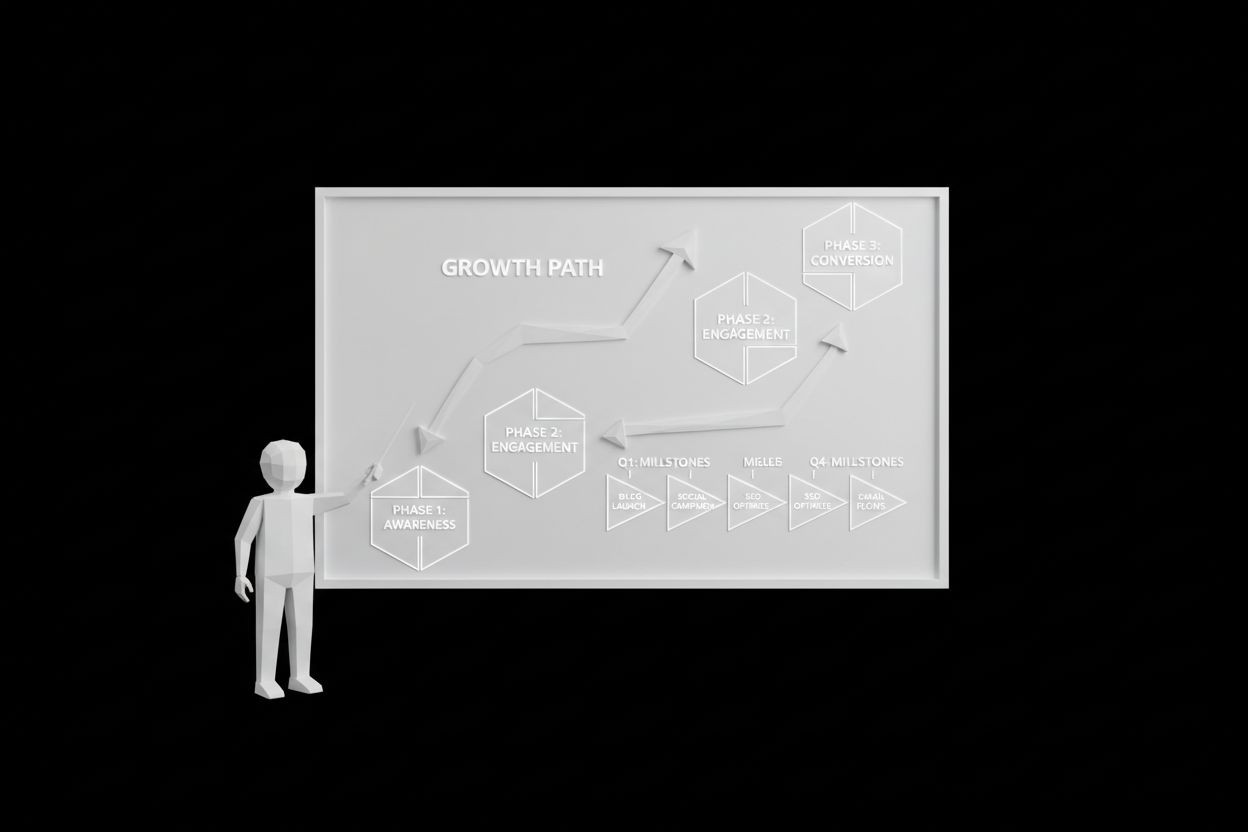
Growth marketing maturity model: what stage are you in?
A precise engagement starts with maturity. Use this simple model to choose the right scope and deliverables.
Stage 0-1 (0-1): Foundational
Needs: basic analytics, landing pages, conversion tracking
Agency focus: implement GA4, accurate attribution, simple chat agent
Typical monthly budget: $2k to $10k
Stage 1-10 (1-10): Growth engine
Needs: multi-channel acquisition, experiment velocity, lead scoring
Agency focus: programmatic ads, personalization, A/B test frameworks
Typical monthly budget: $10k to $50k
Stage 10-100 (10-100): Scale and automation
Needs: ML-driven optimization, MMM, real-time bidding and pricing
Agency focus: custom models, CDP integration, automated creatives
Typical monthly budget: $50k+
Choosing the wrong stage means slow results or wasted spend. An AI growth marketing agency should show a staged roadmap aligned to these phases and clear KPIs for each.
Services you should expect and how they drive growth
Below are tactical services with the specific outputs that move metrics.
AI-powered advertising (Meta, TikTok, programmatic)
Dynamic creative optimization using models to test headlines, CTAs, formats, and audiences continuously
Automated bid strategies that balance CAC and volume with rules and ML
Channel-level playbooks for prospecting, retargeting, and retention
Practical output: weekly creative rotations, daily audience pruning, and monthly CAC forecasts. For paid ads execution and management, look for an agency that integrates with your ad accounts and provides transparent reporting and scripts. See a typical paid ads service offering here: Paid Ads Management - The Social Search.
AI chat agents and conversational funnels
Deploy chat agents that qualify leads, book demos, and hand off to sales with a lead score
Use retrieval-augmented generation for product-specific answers and compliance-safe replies
Tactical output: scripted flows, analytics on conversion rates, and integration with CRM. If you want automated chat solutions, review this service example: Automated AI Chat Agents - The Social Search.
Automated social media and creative systems
Use AI to generate caption variants, video edits, and ad cuts optimized per platform
Schedule and A/B test posting times and formats programmatically
Tactical output: weekly content packs, engagement forecasts, and platform-specific playbooks. For automated social solutions, see: Automated Social Media - The Social Search.
Programmatic and AI SEO
Programmatic SEO for high-scale landing generation using templates and AI content that respects intent
Keyword clustering, internal linking plans, and automated content briefs generated and scored by models
Tactical output: new landing pages per theme, ranking velocity reports, and content health dashboards. See related SEO automation: Automated SEO - The Social Search.
Lead generation and pipeline automation
Predictive scoring models that reduce false positives and increase qualified leads to sales
Automated nurturing sequences based on behavior and propensity
Tactical output: conversions per channel, MQL to SQL conversion uplift, and revenue attribution. Example lead generation offering: Automated Lead Generation - The Social Search.
Tools and tech stack transparency you should demand
A good agency lists the specific tools and how they are used. Typical stack components:
Language models: ChatGPT, Claude, or specialized transformer-based APIs for content and chat
Creative tools: Midjourney or DALL-E for visuals, Synthesia or HeyGen for video
Ads automation: platform APIs, Meta Marketing API, TikTok Ads API, and DSPs for programmatic buys
Data infra: GA4, BigQuery, Snowflake, or a CDP like Segment or RudderStack
CRM and automation: HubSpot, Salesforce, or Pipedrive with webhook and API integrations
Experimentation: Optimizely or internal feature flagging and A/B testing frameworks
Ask the agency to map each tool to outcomes and to provide sample API call flows. If custom models are proposed, request a data provenance plan and a retraining schedule.
Experimentation framework: run more tests that matter
Competitors talk about A/B testing but not experimentation velocity. Use this hypothesis template to standardize tests:
Hypothesis: If we change [variable] for [audience], then [metric] will increase by [X percent] because [rationale].
Example:
Hypothesis: If we personalize homepage hero copy to reflect the visitor industry, then demo requests will increase by 18 percent because relevance reduces friction.
Test design: Randomized split by traffic source, run for two full weekly cycles, minimum sample n=3,000 per treatment.
Success criteria: Statistically significant lift at p < 0.05 and 15 percent relative lift in demo conversion.
Recommended cadence: run at least 8 medium-sized tests per quarter across acquisition and on-site conversion. Use a testing board and map each experiment to an AARRR metric.
Stage-specific budgets and tactical plans
Practical budgets and what you should expect in deliverables.
$5k/month range
Deliverables: GA4 setup, basic chat agent, 1-2 creative sets, single-channel ads optimizations
Goal: clean tracking and initial CAC baseline
$15k/month range
Deliverables: multi-channel ads, weekly creative optimization, lead scoring model, landing page experiments
Goal: double down on the best channels and reduce CAC by 15 to 30 percent
$50k+/month range
Deliverables: custom ML models, programmatic buys, CDP and BigQuery integration, MMM, cross-channel incrementality tests
Goal: scale volume sustainably while maintaining CAC and improving LTV
These ranges are directional. The agency should provide a clear resource plan that maps to KPIs.
Measurement, attribution, and proving incrementality
Measurement is where many engagements fail. Demand the following from an AI growth marketing agency:
Algorithmic multi-touch attribution that uses probabilistic models to assign credit across channels
Incrementality testing using holdout groups for paid channels
Marketing mix modeling to understand offline and seasonality effects
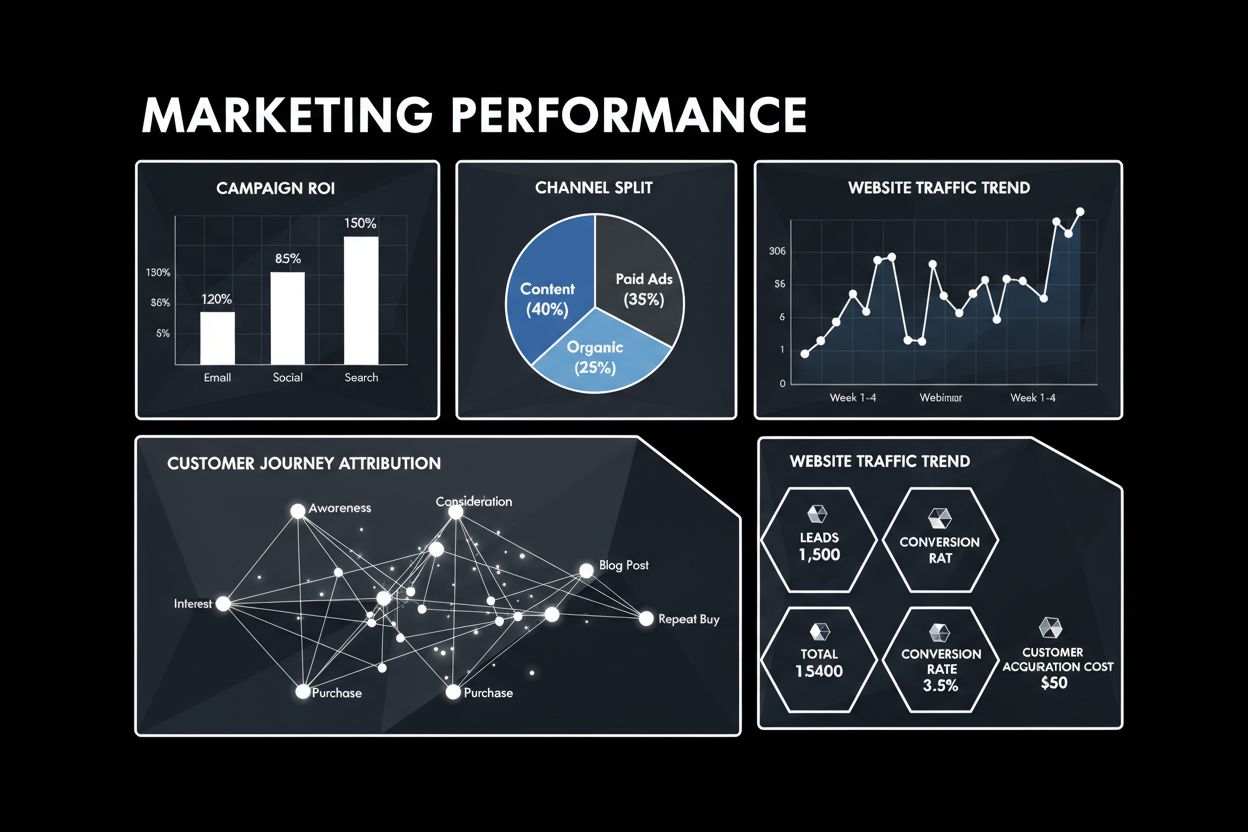
Real-time dashboards showing CAC, CAC by cohort, LTV by cohort, and return on ad spend
Set up a minimum viable dashboard with these KPIs and ask for a monthly executive summary that interprets model outputs in plain language.
Vertical playbooks: tailoring AI to your industry
AI strategies need to be vertical-aware. Here are quick playbooks for common industries.
SaaS
Tactics: product-led onboarding optimization, trial-to-paid propensity models, email sequences tuned by user behavior
KPI focus: onboarding completion, MRR churn, activation rate
E-commerce
Tactics: dynamic pricing, inventory forecasting, personalized product recommendations, abandoned cart rescue via chat agents
KPI focus: AOV, repeat purchase rate, inventory turns
B2B and Fintech
Tactics: account-based prospecting with AI-crafted outreach, compliance-safe messaging, intent scoring
KPI focus: opportunities created, deal size, sales cycle length
Make sure the agency can show previous vertical outcomes or provide a pilot that demonstrates domain competence.
Ethical AI, privacy, and compliance
AI campaigns must comply with local regulations and avoid biased outcomes. Key checks:
Data governance: clear data retention policies and consent management
Privacy: PDPA-aware workflows in Singapore and equivalent laws elsewhere
Bias audits: test ad targeting and scoring models for demographic skew and unintended exclusions
Explainability: provide rationales for model-driven decisions that affect targeting or pricing
Ask for a compliance checklist at the start of the engagement and periodic audits as models retrain.
Building a playbook for hiring an AI growth marketing agency
Use this selection checklist during procurement:
Growth methodology clarity: Do they have an experimentation roadmap and a growth maturity model?
Tech stack transparency: Can they list tools and show sample integrations?
Vertical experience: Do they have relevant case studies or a pilot offer?
Measurement rigor: Do they provide algorithmic attribution and incrementality testing?
Ethical practices: Do they have privacy and bias mitigation processes?
Commercial clarity: Are deliverables, pricing, and KPIs clearly stated?
Create an evaluation scorecard and require a short pilot that runs for 30 to 60 days with a small budget and concrete KPIs.
Example 60-day pilot scope
Week 0: Audit and tracking fixes, GA4 and CRM integration
Weeks 1-2: Launch two creative ad tests on Meta and TikTok and deploy chat agent
Weeks 3-4: Implement lead scoring and run first on-site experiment
Weeks 5-8: Scale winning variants, run incrementality holdouts, and deliver a performance and insights report
Deliverable: a prioritized 90-day roadmap with expected revenue lift and next-step budgets.
Internal resources and links for next steps
If you want to learn more about the channels and automation tools mentioned, these resources are helpful:
For ad execution and campaign management best practices see Paid Ads Management - The Social Search
To explore automated AI chat solutions that drive conversion see Automated AI Chat Agents - The Social Search
For social media automation and scaling content see Automated Social Media - The Social Search
For programmatic SEO and scaling content production see Automated SEO - The Social Search
For lead generation automation and pipeline optimization see Automated Lead Generation - The Social Search
Final checklist before you sign
Do they tie experiments to revenue and not just to clicks?
Can they show sample API flows and data diagrams?
Do they commit to incremental testing and holdouts?
Is privacy and bias mitigation documented?
Can they start with a low-risk pilot and scale with predictable milestones?
A strong AI growth marketing agency combines a growth playbook, engineering discipline, compliance awareness, and creative systems. When these components are in place you get not only smarter campaigns but repeatable growth loops that scale.
If you want a practical next step, set a 60-minute briefing that covers your current tracking, top three growth priorities, and a quick data sample. An effective agency will return a prioritized 30-60-90 plan and the exact experiments they would run in your first 60 days.