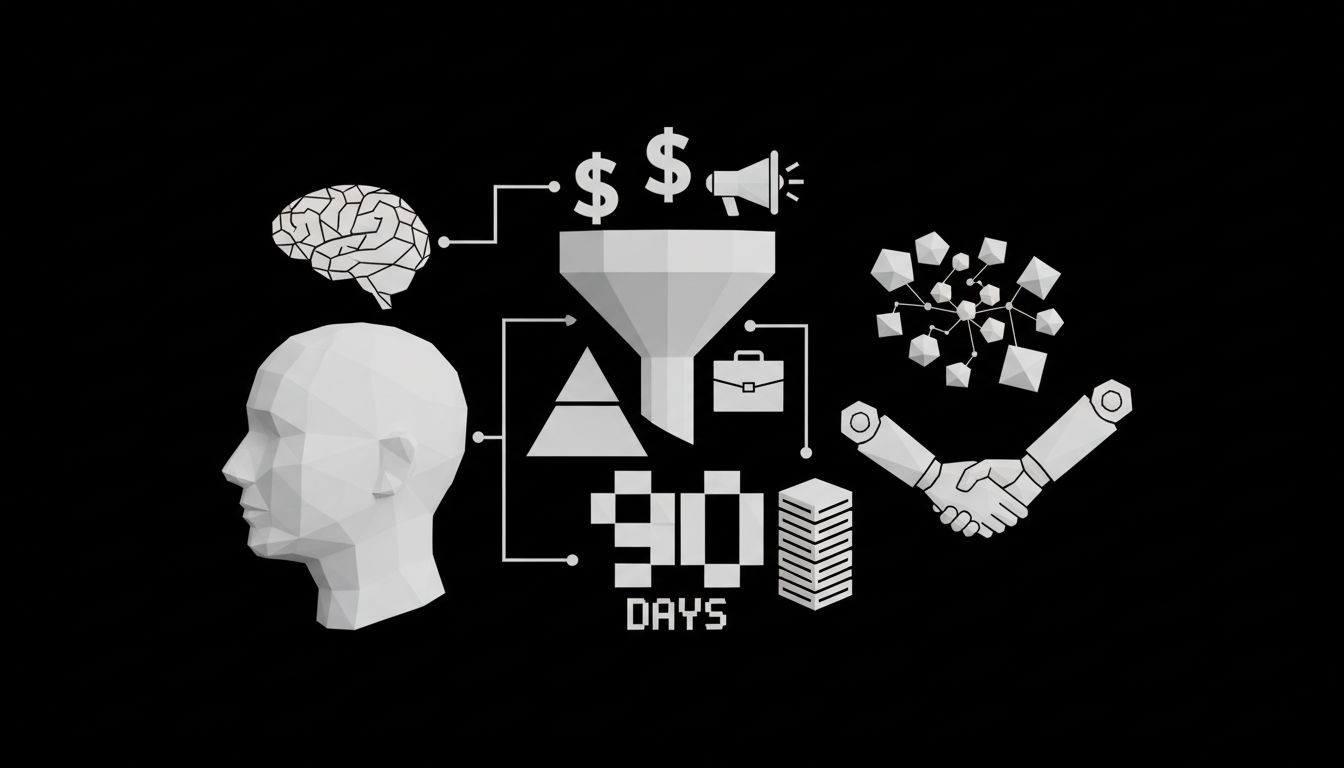
AI Automation for Sales and Marketing: A Practical 90-Day Guide to Leads, Ads, and Human-AI Collaboration
Complete, practical guide to AI automation for sales and marketing: 90-day rollout, KPIs, tool selection, industry playbooks, troubleshooting, and ROI strategies.
Manual lead qualification, messy data, and slow campaign cycles are common reasons revenue teams fall behind. AI automation for sales and marketing changes that by turning signals into prioritized actions, repetitive tasks into scalable workflows, and customer touchpoints into personalized experiences. This guide walks through what to automate first, a concrete 30/60/90-day rollout, measurement templates, common failure modes, and industry playbooks you can apply now.
What is AI automation for sales and marketing and why it matters
AI automation for sales and marketing means using machine learning, natural language processing, and rules-based automations together to handle tasks that used to require manual effort. These tools do things like score leads based on intent signals, personalize ad creative at scale, route chats to the right rep, and predict churn. When implemented well, AI automation increases qualified leads, shortens sales cycles, and improves campaign ROI.

Benefits you will see quickly
Faster lead response times and higher conversion rates
More relevant ads and social creative with dynamic personalization
Sales focus on high-value conversations instead of data entry
Predictable funnel metrics and clearer attribution
This guide assumes you want a practical path from pilot to production. It focuses on lead generation, AI chat agents, social and paid ads orchestration, and aligning sales and marketing operations to measurable revenue outcomes.
Core capabilities to prioritize
Before you pick tools, map the capabilities that matter for lead generation and revenue growth.
Intent detection and lead scoring
Collect behavioral signals from website visits, ad clicks, email opens, and content consumption
Use models that combine firmographic and behavioral data for account prioritization
Multi-channel orchestration
Automate sequences across email, chat, social, and ads
Trigger actions based on behavior, not fixed time
Personalization at scale
Dynamically swap ad creative, landing page copy, and email content based on segment or intent
Automated conversations and routing
AI chat agents that qualify and hand off to sales when a lead meets intent thresholds
Conversation transcripts stored in CRM for context
Measurement and attribution
Capture events and tie them to revenue outcomes
Compare before and after cohorts for lift analysis
Tools and where they fit
For automated lead generation and list enrichment, consider platforms that integrate intent data and CRM syncing. See our service page for automated lead generation for examples and workflows: Automated Lead Generation - The Social Search.
For social creative automation and scheduling, use solutions that support dynamic content and A/B testing across channels. Our automated social media service explains typical setups: Automated Social Media - The Social Search.
For AI chat agents that qualify leads and route conversations, look for systems that log interactions to CRM and support human takeover. See our chat agent offering here: Automated AI Chat Agents - The Social Search.
For paid advertising orchestration with audience and creative automation use-case, integrate with paid ads management capabilities: Paid Ads Management - The Social Search.
If your CRM strategy needs alignment to automation, review guidance on how CRM supports marketing automation and AI-driven workflows: What Is CRM in Marketing: A Complete Guide to Strategy, Automation, AI, and Growth - The Social Search.
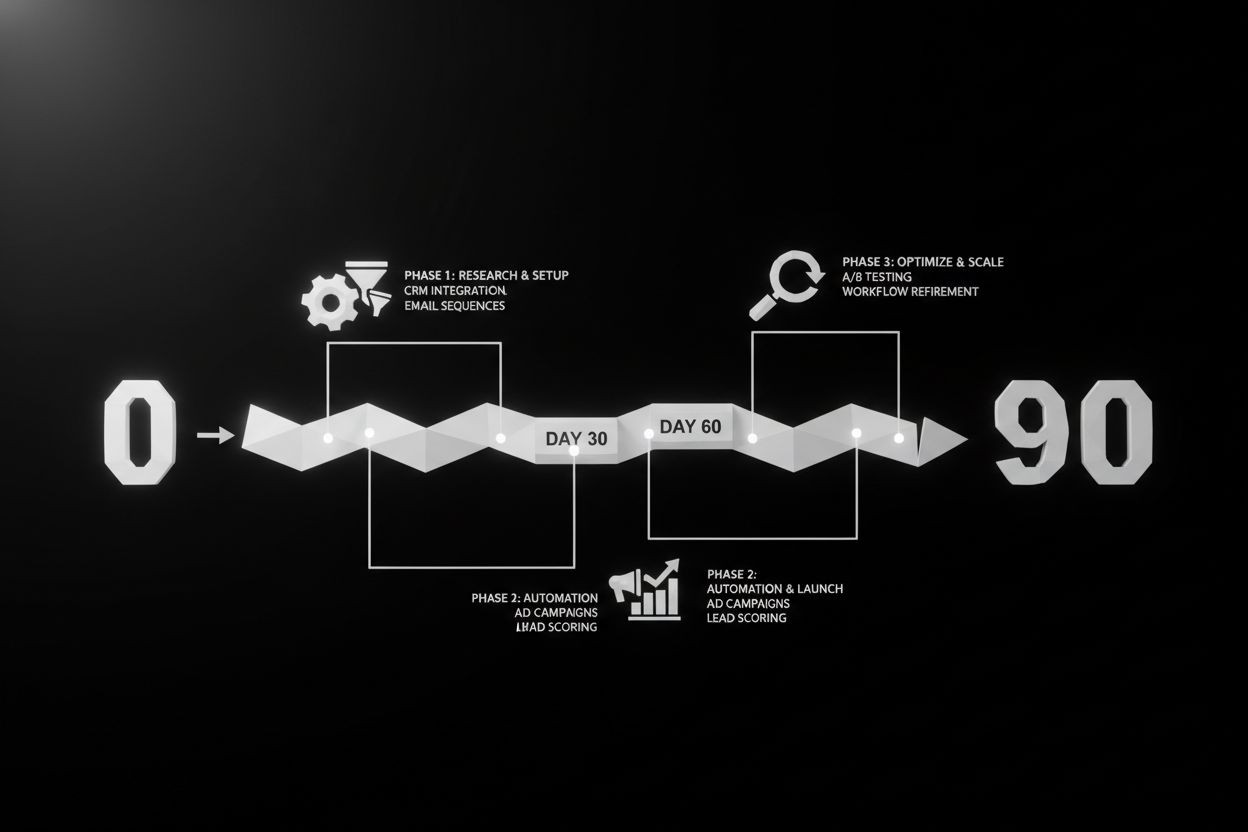
A 90-day implementation roadmap you can follow
This is a practical, week-by-week plan for a mid-market B2B or B2C company. Adjust scope by team size and budget.
Days 0 to 14 - Discovery and quick wins
Assemble a cross-functional core team with an executive sponsor, marketing ops, a sales rep, and an engineer or integration partner
Audit current data sources, CRM fields, and tracking coverage
Identify one high-value workflow to automate first, such as inbound lead routing or a Facebook lead ad to CRM flow
Set up tracking and a temporary dashboard for lead response time and conversion rate
Days 15 to 45 - Pilot and measurement
Build a minimum viable automation: lead scoring that combines form data and behavior plus an automated email sequence
Configure an AI chat agent on your highest-traffic landing page to capture and qualify leads
Run a 2-week pilot and compare conversion metrics to the prior period
Define success criteria: conversion lift of X percent, reduction of lead response time to under Y minutes, or similar
Days 46 to 90 - Scale and iterate
Expand automation to paid channels: dynamic creative for Meta or TikTok ads with automated audience exclusion and budget reallocation based on performance
Add routing rules that push qualified leads directly to sales queues and create SLA alerts for missed follow-ups
Implement attribution tagging and a cohort analysis to measure campaign-level ROI
Formalize handover processes and train teams on interpreting AI signals
Templates to adopt
30/60/90 checklist (downloadable): inventory, pilot metrics, scaling tasks
Lead scoring matrix: fields, points, and threshold to mark Marketing Qualified Lead and Sales Accepted Lead
SLA dashboard: average response time, percent of leads followed up within SLA, conversion by source
Industry-specific playbooks
Automation is not one-size-fits-all. Below are concise playbooks you can adapt.
SaaS
Priority workflows: trial-to-paid conversion, product-qualified lead scoring, onboarding message sequencing
Signals: product usage events, feature adoption, freemium to premium conversion attempts
KPI benchmarks: trial-to-paid conversion 2 to 5 percent for self-serve plans, demo-to-close conversion 20 to 40 percent for qualified leads
Manufacturing and B2B industrial
Priority workflows: account-based prospecting, multi-stakeholder nurturing, post-inquiry technical content delivery
Signals: repeated visits to spec sheets, CAD downloads, distributor lookup pages
KPI benchmarks: MQL to SQL conversion 10 to 25 percent depending on product complexity
Professional services
Priority workflows: proposal follow-up automation, case study personalization, referral request sequences
Signals: RFP download, pricing page views, contact form details indicating budget or timeline
KPI benchmarks: proposal acceptance rates and pipeline velocity improvements after automation
These playbooks should link to your lead sources and sales process. Use the CRM to map data fields that feed scoring and routing rules. For more high-level marketing automation frameworks consider reviewing the comprehensive lead generation guide: Lead Generation and Marketing Automation Guide for 2026 Success - The Social Search.
Measurement framework - what to track and how to compare
Good measurement separates hype from real impact. Use this framework to get objective answers.
Baseline collection
Capture last 90 days of conversion rates by channel, average deal size, average sales cycle length, and cost per acquisition
Define primary metric
Choose one outcome metric tied to revenue. Examples: MQL-to-customer conversion rate, pipeline velocity, or cost per qualified lead
Secondary metrics
Lead response time, demo show rate, content engagement, churn prediction accuracy
Attribution and cohort tests
Run A/B tests or holdout cohorts to compare automation on versus automation off
Attribute revenue to experiments using time-windowed revenue matching
Reporting cadence
Daily alerts for SLA breaches, weekly dashboards for conversion movements, monthly deep dives for attribution
Sample KPI targets after automation (benchmarks, adjust by industry)
Response time under 15 minutes for inbound leads
20 to 40 percent increase in qualified lead rate for targeted audiences
10 to 25 percent improvement in conversion for dynamically personalized ads
Downloadable templates and comparisons help with stakeholder buy-in. Create before-after snapshots for three KPIs to show impact within 60 days.
Common pitfalls and troubleshooting
Automation can backfire when teams skip planning or ignore data quality. Here are the most common failure scenarios and how to fix them.
Problem: AI scores seem wrong
Cause: insufficient or biased training data, or mis-specified features
Fix: backfill high-quality labeled examples, retrain models with updated features, and add human review for edge cases
Problem: Automated sequences drive churn or spam complaints
Cause: poor personalization or frequency control
Fix: add suppression lists, set cadence caps, and personalize content using recent behavior
Problem: Sales team ignores AI recommendations
Cause: lack of trust or unclear handoff rules
Fix: co-design decision rules with sales, provide transparency on why leads are scored, and start with recommendations rather than hard routing
Problem: Data gaps and integration lag
Cause: missing events, slow CRM syncing, or mismatched identifiers
Fix: enforce consistent tracking IDs, use webhooks for real time sync, and create reconciliation jobs to catch missed events
When not to automate
Do not automate high-sensitivity negotiations or situations that require bespoke relationship building
Avoid automating decisions with legal or compliance implications without human oversight
Human-AI collaboration and change management
People make automation work. Invest in training and set clear escalation paths.
Role definitions: who owns model thresholds, who handles escalations, who audits outcomes
Training: run role-playing sessions for sales using AI prompts and AI-provided conversation starters
Trust building: show examples where the AI helped win deals and where humans corrected the AI
Governance: schedule quarterly audits of scoring models and campaign performance
Practical rule: start with AI as a recommender. Move to automated routing only after a 60-day pilot and demonstrated uplift.
Compliance, privacy, and bias considerations
Automation touches personal data. Make privacy and fairness part of your rollout checklist.
Consent tracking: ensure opt-in signals for marketing and log consent dates to support targeting
Data minimization: store only fields required for scoring and attribution
Bias audits: sample scored leads across segments and verify that protected characteristics are not driving outcomes
Documentation: keep model cards describing inputs, outputs, and known limitations
If you operate in GDPR or CCPA jurisdictions, include legal early in the project to align on data retention and subject access requests. For consented messaging, keep an audit trail and easy unsubscribe paths.
Advanced strategies and future trends
Once basic automations deliver consistent results you can move into higher-return, higher-complexity tactics.
Cross-sell and expansion automation
Use product usage signals to trigger tailored expansion campaigns and personalized offers
Churn prediction and retention orchestration
Combine product telemetry with NPS and support tickets to automatically route at-risk accounts to customer success
Creative automation for Meta and TikTok
Generate multiple creative variants and let automated bidding test them in parallel. Use creative performance signals to iteratively train ad models
Multi-product funnel automation
Coordinate messaging to avoid internal channel competition and to surface the right solution to the right buyer at each stage
Model ensembles and hybrid approaches
Combine rules-based heuristics with ML for interpretability and safety
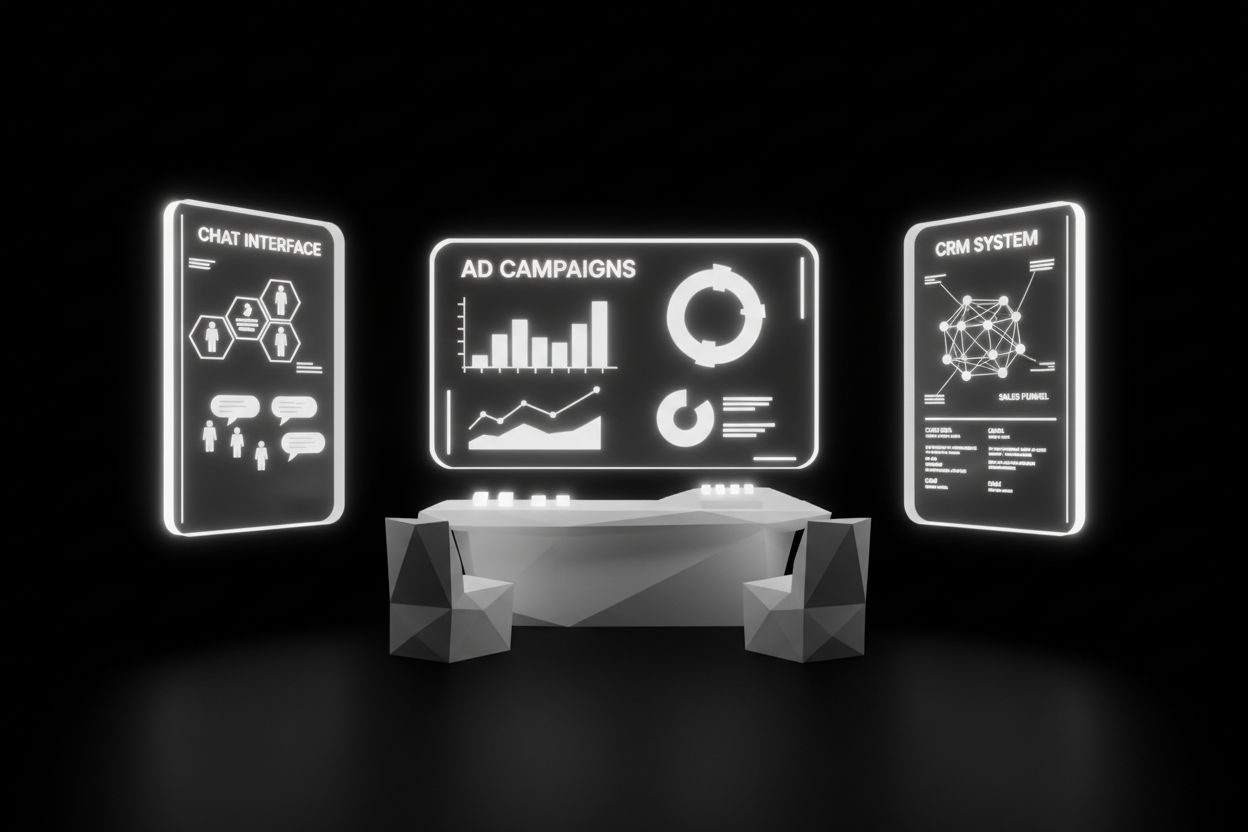
These strategies require stronger governance and better data architecture, but they drive the biggest long-term upside.
Quick technical checklist and architecture notes
Event tracking: standardize on a single event schema and unique user identifier
Data pipeline: choose a near-real-time ingestion method and a central data store for model training
Model retraining cadence: schedule weekly or monthly retrains depending on data velocity
Integrations: Webhooks for real time triggers, batch sync for enrichment, and API-based lead creation for speed
Decision criteria for tool selection
Does it integrate with your CRM out of the box
Can it handle privacy and consent requirements for your region
Does it expose model explainability or at least feature importance
What is the total cost of ownership including integration and maintenance
FAQ
Q: How fast will I see results with AI automation for sales and marketing
A: Expect measurable wins for simple workflows in 30 to 60 days. More complex cross-channel automation may take 90 days or more to mature.
Q: Will automation replace my sales team
A: No. Automation should remove repetitive tasks and enable reps to focus on higher-value conversations. Human judgment is critical for closing and complex negotiations.
Q: How do I measure ROI
A: Use a primary revenue-linked metric and run controlled experiments or holdout cohorts. Compare cost per qualified lead and pipeline velocity before and after rollout.
Q: What data is required to score leads effectively
A: At minimum you need identifiers, firmographic or demographic fields, and behavioral events like page views, content downloads, or product usage. More signals improve accuracy.
Q: How do I avoid over-automation
A: Set human review gates, cap message frequency, and monitor negative feedback signals such as unsubscribes or spam complaints.
Next steps and resources
Start with a focused pilot: pick one high-volume funnel, agree success metrics, and run a 30-to-60-day pilot. If you need design templates, SLA dashboards, or help building a pilot end-to-end, check the automated services and contact pages for hands-on support:
For lead generation workflows see Automated Lead Generation - The Social Search.
For social and creative automation processes see Automated Social Media - The Social Search.
To deploy AI chat agents that qualify and route leads see Automated AI Chat Agents - The Social Search.
If paid channel orchestration is a priority, review Paid Ads Management - The Social Search.
To align automation with CRM and growth strategy see What Is CRM in Marketing: A Complete Guide to Strategy, Automation, AI, and Growth - The Social Search.
If you want a tailored 90-day plan for your business, contact the team to schedule a discovery call: https://www.thesocialsearchsg.com/contact
This guide equips you with the playbooks, templates, and checkpoints you need to move from experimentation to predictable revenue impact with AI automation for sales and marketing. Start small, measure, and scale the workflows that actually move the needle.