What Is Content Marketing: Practical Guide for Lead Generation, AI, and Social Ads
Learn what is content marketing, why it matters, and how to use AI, social media, and paid ads for lead generation with a step by step 90 day playbook.
Content that solves a problem will always outperform content that only talks about a product. If you want predictable leads, better search visibility, and higher conversion rates, content marketing is the engine that makes those outcomes repeatable.
This guide explains what is content marketing, how it works across channels and the funnel, and how to set up a modern, AI-enhanced program that drives leads and scales paid social ads on Meta and TikTok. It includes budgets, team roles, common failure patterns, legal checklists, and a 90 day starter playbook you can use right away.
What is content marketing?

Content marketing is a strategic approach that uses valuable, relevant content to attract, engage, and convert a specific audience over time. Instead of interrupting people with traditional ads, content marketing helps potential customers solve problems, learn, or be entertained. The result is trust, brand preference, and measurable leads.
Key characteristics:
Audience first. Content is created to meet the needs of a clearly defined audience, not to push features.
Utility and consistency. Content educates, inspires, or entertains on a regular schedule.
Owned distribution. Content lives on channels you control, like your blog, email list, or knowledge base, and then flows to social and paid channels.
Measured outcomes. Every piece is tied to metrics: traffic, leads, conversions, revenue.
What content marketing is not:
It is not short term hacks. Content compounds slowly and grows traffic over months.
It is not random posting. Lack of strategy and poor distribution turn content into noise.
Why content marketing matters for lead generation and ads
Content lowers the cost of acquisition by creating trust before someone talks to sales. A good blog post, explainer video, or social series can reduce the number of ad impressions needed to convert a lead. That makes paid channels like Meta and TikTok more efficient when you use content as the creative backbone.
Benefit highlights:
Better lead quality. Educated prospects are more likely to convert and stay longer.
Compounding ROI. Evergreen content continues to attract leads with little extra cost.
Lower paid spend. Ads perform better when they point to helpful content rather than just a product page.
If you want a practical example, read a focused guide on lead generation and automation to see how content plugs into conversion systems. Lead Generation and Marketing Automation Guide for 2026 Success explains how content feeds automated funnels and AI agents.
Types of content and where to use them
Content formats vary by audience and funnel stage. Use a mix so you can support awareness all the way to purchase.
Blog posts and articles. Best for SEO and mid funnel education.
Video and short form social. Great for awareness on TikTok and Meta Reels.
Email sequences and newsletters. High ROI for nurturing and retention.
Case studies and white papers. Effective for B2B decision makers.
Webinars and demos. Convert high intent leads and support sales conversations.
Podcasts and interviews. Build authority and reach niche audiences.
Infographics and data visualizations. Help complex concepts travel on social.
When running Meta or TikTok ads, align creative to content. For example, use short videos to drive TOFU traffic to a how to article, then retarget with demo invites or lead magnets.
How content supports the funnel: TOFU, MOFU, BOFU
Awareness (TOFU): Short videos, social posts, listicles, and infographics that answer common questions.
Consideration (MOFU): Long form blog posts, comparison guides, and webinars that help buyers evaluate options.
Decision (BOFU): Case studies, pricing pages, product demos, and ROI calculators.
Tactical examples:
TOFU TikTok: 30 second tip that ends with a link to a deep dive article.
MOFU email course: A 5 day sequence that expands on the article and invites a demo.
BOFU retargeting: Meta carousel ad promoting a case study to visitors who read the article.
Track conversions at each stage and measure assisted conversions to understand how content contributes across the customer journey.
AI, tools, and modern workflows

AI is no longer optional. It speeds drafting, personalization, and optimization. But AI must be guided by strategy, editing, and human review to maintain authenticity.
Where AI helps:
Topic research and keyword clustering. Use AI to map content ideas to search intent.
Drafting and outlines. Generate initial drafts and save editing time.
Optimization and testing. Tools can test headlines, meta descriptions, and predict performance.
Personalization. Serve variant content segments based on behavior or CRM data.
Where humans remain essential:
Strategy and narrative. Humans pick priorities, define voice, and set ethical bounds.
Final editing and fact checking. Ensure accuracy, tone, and brand alignment.
Creative direction for video and social.
Integrate AI chat agents to handle inbound queries and convert content readers into leads. Learn how to implement conversational AI for marketing and sales in a focused service. Automated AI Chat Agents - The Social Search
Ethics and authenticity:
Be transparent when content includes AI generated text or images.
Avoid factual inaccuracies by establishing verification steps.
Use AI to augment expertise, not replace it.
Budgeting and team structure
Content budgets vary by goal and industry, but you can plan with simple tiers.
Small business minimum viable budget - first 6 months:
Content creation: $1,000 to $3,000 per month (mix of in house and freelancers)
Promotion and small paid tests: $500 to $2,000 per month
Tools and software: $100 to $400 per month
SaaS growth stage budget - scaled plan:
Content ops team: 1 strategist, 2 writers, 1 editor, 1 designer, 1 analyst
Monthly spend: $10,000 to $30,000 for content, production, and promotion
In house vs agency vs freelance:
In house gives control and deep product knowledge.
Agencies scale faster and bring processes and ad skills.
Freelancers are cost effective for specialist tasks.
Core roles and responsibilities:
Content strategist. Sets priorities, maps the funnel, and measures impact.
Creators. Writers, videographers, designers who produce assets.
Editor. Ensures quality, voice, and SEO.
Distribution manager. Publishes, schedules, and runs ads.
Analyst. Tracks metrics, performs attribution, and optimizes.
If you want assistance automating lead flows from content into scalable pipelines, check an automation service that pairs content with conversion systems. Automated Lead Generation - The Social Search
Common mistakes and why content marketing fails
Many programs stall not because content is bad, but because processes are missing. Watch for these failure patterns:
No clear audience. Content talks to everyone and converts no one.
Inconsistent publishing. Sporadic output yields no compounding effects.
Poor distribution. Great articles that no one sees will not generate leads.
Measuring the wrong things. Vanity metrics like followers do not equal pipeline.
Ignoring search intent. Writing for keywords without solving the user’s problem reduces engagement.
How to recover:
Reassess your target persona and map content to their questions.
Build a 90 day calendar and commit to measurable experiments.
Set up basic conversion tracking and a lead nurturing sequence.
Repurposing framework: get more from every asset
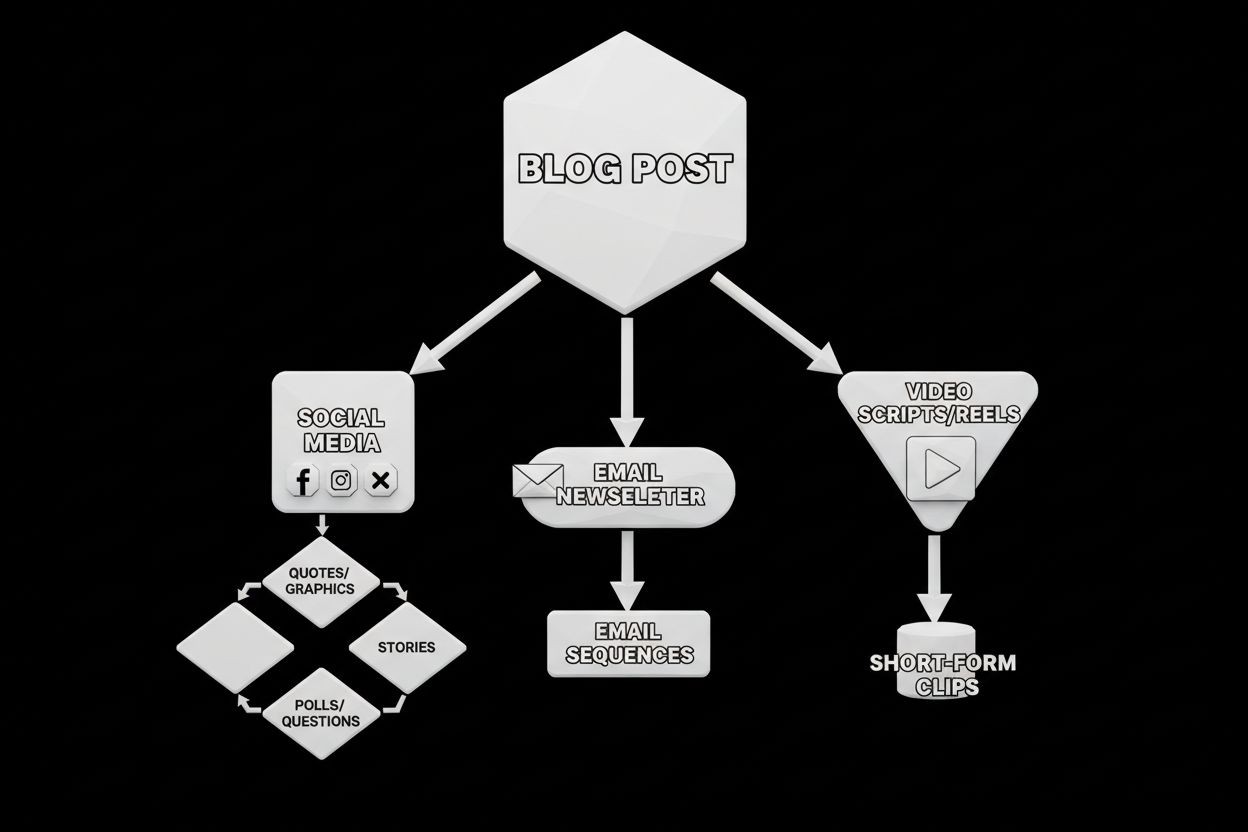
A systematic repurposing approach multiplies ROI. Use this four step framework:
Create a pillar piece. Long form article, white paper, or webinar.
Extract micro content. Turn sections into short videos, carousels, and tweets.
Distribute and test. Push to organic channels and small paid campaigns on Meta and TikTok.
Recycle and refresh. Update evergreen posts with new data and re-promote.
Cross platform tips:
TikTok and Reels: Vertical clips with captions and a clear hook in the first 3 seconds.
LinkedIn: Use long form summaries and case studies for B2B audiences.
Email: Send a concise version with a clear next step to capture leads.
If you run social campaigns at scale, an automated social media service can streamline repurposing, scheduling, and ads optimization. Automated Social Media - The Social Search
Advanced measurement and attribution
Move beyond simple metrics. Advanced measurement explains how content influences revenue.
Useful advanced metrics:
Content engagement score. Combine time on page, scroll depth, and shares into a single score.
Assisted conversions. Count how many purchases had a touchpoint with each content asset.
Content lifetime value. Track revenue attributable to content over 12 months.
Attribution models. Use multi touch or data driven attribution to assign credit across channels.
Tools and tactics:
Set up UTM tagging and consistent naming for campaign tracking.
Use event-driven analytics to capture content interactions.
Build dashboards that tie content engagement to MQLs and SQLs.
Legal, compliance, and accessibility
Content teams need simple checklists to avoid legal issues and protect users.
Legal basics:
Copyright and attribution. Secure rights for images and content. Credit guest contributors.
Disclosures. Clearly mark sponsored content and affiliate links.
Privacy and data. Follow GDPR when collecting form data and store consent records.
Accessibility. Add alt text, captions, and readable formats to widen reach and reduce risk.
For terms and privacy reference, maintain up to date site policies and ensure forms link to your privacy page.
90 day starter playbook: what to do first
Week 1-2: Foundation
Define one core persona and top 10 questions they ask.
Choose 3 topic pillars aligned to product value and keywords.
Set up tracking: analytics, UTM conventions, basic conversion events.
Week 3-6: Create and publish
Produce one pillar article and two supporting pieces.
Create 4 short videos derived from the pillar.
Launch a paid awareness test on TikTok and Meta with small budgets.
Week 7-10: Nurture and optimize
Build a 3 email nurture sequence for content downloads.
Start retargeting site visitors with BOFU creative.
Run A B tests on headlines and ad creative.
Week 11-12: Measure and scale
Evaluate lead quality and cost per lead by channel.
Reallocate budget to top performing content and ads.
Refine production workflow and add one more content creator or freelancer.
Conclusion and next steps
Content marketing is measurable long term work that powers lead generation, improves paid ad efficiency, and builds brand trust. Start with a clear audience, a few pillar assets, and disciplined distribution. Use AI to speed production and personalization, but keep humans in the loop for strategy and quality control.
If you want help turning content into a predictable lead machine with ads and automation, consider pairing content with professional ad management. Services that combine content, paid campaigns, and AI-driven chat agents deliver faster results. Learn more about paid campaign management and how to scale content-fed ads. Paid Ads Management - The Social Search
Ready to start? Map one pillar topic, write one useful article this week, and run a small Meta or TikTok test to see how content changes your cost per lead.
Article created using Lovarank