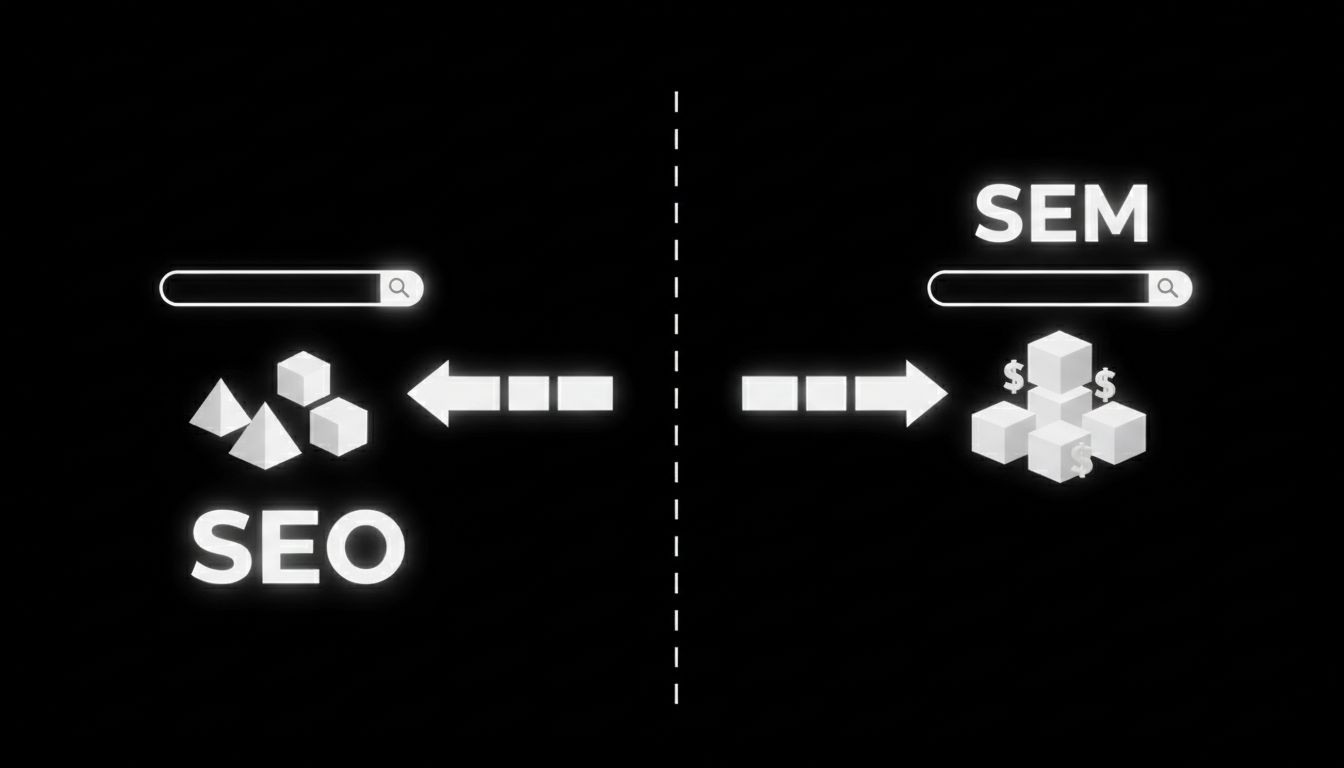
Difference Between Search Engine Optimization and Search Engine Marketing
Learn the difference between search engine optimization and search engine marketing with integration tips, budget guidance, AI tools and lead-generation steps.
People searching online do not separate channels the way marketers do. They type queries, click results, and follow whatever answer feels most useful. For businesses that need predictable leads and growth, knowing the difference between search engine optimization and search engine marketing is the first step to designing a marketing system that delivers both short-term wins and long-term value.
What is search engine optimization (SEO)

SEO is the set of tactics focused on improving a website’s visibility in organic search results. It covers content, site structure, technical performance, and off-site reputation signals. SEO drives organic traffic that continues to produce value over time when it is done correctly.
Key components of SEO
On-page SEO - keyword-focused content, title tags, meta descriptions, header structure, and internal linking.
Technical SEO - site speed, mobile-first design, crawlability, structured data, canonicalization, and sitemap management.
Off-page SEO - backlinks, brand mentions, partnerships, and local citations.
Content strategy - topical depth, user intent alignment, evergreen resources, and content hubs.
Why SEO matters
Cost structure - SEO requires time, content creation, and technical work instead of paid clicks. That makes it cost-effective over time for consistent queries.
Longevity - high-quality content and strong technical foundations can rank for months to years.
Trust signal - organic rankings often build credibility and higher click-through rates compared to paid results.
When SEO performs best
SEO is best when your business wants sustainable acquisition, brand authority, and improved margins over time. It is essential for e-commerce catalogs, knowledge resources, and local businesses looking to dominate recurring queries. If you want to automate parts of your SEO workflow, see our automated SEO services for campaign scaling and maintenance: Automated SEO services.
What is search engine marketing (SEM)
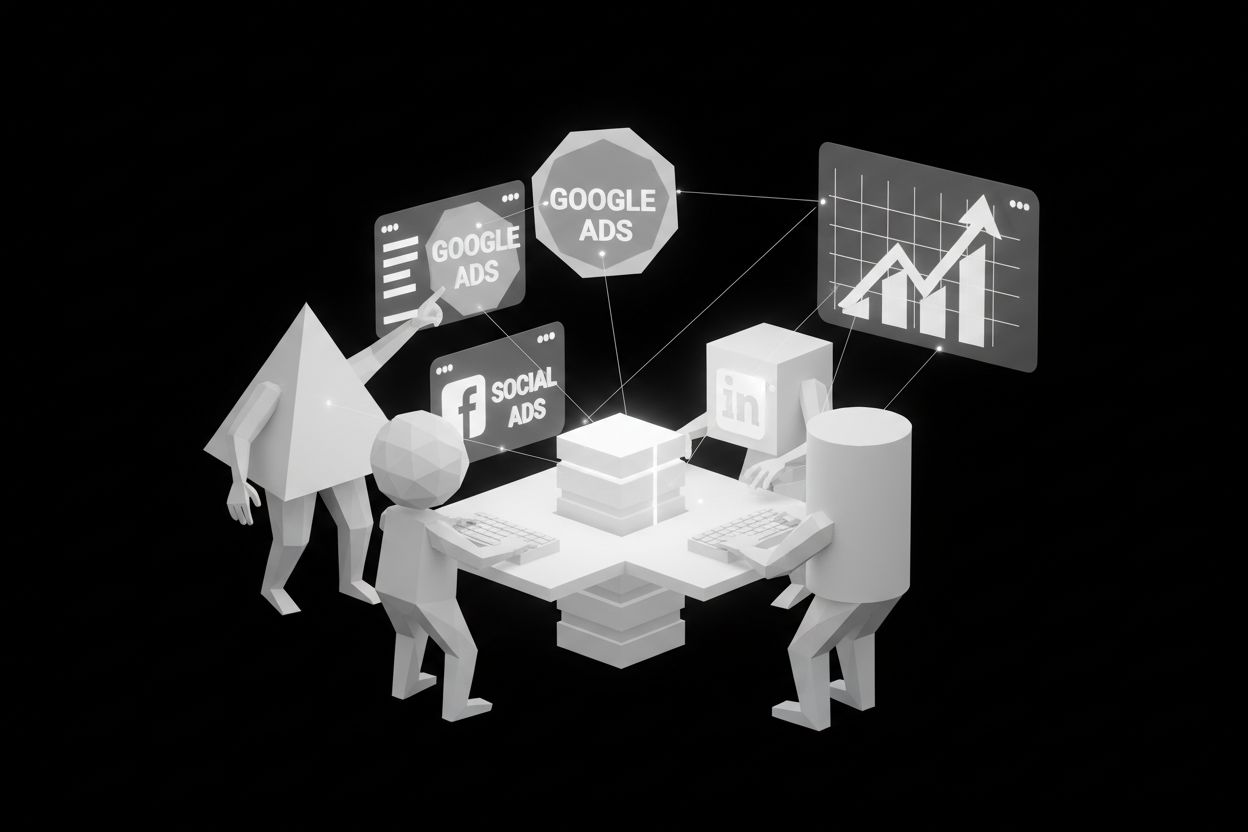
SEM traditionally refers to paid search advertising, most commonly pay-per-click campaigns on platforms like Google Ads and Microsoft Advertising. Modern SEM often expands to include paid social search intent tactics and any paid activity designed to capture search-driven demand.
Core elements of SEM
Paid search campaigns - keyword bidding, ad copy testing, bidding strategies, and landing page optimization.
Shopping and product listing ads - product data feeds, price competitiveness, and inventory management.
Remarketing and audience targeting - list-based bids, dynamic remarketing, and audience segmentation.
Creative and ad extensions - sitelinks, callouts, structured snippets, and local extensions.
Why SEM matters
Speed - SEM provides immediate visibility once campaigns are live and budgets are funded.
Precision - you can target by keyword, intent, device, location, and audience characteristics.
Testing - SEM is an efficient way to test messaging, landing pages, and conversion rates before committing to broader SEO content.
When SEM performs best
Use SEM when you need immediate traffic, are launching new offers, or want to test demand in competitive spaces. For full-service campaign setup and management, including Meta and TikTok ad strategies, consider our paid ads management offering: Paid Ads Management.
Key differences between SEO and SEM
Understanding the differences helps you allocate budget and set expectations. Below are the most consequential contrasts.
Cost and budgeting
SEO - mostly time and resource investment. Costs include content creation, technical work, and tools. Results compound over time, so initial ROI is lower but long-term ROI is higher for evergreen queries.
SEM - direct media spend per click. You pay for traffic and can scale up or down instantly. It is predictable but stops producing results the moment you turn off the budget.
Time to results
SEO - slow burn. Expect noticeable progress in 3 to 12 months for most competitive keywords and 12 to 36 months for top-tier results.
SEM - immediate. Campaigns can generate clicks and conversions in days.
Longevity and sustainment
SEO - durable. Once you rank, ongoing maintenance and content updates preserve traffic.
SEM - transient. Performance disappears without budget.
Conversion rates and user intent
Organic traffic often produces higher trust and better long-term conversion rates. Many studies show organic listings generate a larger share of clicks for informational queries.
Paid search can convert strongly for transactional queries when ads and landing pages match intent.
Scalability and testing
SEM is the preferred testing ground for messaging, offer validity, and landing page structure because results and data accumulate quickly.
SEO scales through content hubs and topical clustering but requires validation up front through search intent research.
Impact on each other
High-quality SEO content can reduce cost-per-click by improving Quality Score and relevance signals in paid campaigns.
SEM data helps identify high-converting keywords for SEO content investment.
How to decide: framework and budget allocation

A practical framework balances immediate needs with long-term goals. Below is a decision process you can follow.
Step 1 - Define goals and timeframe
Short-term growth and lead flow - prioritize SEM for immediate traffic and testing.
Long-term cost efficiency and authority - prioritize SEO to build sustainable organic presence.
Mixed goals - combine both, with SEM supporting SEO milestones.
Step 2 - Assess competition and keyword difficulty
High competition or expensive CPCs - invest in SEO content and niche long-tail keywords while running targeted SEM for top-converting terms.
Low competition or time-sensitive offers - lean heavier on SEM.
Step 3 - Sample budget splits
Early-stage startups with revenue pressure - 60 percent SEM, 40 percent SEO until product-market fit appears.
Growth-stage businesses with steady revenue - 40 percent SEM, 60 percent SEO to build equity.
Enterprise brands with broad goals - 30 percent SEM, 70 percent SEO to protect organic share.
Step 4 - Use SEM to accelerate SEO
Test ad copy, landing pages, and value propositions in SEM. When data shows clear winners, scale those into SEO content and UX changes.
Step 5 - Reallocate dynamically
Reevaluate monthly in the first quarter and quarterly thereafter. Shift budget based on conversion data, seasonality, and product launches.
Budget calculator formula (quick)
Target leads per month x target cost-per-lead = monthly budget required.
Example: If you want 200 leads and average CPL in SEM is $50, budget = 200 x 50 = $10,000. Use part of that to fund SEO content that reduces CPL over time.
Tools and skills that bridge SEO and SEM
Keyword research platforms - use unified keyword lists for both channels so paid and organic teams align on intent.
Analytics and attribution - set up conversion tracking and multi-touch attribution to measure combined impact.
Landing page testing - feed high-converting landing pages from SEM into SEO templates for organic testing.
For automated social and AI-driven outreach that complements search strategies, consider our automated social media services: Automated Social Media. For automating lead capture with conversational agents see: Automated AI Chat Agents.
Advanced topics: quality score, SERP features, mobile and voice search
Quality Score and relevancy
Many SEM platforms use Quality Score or equivalent. Relevance factors like landing page experience, expected click-through rate, and ad relevance are influenced by SEO practices. Improving organic relevance often lifts paid performance.
SERP features and presence
Search engine result pages are no longer simple blue links. Featured snippets, knowledge panels, local packs, image carousels, and shopping results change where and how users click. SEO can win featured snippets while SEM can appear in paid shopping and local packs.
Mobile and voice
Mobile-first indexing means technical SEO and page speed are essential.
Voice queries are more conversational and often long-tail. Use natural language content and structured data to capture voice-driven traffic.
AI and generative search
Generative AI agents and AI-driven search features influence how users discover answers. Create content designed to satisfy intent people might ask an AI, then use SEM to reinforce offers for high-intent transactional queries.
30/60/90 day plan to combine SEO and SEM for lead generation
30 days - foundation and quick wins
Audit existing search performance and tag high-converting keywords.
Launch targeted SEM campaigns for top transactional keywords and set conversion tracking.
Publish or optimize 3 to 5 high-intent landing pages.
Quick wins: fix mobile speed and critical technical issues.
60 days - scale testing and content
Use SEM data to map winning ad copy and landing page elements into SEO content topics.
Create 6 to 10 pieces of long-form content that match top intent clusters.
Set up remarketing lists and lookalike audiences for paid channels, including Meta and TikTok ad strategies.
Begin outreach for high-value backlinks and partnerships.
90 days - optimize and automate
Scale content production for topics that showed early traction.
Use automation where possible to publish social syndication and conversational lead capture via AI chat agents.
Adjust budget allocation based on CPL and lifetime value analysis.
Implement multi-touch attribution to credit both SEO and SEM appropriately.
If you want help building an automated lead generation engine that combines search traffic with chat agents and social ads, our automated lead generation offering outlines how to connect paid and organic channels: Automated Lead Generation.
Measurement, KPIs and attribution
Core KPIs to track
Organic impressions, clicks, and keyword rankings.
Paid impressions, CPC, CTR, conversions, and cost-per-lead.
Assisted conversions and multi-touch paths to show SEO contributions to paid conversions.
Revenue per channel and lifetime value to inform sustainable budgets.
Recommended attribution approach
Start with last-click for simplicity but move to data-driven or multi-touch attribution as soon as you have enough conversion volume.
Use landing page UTM tagging and CRM integration to track which content and ads contributed to closed business.
Common mistakes to avoid
Treating SEO and SEM as isolated silos rather than coordinated channels.
Ignoring mobile UX. Slow pages kill both organic rankings and paid landing page conversions.
Chasing vanity metrics like impressions without tying them to lead quality.
Over-optimizing for broad keywords and ignoring long-tail intent that drives cheaper traffic and higher conversion rates.
Final recommendations
Both SEO and SEM are powerful when used together. SEM gives you fast feedback and immediate reach. SEO builds compounding organic growth and lowers acquisition costs over time. Start with clear goals, test aggressively in SEM, and fold the learnings into a sustainable SEO program. Use modern AI tools and automation to scale content distribution, conversational lead capture, and ad creative testing.
If you want a customized plan that combines paid search, social ads on Meta and TikTok, AI chat agents, and long-term organic growth, contact our team for a strategic audit and hands-on implementation: Contact The Social Search.
Need examples of how SEM and SEO have been combined successfully or want a walkthrough of the tools and templates we use? Explore our insights and case studies for practical playbooks: SEO vs SEM: Choose Combine Maximize ROI and our broader blog for growth and automation tactics: Insights and blog.
Choosing the right balance is not a one-time decision. It is an ongoing process of measurement, creative testing, and strategic reinvestment. Use paid search to learn fast and organic search to build lasting value.