Demand Generation Explained: How to Build a Strategy That Creates Pipeline
Learn what demand generation is, how it works, and how to build a pipeline-focused strategy with SEO, social media, ads, AI chat, and proof for B2B growth.
Demand generation is what turns attention into future pipeline. It is the work of making the right people aware of your brand, curious about your offer, and confident enough to keep moving toward a purchase. That means demand generation starts before a form fill, a demo request, or a sales call. In many cases, it starts before the buyer even knows exactly what they want.
For teams running SEO, social media, Meta or TikTok ads, AI chat agents, and lead generation campaigns, demand generation is the layer that makes everything else perform better. It gives people a reason to recognize your name, trust your point of view, and come back when they are ready to compare options.
What demand generation means
Demand generation is the set of marketing and sales activities that creates awareness, shapes preference, and builds interest in a problem and a solution. It is not limited to one channel. It usually combines educational content, search visibility, social distribution, paid media, webinars, customer proof, and follow-up systems that keep prospects engaged over time.
The goal is not just to get attention. The goal is to create meaningful demand for your category, your solution, or your brand. That can mean making a problem feel urgent, helping buyers understand a better approach, or giving them enough confidence to move from research to conversation.
A simple way to think about it:
Demand generation creates the interest.
Lead generation captures the contact.
Demand capture converts existing intent.
When those three work together, acquisition gets cheaper and sales conversations get better.
Why demand generation matters now
Buying behavior has changed. People research on search engines, social platforms, review sites, and AI assistants before they ever talk to sales. They compare vendors privately, read customer stories, watch short demos, and look for signs that a company understands their problem. That is why demand generation cannot be treated like a one-off campaign. It has to be a system.
If your visibility in search is weak, automated SEO helps you build the pages buyers actually need, including comparison pages, solution pages, and educational posts. If your audience lives on feeds, short video, and creator-style content, automated social media keeps your message active without burning out your team.
In a market where buyers do a lot of self-serve research, the brands that win are usually the ones that show up early, explain clearly, and prove they can solve the problem. Not the ones that shout the loudest.
Demand generation vs lead generation
Demand generation and lead generation work best together, but they are not the same thing.
Concept | Main job | Best stage | Success looks like |
|---|---|---|---|
Demand generation | Create awareness, trust, and interest | Before and during consideration | More branded search, more qualified traffic, stronger preference |
Lead generation | Capture contact details and qualify interest | When the buyer is ready to engage | Forms filled, demos booked, trials started |
Demand capture | Convert existing intent | Bottom of funnel | Pricing page visits, comparison clicks, demo requests |
ABM | Focus on named accounts with targeted messaging | Mid to bottom of funnel | Engagement from target accounts, meetings, pipeline |
Think of it this way. Lead gen asks for the hand raise. Demand generation earns it.
That distinction matters because too many teams optimize only for the moment someone submits a form. If there is no trust built beforehand, the lead is colder, sales has to do more education, and conversion rates usually suffer.
How demand generation works across the buyer journey
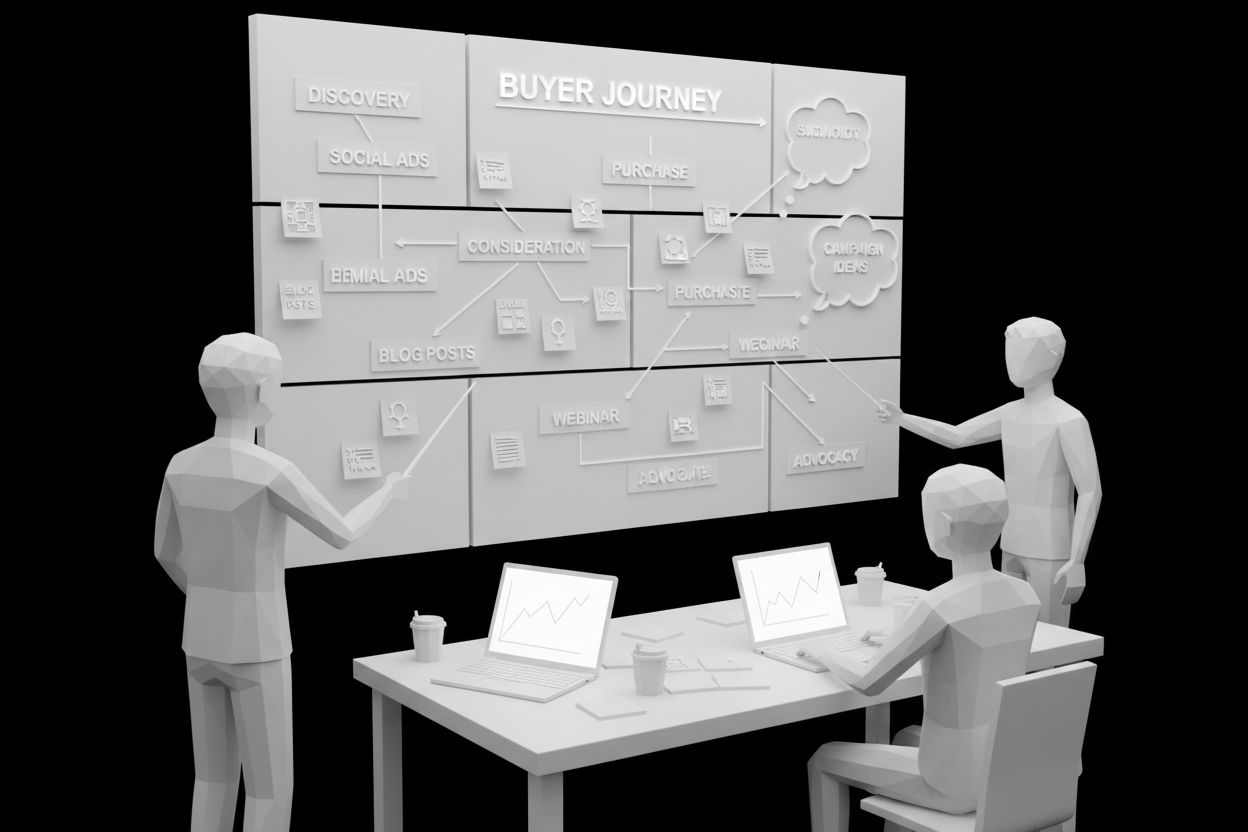
Demand generation works best when it supports the full journey, not just the first click. The buyer usually moves through four stages.
Awareness
At the awareness stage, buyers are trying to name the problem. They may not know the solution category yet. Your job is to educate, frame the issue, and help them see that the problem is worth solving.
This is where blog posts, short videos, social content, SEO pages, and podcast clips do their best work. The content should be useful first and promotional second.
Consideration
At the consideration stage, the buyer knows the problem and starts comparing approaches. They want to understand the tradeoffs, the process, the pricing range, and the likely outcome.
Here, demand generation content needs to get more specific. Use comparison pages, use-case pages, webinars, checklists, and case studies that help the buyer narrow the field.
Validation
At the validation stage, buyers want proof. They want to know if you have done this before, whether your customers are happy, and how painful the implementation will be.
This is where testimonials, product demos, reviews, detailed case studies, ROI tools, and automated AI chat agents can make a big difference. A good chat agent can answer objections, route people to the right resource, and keep high-intent visitors from bouncing when they are still hesitant.
Conversion
At the conversion stage, demand generation should make the next step feel obvious. That may be a demo, a consultation, a quote, a trial, or a sales call. The offer should be low friction and closely tied to the value the buyer has already seen.
The best demand generation programs make each step feel natural. Buyers do not feel pushed. They feel guided.
How to build a demand generation strategy
A strong demand generation strategy is not built around random content ideas. It starts with a clear plan.
Define the buyer and the problem
Get specific about who you are trying to reach, what they are trying to fix, and what makes them act now. The more precise the pain point, the easier it is to create content and offers that land.Map questions to each stage
List the questions buyers ask at awareness, consideration, validation, and conversion. Then build content that answers those questions in the order buyers actually ask them.Create a small set of core assets
You do not need fifty assets to begin. Start with a few strong ones: a main explainer page, a comparison page, a pricing or estimate page, a case study, and a demo or booking page.Choose channels based on intent
Use SEO for discovery, paid social for reach, retargeting for recall, and email for nurture. If you are investing in paid distribution, paid ads management helps keep Meta and TikTok campaigns aligned with the right audience, offer, and funnel stage.Connect capture to nurture
Demand generation only works if follow-up is tight. Route leads quickly, score them properly, and make sure sales and marketing agree on what happens after a click, a form, or a chat interaction.Review the metrics monthly
Demand generation improves when you look at the right numbers and act on them. If a channel drives traffic but no pipeline, adjust the offer. If a page converts but the leads are weak, tighten the targeting. If a campaign creates interest but no follow-up, fix the handoff.
Demand generation channels that actually move pipeline

The best demand generation programs use a mix of channels, each with a clear job.
SEO and search discovery
Search is still where many buying journeys begin. Good demand generation SEO does more than chase traffic. It helps buyers find answers to questions like what a solution does, how it works, who it is for, what it costs, and how it compares to other options.
That means your content should not stop at generic educational posts. Build pages for use cases, alternatives, comparisons, pricing, and implementation. Those are the pages buyers actually use when they are getting close to a decision.
Paid social on Meta and TikTok
Meta and TikTok are not just for awareness, they can be strong demand gen channels when the creative is built around education and proof. Short-form video works well for showing the pain point, the before-and-after result, or a quick objection handled clearly.
The goal is not to cram everything into one ad. It is to open a loop and keep the audience moving. A strong retargeting sequence might start with a simple problem awareness video, then move to a case study, then to a demo invitation.
Organic social and founder-led content
Organic social gives your brand a voice. It is where you can repeat key ideas, explain your point of view, answer common objections, and show customer wins without waiting for a campaign launch.
This is also one of the best places to build trust over time. People remember brands that teach well, not just brands that post often.
Webinars, workshops, and live demos
Live formats work well when the product needs explanation or the buyer has a lot of questions. A good webinar should not feel like a lecture. It should feel like a fast path to clarity.
Use live sessions to show the product, walk through a real workflow, or break down a topic your audience keeps asking about. Then turn the recording into clips, quotes, and follow-up content.
AI chat agents and conversational conversion
Many buyers do not want to fill out a form on the first visit. They want to ask one or two questions and see if the offer fits. That is where conversational tools help.
An on-site AI assistant can qualify interest, point visitors to the right page, recommend next steps, and capture intent before the visitor leaves. In demand generation, that matters because the job is not only to attract attention. It is to keep momentum once interest appears.
Email nurture and sales handoff
Email is still one of the most underrated demand gen channels because it lets you continue the conversation after the first touch. Use it to share proof, answer objections, and invite the buyer back when the timing is right.
The handoff matters just as much as the email. If your process is messy, the best lead in the world can go cold. A solid lead generation and marketing automation guide for 2026 success is helpful if you want a tighter system for routing, scoring, and follow-up.
The content assets buyers expect before they buy
Demand generation gets much easier when your site has the right assets.
Some of the most useful ones are:
Comparison pages
Pricing or estimate pages
Case studies
Product demo pages
Implementation guides
ROI calculators
Templates and checklists
FAQ pages that answer objections
Customer quote libraries
Alternatives or versus pages
These pages help buyers self-educate. They also help search engines and AI assistants understand what you offer, who it is for, and why it matters. In other words, they support both human discovery and machine discovery.
If you are missing most of these assets, demand generation will feel harder than it should. The problem is often not the channel. It is the lack of proof and clarity once someone clicks.
How to measure demand generation
If you want demand generation to drive real growth, do not measure it only by impressions or form fills. Those numbers can be useful, but they do not tell the full story.
Better metrics include:
Pipeline sourced
Pipeline influenced
MQL to SQL rate
Demo or trial conversion rate
Branded search growth
Returning visitor rate
Content-assisted conversions
CAC and payback period
Win rate by channel
Sales cycle length
The most important shift is this: measure whether demand generation creates better buyers, not just more visitors.
That is also why your CRM and marketing systems matter. If the handoff is broken, the data is broken. If the data is broken, optimization becomes guesswork.
Common demand generation mistakes that weaken results

A lot of demand generation efforts stall because of a few predictable mistakes.
Treating every channel like a lead gen channel. Not every post, ad, or page should ask for a form fill.
Gating too much content. If everything is locked behind a form, buyers lose trust and stop exploring.
Skipping proof. If you do not show customer stories, results, and social proof, your message stays abstract.
Buying traffic before fixing the offer. More traffic will not solve weak positioning.
Ignoring sales alignment. Demand generation breaks when marketing and sales disagree on quality or follow-up.
Using the wrong message for the stage. Awareness ads should not sound like closing pages.
Publishing once and moving on. Demand generation needs repetition and distribution.
Forgetting AI search and social discovery. Buyers now cross-check information across more places than ever.
A good way to test your program is simple. If the campaign disappeared tomorrow, would anyone remember what the brand stands for or why it is different? If the answer is no, the demand gen is too thin.
Demand generation examples by business type
Demand generation looks different depending on what you sell.
B2B SaaS
For SaaS, demand generation often starts with search content, comparison pages, and founder-led social posts. Add short demo clips, webinars, customer stories, and paid retargeting that brings visitors back to book a meeting.
eCommerce or DTC
For eCommerce, demand generation usually leans on creator-style social content, Meta and TikTok ads, UGC, product education, and email flows that turn first-time interest into repeat visits and purchases.
Enterprise software
For enterprise software, demand generation needs more proof and more patience. Think thought leadership, analyst-style content, deep case studies, sales enablement, and account-specific messaging that helps multiple stakeholders agree on a path forward.
Local and high-consideration services
For local services, demand generation is often built on trust. That means educational landing pages, strong reviews, FAQ content, short explainer videos, and easy ways to call, chat, or book.
Early-stage startups
For early-stage startups, demand generation should stay focused. Pick one audience, one problem, and one or two channels that you can execute well. Founder content, niche SEO, and sharp proof assets usually outperform a broad, unfocused campaign.
The common thread is simple. No matter the business model, demand generation works best when it helps the buyer feel informed before they feel sold to.
Demand generation is not about chasing attention for its own sake. It is about creating memory, trust, and intent so that when someone is ready to buy, your brand already feels familiar and credible. The strongest programs connect SEO, social media, paid ads, AI chat, proof, and clean lead handoff into one system. That is what makes pipeline easier to create, and easier to keep.