Click Through Rate Formula: How to Calculate, Benchmark, and Boost CTR in 2026
Learn the click through rate formula, step-by-step examples, platform benchmarks, AI and privacy impacts, and actionable tactics to improve CTR for ads and social.
You launched a campaign and the dashboard shows impressions but not the clicks you expected. Click through rate can tell you where the gap is between attention and action. This guide explains the click through rate formula, walks through real examples for email, Google Ads, and social, and gives practical tactics to lift CTR for paid and organic channels in 2026.
What is click through rate and why it matters

Click through rate or CTR is the percentage of people who click an element after seeing it. It is a primary signal for creative relevance and audience fit across email, search, social, and display. A higher CTR usually means your headline, creative, or targeting is aligned with intent. Lower CTR suggests a mismatch that costs you visibility and drives up cost per acquisition.
Why CTR matters for modern marketers
It affects ad performance and cost. In auctioned ad platforms, higher CTR often improves relevance scoring, which can lower cost per click.
It is an early indicator in the funnel. CTR tells you if you can attract interest before you optimize conversion flow.
It guides creative testing. Small headline or image changes can move CTR and scale impact fast.
Types of CTR you will track
Email CTR: clicks divided by delivered or opened messages depending on context.
PPC CTR: clicks divided by impressions for search and display ads.
Organic CTR: clicks from search engine results divided by impressions.
Social CTR: clicks from feeds, reels, or stories divided by impressions.
If you run multi-channel campaigns, track CTR by channel and by creative variation to find where attention is strongest.
CTR formula explained: math, components, and common mistakes
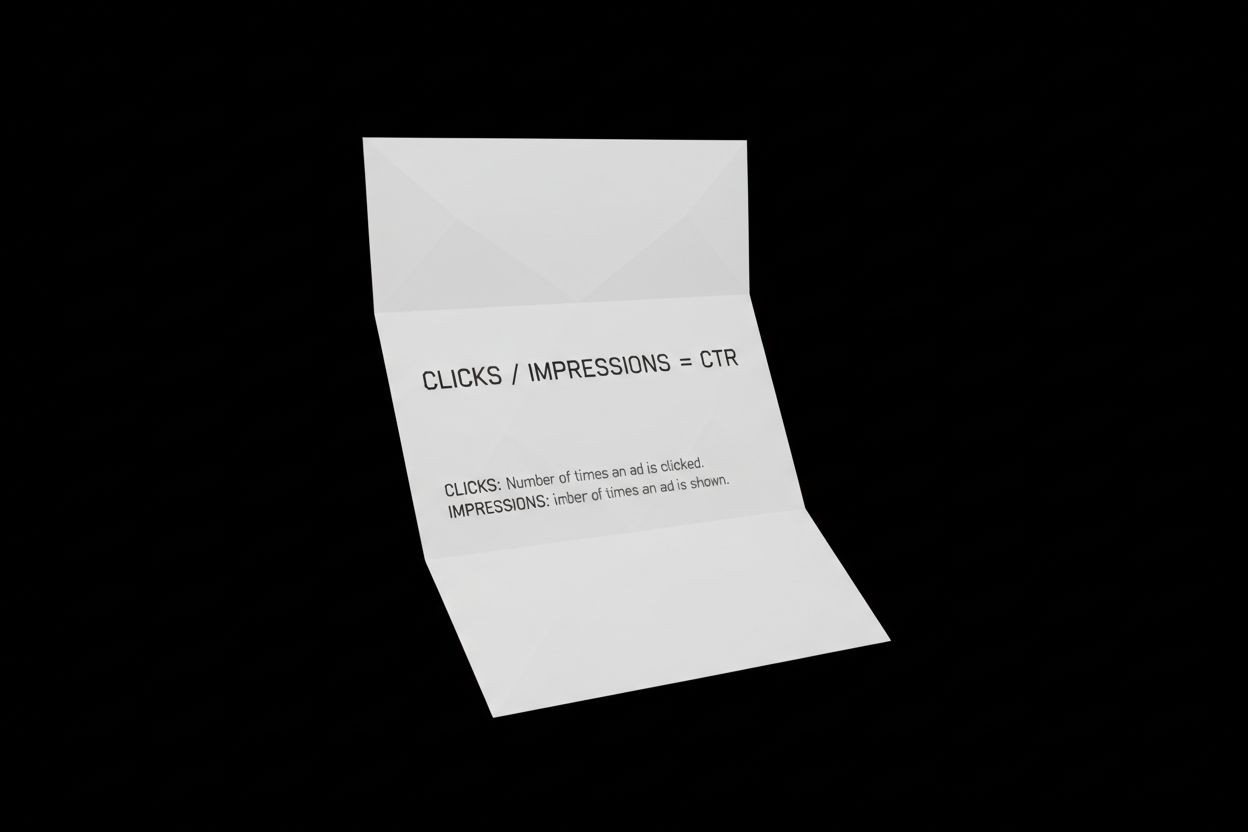
The basic click through rate formula is straightforward:
CTR = (Clicks ÷ Impressions) × 100
Clicks are the number of times people clicked the link, ad, or call to action.
Impressions are the number of times the creative was shown.
Keep these points in mind
Use the same denominator consistently. For email campaigns, decide whether you report CTR relative to delivered messages or opens and stick with it.
Exclude bots and invalid clicks where possible. Ad platforms attempt to filter invalid activity, but audits help.
Time window matters. Compare CTR over equivalent campaign durations and traffic volumes.
Worked example 1: Email campaign
You sent 25,000 emails, 1,250 recipients clicked a promotional link.
CTR = (1,250 ÷ 25,000) × 100 = 5%.
Worked example 2: Google search ad
An ad received 12,000 impressions and 360 clicks.
CTR = (360 ÷ 12,000) × 100 = 3%.
Worked example 3: TikTok campaign
A TikTok video ad played for 40,000 viewers with 2,800 link clicks.
CTR = (2,800 ÷ 40,000) × 100 = 7%.
Common calculation mistakes
Dividing by clicks instead of impressions.
Mixing impressions with reach. Reach counts unique people, impressions count views which can repeat.
Reporting clicks from different tracking windows when benchmarking.
What is a good CTR in 2026: benchmarks by channel and industry
Benchmarks change with platform shifts, creative formats, and privacy rules. The ranges below are current rules of thumb in 2026. Use them as directional benchmarks rather than absolute targets.
Search ads (Google, Bing)
Excellent: 6% and above
Good: 3 to 6%
Average: 1.5 to 3%
Social feed ads (Meta, TikTok, Instagram)
Excellent: 3 to 8% depending on format
Good: 1 to 3%
Average: 0.3 to 1%
Display ads
Excellent: 0.5 to 1%
Good: 0.2 to 0.5%
Average: 0.05 to 0.2%
Email
Excellent: 4% and above (click to delivered)
Good: 2 to 4%
Average: 0.5 to 2%
Video (YouTube, Reels, Shorts)
Click to view rates vary by call to action; 1 to 3% is a practical benchmark for strong creatives
Industry notes
E commerce tends to get higher social CTR where product thumbnails drive clicks.
B2B search ads can achieve higher CTR for tightly targeted keywords but lower absolute traffic.
Finance and legal verticals often see lower CTR on display due to regulatory content restrictions.
Platform nuance
Social CTR varies by placement. Story and reel placements have different viewer intent than in-feed posts. Always benchmark by placement and device.
How to calculate and compare CTR across campaigns
When you manage multiple campaigns, normalize CTRs to compare apples to apples:
Use the same impression source. If one report uses platform impressions and another uses tracking pixels, reconcile the difference.
Compare the same time intervals and audience segments.
Segment by device. Mobile and desktop CTR can diverge significantly.
Mini calculator examples
Campaign A: 50,000 impressions, 500 clicks = (500 ÷ 50,000) × 100 = 1%.
Campaign B: 10,000 impressions, 300 clicks = (300 ÷ 10,000) × 100 = 3%.
Campaign B has three times the CTR of Campaign A. If both have similar conversion rates after click, Campaign B will be more efficient for cost per acquisition.
How to improve click through rate: proven tactics for 2026

Improving CTR requires creative tests and audience refinement. Below are tactical steps that produce measurable improvements.
Write headlines that signal value immediately
Use benefit-first language and specific offers.
Include numbers, percent savings, or time-bound urgency.
Test two headline types: curiosity driven and utility driven.
Align creative with audience intent
Use audience insights to show products or benefits that match their lifecycle stage.
Personalize at scale using dynamic creative where available.
For paid ads, test narrow interest clusters rather than broad audiences.
Use compelling CTAs and placement
Make CTA text action-oriented and concrete. Replace generic “Learn more” with “Get your free ROI audit”.
Place CTAs consistently across creative to build recognition.
Optimize thumbnails and first-frame visuals for video
Use high contrast and a clear subject in the first 1 to 2 seconds.
Add concise overlay text that communicates the hook.
Run structured A/B and multivariate tests
Change one variable per test to isolate impact.
For major lifts, run sequential multivariate tests that combine top performers.
Improve relevance signals for ad auctions
Improve landing page relevance and reduce load time.
Use conversion and engagement signals to inform platform learning.
Leverage automation and AI for personalization
Use automated creative optimization to test dozens of variants quickly.
Apply predictive models to serve the creative most likely to lift CTR for each user segment.
If you want hands-on help with ad creative scale and AI-driven personalization, our paid campaigns team can assist: Paid Ads Management - The Social Search.
Advanced topics: AI, privacy, device behavior, fraud, and statistical significance
AI impact on CTR in 2026
AI created headlines and automated creative testing have accelerated iteration cycles. Generative headlines can surface dozens of variations, but human review is essential to preserve brand voice and avoid deceptive hooks. AI helps predict which creative combinations will likely lift CTR, but always validate with live tests.
Privacy and tracking changes
Apple’s changes and the cookie ecosystem evolution have made some impression and click attributions noisier. Expect these effects:
Attribution windows may shrink, changing reported CTRs for late-click channels.
Server-side tracking and first party signals are more important. Implement robust tagging and consented event capture.
Device differences
Mobile CTRs often outpace desktop for social and video, but mobile post-click conversion can be lower if UX is not optimized.
Segment by device in your reporting and tailor creative and CTAs accordingly.
CTR fraud and invalid traffic
Be alert for: sudden, unexplained CTR spikes, unusually low dwell times after click, and irregular geographic patterns. Use platform filters and third-party fraud detection to remove invalid clicks that distort CTR.
When CTR lifts are misleading
High CTR is not always good. If the traffic coming from those clicks does not convert or has high bounce rate, your targeting may be attracting the wrong audience. Use CTR in context with conversion rate and downstream revenue metrics.
Statistical significance: when does a CTR difference matter
When comparing two CTRs, ask if the difference is statistically meaningful. Use a two-proportion z-test as a practical approach. For a quick heuristic, larger sample sizes reduce the margin of error and allow you to trust smaller lifts. A/B tests with fewer than a few thousand impressions per variant are often underpowered for small CTR differences.
Quick guide to sample size
Expect to need more impressions when baseline CTR is low.
Use an online significance calculator or run your sample size estimation before tests. If you need help designing robust tests, consider our automated lead and campaign services: Automated Lead Generation - The Social Search.
Tools, audits, and production checklist
Use a simple CTR audit checklist to find quick wins:
Verify impression and click definitions match across reports.
Segment CTR by device, placement, and audience.
Check landing page relevance and load time.
Scan for invalid traffic or bot patterns.
Review top-performing creatives and replicate formats.
Tools to consider
Platform native dashboards for initial insights.
Creative testing platforms that automate multivariate tests.
Server-side analytics and first party event capture to protect attribution from privacy changes.
For automated creative testing and social scaling, our automated social media service can accelerate experiments: Automated Social Media - The Social Search. If you need help building a privacy-safe analytics stack, our automated SEO team can help: Automated SEO - The Social Search.
Real-world example: turning a 0.8% CTR into 3.2% in four weeks
Scenario
A consumer brand had a search campaign with 0.8% CTR and rising CPCs. Steps taken:
Rewrote headlines to include product benefits and price indicators.
Narrowed keyword match types and excluded low-intent queries.
Tested three ad variations and doubled the click-through for the best-performing headline.
Improved landing page load speed and matched headline messaging to reduce bounce.
Result
Within four weeks the best ad reached a 3.2% CTR and conversion rate improved, reducing CPA by 38 percent. This shows that coordinated creative and targeting optimization moves both CTR and ROI.
If you want a tailored audit that reviews creative, tracking, and testing plans, our Automated AI Chat Agents can onboard your campaign and provide automated recommendations: Automated AI Chat Agents - The Social Search.
Frequently asked questions
What is the difference between CTR and conversion rate?
CTR measures clicks per impression. Conversion rate measures conversions per click. High CTR brings traffic, high conversion rate turns that traffic into outcomes.
How often should I test creative?
Run continuous small tests and large follow-up tests on winners. For meaningful results, accumulate enough impressions so differences are statistically significant.
Does a higher CTR always lower cost per acquisition?
Not always. Higher CTR improves relevance scores, which can lower cost per click. But if traffic does not convert, CPA can stay high. Evaluate CTR with conversion and revenue metrics.
How do I compare CTR across platforms?
Normalize impressions definition, segment by placement and device, and evaluate creative formats. Use relative lift rather than raw percentages for cross-platform comparisons.
Can AI improve CTR reliably?
AI speeds up idea generation and predicts high-potential variants. Always validate predictions with live experiments and quality checks.
What tools can help detect CTR fraud?
Platform-level filters, server-side event logs, and third-party fraud detection tools are all useful. Anomalies in geographic or temporal patterns often signal invalid activity.
Next steps and where to get help
Start by calculating CTR for your top five campaigns using the click through rate formula and segmenting by device and placement. Run a quick creative audit focusing on headlines and CTA. If you want an integrated plan that combines paid ad strategy, creative automation, and privacy-first tracking, our team can help with end-to-end execution.
Speak with a campaign specialist to design tests that move CTR and revenue in parallel: Paid Ads Management - The Social Search.
For general questions or to request a diagnostic, contact our team: Contact The Social Search