AI Growth Systems for Founders: A Practical Guide to Build, Scale, and Measure
A practical guide for founders on AI growth systems for founders, with roadmap, stack audit, ROI model, ad tactics for Meta and TikTok, and governance best practices.
Founders are under pressure to grow faster while keeping costs under control and brand trust intact. AI can multiply output, but only when it is built into a coherent growth system. This guide shows how to design AI growth systems for founders with technical patterns, a 90-day roadmap, unit economics, ad strategies for Meta and TikTok, and governance rules you can apply right away.
The dilemma: speed vs control

Every founder faces the same tension. You can spin up automations fast and push to market, or you can move deliberately and risk losing first-mover advantage. The sweet spot is predictable speed with clear guardrails.
Key questions to answer before you scale with AI:
Where should AI act autonomously and where should it assist a human
How will you measure model performance and business impact
Who owns the data, the model, and the business risk
Treat AI as a system - not a single tool. A reliable system defines boundaries, ownership, and metrics from day one. That approach reduces brand risk and avoids fragile automations that break when scale or data shifts.
What “AI growth systems for founders” actually means
When I say AI growth systems for founders I mean a modular, measurable pipeline that converts inputs to repeatable growth outcomes. Inputs include first party data, creative assets, and business rules. Outputs include leads, conversions, retention improvements, and lower CAC.
A true growth system connects these layers:
Data and instrumentation - clean events and user profiles
Models - from embeddings to LLMs to custom classifiers
Action layer - ads, chat agents, emails, and content pipelines
Measurement - causal tests and cohort analysis
Governance - safety checks, rollout policies, and human review
This framework keeps you focused on outcomes instead of chasing shiny tools.
The AI growth stack audit - what to check, what to build
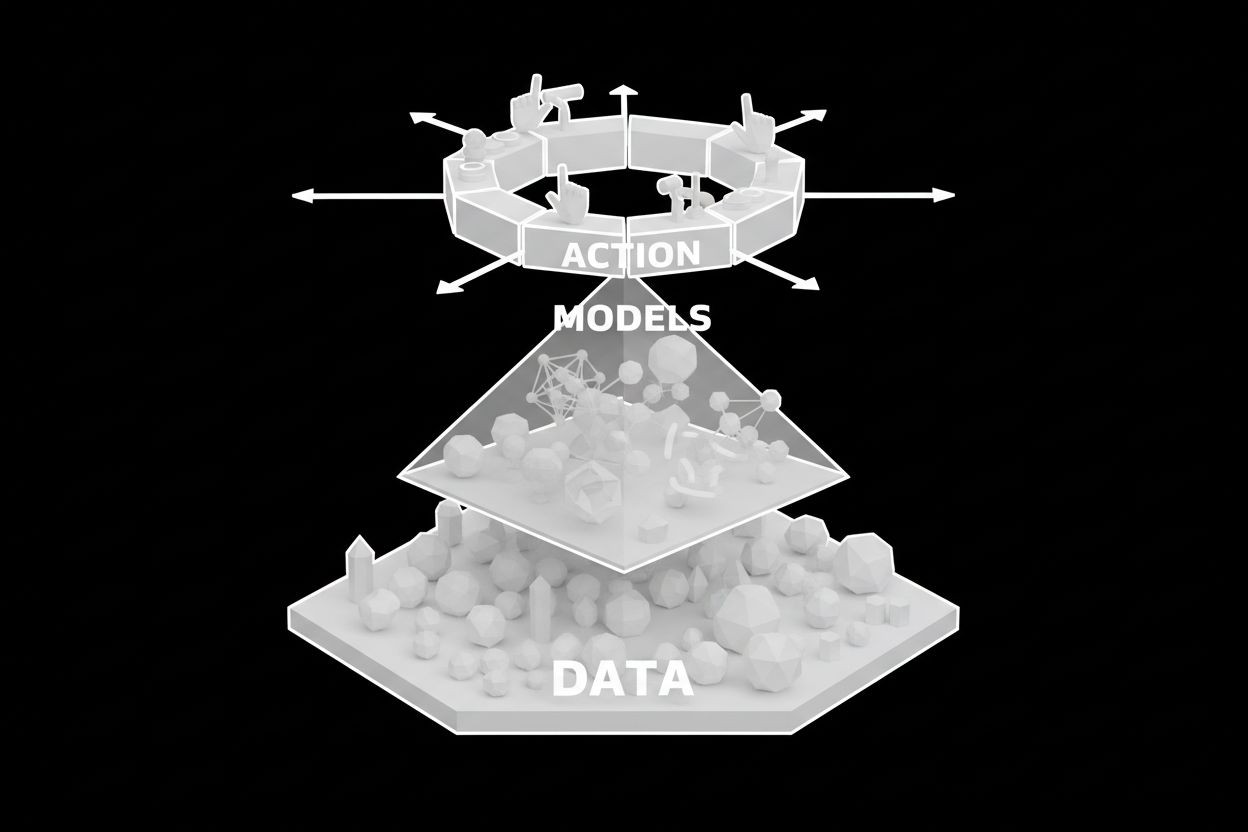
Run an AI growth stack audit before you invest. The audit is a checklist founders can use to evaluate readiness and prioritize work.
Audit steps and remediation actions:
Data hygiene
Check: events tracked, identity stitching, clean user profiles
Fix: add server side events, backfill missing keys, use a single user ID
Model selection criteria
Check: cost per token, latency, fine-tuning options, safety filters
Fix: benchmark GPT-4o or similar for high-quality responses, test Claude and open-source for lower cost inference
Vector store and retrieval
Check: embeddings for knowledge retrieval, freshness strategy
Fix: choose a vector DB like Pinecone or Milvus and set TTL for stale docs
Action integrations
Check: can models call APIs securely, is logging enabled
Fix: add a middleware layer that records model decisions and supports human override
Monitoring and rollback
Check: alerting for increased fallback rates or user complaints
Fix: create phased rollouts and automated rollback triggers
Minimal working stack for founders wanting quick wins:
Instrumentation: server events to a CDP, user ID sync
Storage: cloud DB plus vector store for embeddings
Models: hosted LLMs for prototyping, self-hosted for cost at scale
Orchestration: small service to route prompts, call APIs, and log outputs
Action: ad platform APIs, chat agent channels, email provider
Example integration pattern (pseudocode for prompt enrichment and retrieval):
This pattern keeps retrieval and generation separate so you can swap models without rearchitecting the system.
90-day AI implementation roadmap

A focused 90-day plan converts the audit into business results. Week by week:
Phase 1 - Weeks 1 to 3: Discovery and instrumentation
Map growth funnel and identify 2 highest impact use cases (lead capture, ad creative, chat triage)
Complete event tracking and identity stitching
Run baseline metrics for CAC, conversion rate, average order value, LTV
Phase 2 - Weeks 4 to 7: Prototype and measure
Build a prototype for each use case with hosted LLMs
Run A/B tests with control groups to measure lift
Implement logging, fallback, and human review flows
Phase 3 - Weeks 8 to 12: Harden and scale
Migrate production traffic via phased rollout
Optimize prompts, batch inference for cost savings
Integrate models with ad pipelines for creative generation and targeting
Deliverables at day 90:
Two validated AI automations with measured lift
Cost and latency profile for each automation
Playbook for scaling and governance checklist
This plan is designed for fast learning with low risk. If a prototype underperforms, iterate or reallocate budget to the outperforming use case.
Unit economics and ROI for AI investments
Founders need clear rules for how much to invest and how to measure payback.
High level guidelines:
Start with 1-3 percent of projected marketing spend for AI experiments
If an AI automation improves conversion rate by 10 percent and CAC drops by 8 percent, expand budget to 5-10 percent of the channel spend
Account for recurring costs: inference, vector store, storage, monitoring
Simple ROI example:
Monthly ad spend: $50,000
Baseline CAC: $50
New conversion uplift: 10 percent
New CAC: $45
Monthly new customers: 1,000 baseline; with uplift you get 1,111
Incremental customers: 111
Monthly incremental revenue at $200 ARPU: 111 x $200 = $22,200
Monthly AI cost: $2,500
Net monthly gain: $19,700
Track payback period and marginal CAC improvement. Use these calculations to decide whether to self-host models for cost control or stay with hosted APIs for development speed.
Measurement and KPIs beyond vanity metrics
Vanity metrics are easy to report but they do not prove impact. Use these action-oriented KPIs:
Leading indicators
Query to resolution ratio for chat agents
Creative quality score based on CTR and watch time for TikTok
Rate of human escalation or override
Model confidence distribution and fallback rate
Business metrics
Incremental conversion rate and CAC by cohort
LTV uplift attributable to AI-driven personalization
Retention delta for users exposed to AI workflows
Operational metrics
Cost per 1,000 tokens or inference
Model latency P95 and P99
Error rate and automated rollback frequency
Design dashboards that tie model health to business outcomes. For example, if fallback rate rises, flag a potential drop in conversion.
Team and talent strategy
AI growth systems require a mix of strategic and execution talent. Roles to prioritize:
Product owner with growth metrics accountability
ML engineer or MLOps lead for model integration
Full stack engineer for orchestration and APIs
Data engineer for pipelines and instrumentation
Growth marketer to design experiments and read signals
Hiring guidance
Hire for outcome orientation rather than pure research credentials
Keep initial work cross functional and small so learning is concentrated
Consider agency partnerships for ad creative and execution while you build in-house capabilities
Decide early whether to own models or outsource. Owning models can reduce variable costs and provide control. Outsourcing speeds time to market but may limit customization.
Running AI-driven ads on Meta and TikTok
AI can speed creative production, audience generation, and reporting. Use it carefully to preserve brand voice and comply with ad policies.
Tactical steps
Use AI to generate 10-20 creative variants and run creative testing with conversion campaigns
Generate audience clusters from first party data, then expand using lookalike approaches
Automate copy and assets for TikTok and Meta, but include a human review step before launch
Integrate ad performance back into the model training loop so creative improves over time
Practical tips
For TikTok favor short hooks and rapid cuts. Use AI to produce multiple 6 to 15 second scripts
For Meta use AI to create primary text variations and headline tests
Monitor policy compliance especially for claims, regulated categories, and user data usage
If you need a managed route for ad execution, consider a partner experienced in paid ads management to accelerate testing while you build internal automation. See Paid Ads Management - The Social Search for a managed option.
AI chat agents and social media at scale
Chat agents and social automation are high impact for lead gen and retention. Key implementation notes:
Use AI chat agents for qualification, booking, and simple support. Route complex issues to humans
Connect chat agents to your CRM so leads are captured and scored automatically
Automate social posting pipelines but schedule human review for high sensitivity content
Useful integrations
Sync chat transcripts to CRM for lead scoring and follow up
Use automated social media workflows to repurpose content across channels and formats
Capture leads from chat and trigger automated lead nurturing sequences
For hands-on solutions, see Automated AI Chat Agents - The Social Search and Automated Social Media - The Social Search.
Failure case studies and what to learn from them
Failure is the fastest way to learn when you capture the reasons. Here are three short post-mortems founders can use as guardrails:
Over-automation of customer responses
What went wrong: chat agent provided incorrect billing info causing refunds and brand damage
Fix: add a verification step for billing answers and require human sign off for transactions
Blind creative scaling
What went wrong: a campaign used AI-generated claims that violated platform policies and was paused
Fix: include policy validation in the creative pipeline and have a compliance reviewer
Data drift breaks personalization
What went wrong: embeddings grew stale and personalized recommendations dropped conversion
Fix: schedule re-embedding and refresh pipelines with alerts for signal degradation
Document each failure, the detection signal, and the rollback or patch. Keep a short playbook of recovery steps.
Governance, privacy, and compliance
AI systems depend on data. Protecting that data preserves your customer trust and reduces legal risk.
Practical governance steps
Define data retention and deletion policies and enforce them programmatically
Segment production keys and never log sensitive PII to third party model calls
Use server side call patterns and tokenization to minimize exposure
Maintain an approvals log for any model update or prompt change
Make sure legal reviews any use of third party data for targeting. For regulated verticals you may need to add additional controls or avoid certain automated behaviors.
Building a defensible moat with AI
When everyone uses the same models you need other layers to maintain advantage. Foundational moats include:
Proprietary data: customer interactions, product telemetry, and conversion history
Embedding libraries that capture domain knowledge unique to your business
Prompt and evaluation repositories that codify what works for your brand
Tight integrations into product UX that competitors cannot easily replicate
Invest a small fraction of your AI budget into tooling that turns data into reusable assets. Over time these assets drive sustained advantage.
Final rules of thumb and next steps
Three pragmatic rules for founders building AI growth systems for founders:
Start with the highest impact funnel stage and instrument thoroughly
Measure causally and expand budget only after repeatable lift is proven
Build guardrails early so speed does not become a liability
If you want tactical help implementing these systems, you can explore managed and technical options. For automated lead capture and nurture see Automated Lead Generation - The Social Search. To optimize organic reach and discoverability with AI workflows consider Automated SEO - The Social Search. When you are ready to talk specifics you can contact our team to scope a 90-day engagement.
Designing AI growth systems for founders is both a technical and strategic exercise. Treat the work as building a product with experiments, metrics, and clear ownership. Do that and AI becomes a predictable engine for acquisition, conversion, and retention.