AI Driven Marketing Agency: The Complete Guide to Intelligent Growth
Learn how an AI driven marketing agency boosts leads, scales ads on Meta and TikTok, builds AI chat agents, and protects data. 90-day playbook and cost guide.
Businesses that treat AI as a feature and not a strategy miss the point. An AI driven marketing agency blends data, automation, and creative thinking to produce measurable growth across search, social, and paid channels. This guide explains what an AI driven marketing agency does, how the technology stack works, what to expect in the first 90 days, realistic budget ranges for Singapore, and the questions every marketing leader should ask before they buy.
What makes an AI-driven marketing agency different?
Most marketing shops provide creative and campaign execution. An AI driven marketing agency layers predictive models, automated content generation, and continuous optimization to reduce waste and improve personalization at scale. In practice this means two changes: the agency uses models to predict customer behavior and it automates repetitive decisions so teams focus on strategy.
Traditional vs AI-driven: the critical differences
Strategy focus: Traditional agencies focus on creative and placement. AI driven teams add model-driven customer segmentation and predictive scoring.
Speed of iteration: AI enables daily or hourly optimization of creative and bids rather than weekly changes.
Personalization: Where traditional campaigns send a few variants, AI driven campaigns deliver many micro-personalized experiences.
Measurement: AI-driven setups connect predictive metrics to spend decisions and forecast ROI, not just last-click metrics.
The AI marketing technology stack explained
A practical tech stack includes data ingestion, feature engineering, model hosting, content automation, and campaign orchestration. Common components are:
Data layer: CDP or warehouse ingesting CRM, web, ad, and product data.
Feature store: Cleaned signals like recency, frequency, and behavioral cohorts.
Models: Propensity to convert, CLTV prediction, churn models, and creative performance predictors.
Execution: Ad platforms, automated bidding engines, and content generators.
Orchestration and reporting: Dashboards and automated playbooks for teams.
A well-built stack integrates with your existing systems so the agency can test and scale quickly.
When AI marketing delivers maximum ROI
AI performs best when you have consistent streams of first and second party data, multiple channels to optimize, and a clear outcome to measure, for example CPA, lift in LTV, or cross-sell rate. For early wins focus on predictive audience targeting, automated creative testing for Meta and TikTok, and AI chat agents that qualify leads in real time.
Core AI-driven marketing services
An AI driven marketing agency typically provides the following services. Each service should include KPIs and a testing roadmap.
Generative AI content creation at scale
Deliverables: long-form content, social short form, UGC-style creatives, and product descriptions. Generative models speed up ideation and produce many variants for A B testing. Use human review and brand guardrails to maintain quality.
Relevant resource: For automated social media pipelines and scheduling, see Automated Social Media.
Predictive analytics and customer intelligence
Deliverables: propensity models, CLTV segmentation, and churn alerts. These models tell you which audiences to spend more on and where to reduce budget. Track conversion rate lift and ROI by cohort.
AI-powered SEO (GEO, AEO, traditional)
Deliverables: automated content briefs, semantic optimization, and growth experiments. AI can accelerate research and draft content quickly, but you must validate using editorial review and SEO tests.
Relevant resource: If you want to automate ranking tasks and content production, see Automated SEO.
Automated campaign optimization and paid media
Deliverables: dynamic bidding, creative optimization, and cross-channel attribution. For Meta and TikTok campaigns, AI-driven creative testing and signal-driven bidding reduce CAC and improve ROAS. Use platform APIs to close the loop between model predictions and ad spend.
Relevant resource: For agency-managed ad campaigns, see Paid Ads Management.
Conversational AI and lead qualification
Deliverables: AI chat agents that qualify leads, book meetings, and handle routine questions. Proper integration with CRM ensures leads are routed and scored automatically.
Relevant resource: For automated chat solutions that work with your funnels, see Automated AI Chat Agents.
Automated lead generation and nurturing
Deliverables: full-funnel lead generation with automated follow up and segmentation. AI personalizes messaging across email, social, and conversational touchpoints to shorten sales cycles.
Relevant resource: For examples of automated lead workflows, see Automated Lead Generation.
The AI marketing implementation framework
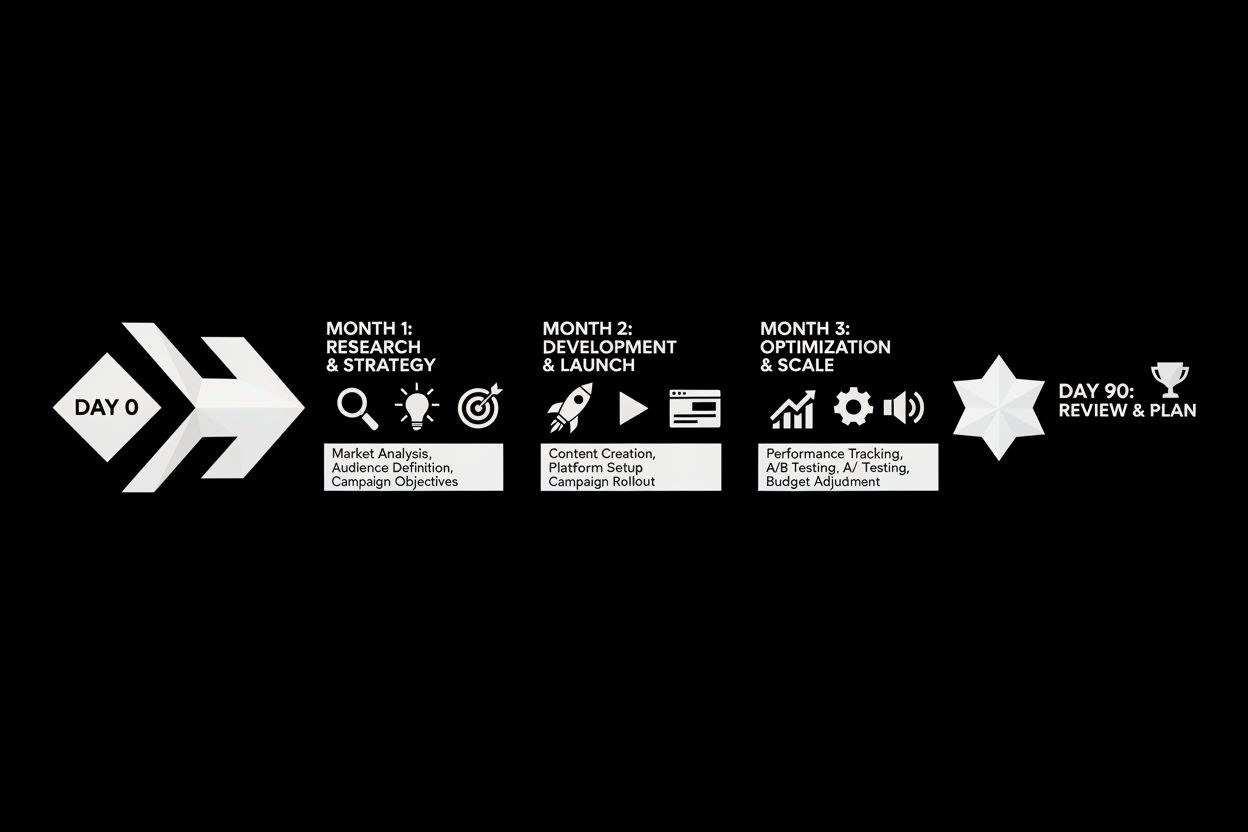
A repeatable framework reduces risk. The 90-Day AI Marketing Transformation Framework below is designed to deliver measurable outcomes quickly.
Phase 1: AI Readiness Assessment (Week 1-2)
Audit data sources, tag quality, and CRM hygiene.
Define business outcomes and baseline KPIs.
Identify quick wins for ads, chat, and content.
Phase 2: Technology Integration (Week 3-6)
Connect data pipelines to the model platform and ad APIs.
Deploy tracking and set up feature engineering scripts.
Build initial models for audience scoring and creative ranking.
Phase 3: Campaign Launch and Learning (Week 7-10)
Launch A B tests across creatives and audience segments on Meta and TikTok.
Deploy an AI chat agent on high traffic pages and integrate with CRM.
Run daily learning loops to pick top-performing variations.
Phase 4: Optimization and Scaling (Week 11-13)
Scale winners, reduce spend on low performers, and introduce personalization layers.
Implement automated reporting and weekly executive summaries.
Plan next quarter experiments for LTV optimization.
30/60/90 day expectations
30 days: Clean data, baseline models, initial small-scale A B tests.
60 days: Model-driven audiences in live campaigns, AI chat agent active, measurable lift in CTR or qualified leads.
90 days: Stronger attribution, scaled campaigns, and demonstrable improvement in CPA and conversion velocity.
Singapore success stories and sample metrics
Showcasing realistic improvements helps set expectations.
B2B SaaS: 312 percent lead generation increase
What changed: Predictive scoring plus an AI chat agent that qualified high intent visitors.
Result: More qualified demo requests, shorter sales cycles.
E-commerce: 47 percent reduction in CAC
What changed: Automated creative testing on TikTok and dynamic product recommendation models.
Result: Lower cost per purchase and improved ROAS.
Financial services: 89 percent improvement in personalization metrics
What changed: CLTV models powering segmented offers and expiry-aware retargeting.
Result: Better cross-sell rates and retention.
These are directional examples. Benchmarks vary by industry and product complexity.
Choosing the right AI marketing partner
A short checklist helps filter vendors from true partners.
15-point agency evaluation checklist
Can they show measurable case studies with metrics?
Do they integrate with your CRM and CDP?
Are the models transparent and auditable?
Do they provide a 90-day roadmap with milestones?
Can they run A B tests and attribute results properly?
Do they have domain experience in your industry?
How do they handle data privacy and compliance?
What SLAs exist for uptime and model performance?
Are creative and data teams co-located or synchronized?
What is the pricing model - retainer, performance, or hybrid?
Do they use human review for generative content?
Can they scale creative variants without quality loss?
How are insights handed over to your internal team?
What tools are included and which require additional licenses?
Can they provide a pilot with clear success criteria?
Red flags to avoid
Vague promises of magic algorithms with no metrics.
Black box models with no explainability.
One-off projects without a plan to operationalize learnings.
Questions every CMO should ask
How will you improve our CPA and by when?
Which channels will you prioritize and why?
How do you measure incremental impact across channels?
AI marketing investment guide for Singapore
Costs depend on scope, data maturity, and channel mix. Below are typical ranges and allocation guidance.
Agency fees
Small pilot: SGD 6,000 to SGD 15,000 for a 90-day pilot.
Ongoing retainer: SGD 8,000 to SGD 30,000 per month depending on services.
Performance models: Mix of base fee plus percentage of media or performance bonus.
Ad spend ranges
Early stage: SGD 3,000 to SGD 10,000 per month split across Meta and TikTok.
Growth stage: SGD 15,000 to SGD 50,000 per month for scale.
Budget allocation guideline
Tools and licensing: 15 to 25 percent of monthly budget for CDP, model hosting, and creative automation.
Strategy and setup: One-time 20 to 30 percent of first quarter spend.
Media and execution: The remainder for campaign spend and creative production.
ROI timeline
Quick wins (30 days): Lower funnel tests, creative swaps, and chat agent qualification that produce immediate lift.
Medium term (60-90 days): Model-driven targeting and personalization show improved CPA and conversion rates.
Long term (6-12 months): LTV improvements and cross-sell lift become measurable.
Data privacy and AI marketing compliance
Complying with PDPA and comparable regulations is non-negotiable. Agencies should adopt privacy-by-design principles.
PDPA checklist
Minimize personal data collection and store only what is necessary.
Obtain explicit consent for profiling and targeted advertising.
Provide clear opt-out pathways and handle data deletion requests quickly.
Keep model training data auditable and avoid storing sensitive data in raw form.
Ethical AI marketing practices
Use explainable features for decisioning.
Validate models against bias and unintended outcomes.
Maintain a human review step for automated content that affects consumer decisions.
Zero-party data strategies
Use direct surveys, preference centers, and gated experiences to collect consented signals for personalization.
When AI marketing fails: common pitfalls and how to avoid them
Poor data quality. Fix: Invest in tracking, cleaning, and event taxonomy.
Over-reliance on automation without human oversight. Fix: Define human-in-the-loop review points.
Misaligned KPIs. Fix: Agree on incremental metrics and control tests.
Ignoring creative quality. Fix: Pair AI variants with human creative directors.
Build your AI-ready marketing team: roles and skills
In-house roles to support an AI program
Head of Growth: Sets outcomes and prioritizes experiments.
Data Engineer: Maintains pipelines and feature stores.
Data Scientist: Builds and validates models.
MarTech Lead: Integrates tools and automations.
Creative Lead: Ensures generated content meets brand standards.
Campaign Manager: Executes and monitors performance.
Smaller teams can outsource specialist roles while retaining strategic ownership.
Get started with AI-driven marketing
If you are evaluating partners, ask for a 90-day pilot with clear KPIs and a data readiness checklist. A good pilot includes predictive audience testing, at least two creative experiments on Meta and TikTok, and an AI chat agent proof of value.
For practical resources on integrating marketing automation, lead generation, and CRM, explore these guides and services:
Automated Lead Generation for funnels and nurture workflows.
Automated Social Media for content pipelines and scheduling.
Automated SEO for scaling organic search results.
Automated AI Chat Agents for on-site qualification and routing.
Paid Ads Management for cross-channel ad execution and optimization.
Ready to evaluate your AI readiness? Book a discovery call or request a pilot scope to see what an AI driven marketing agency can deliver for your business. Visit our contact page to start the conversation: Contact us.