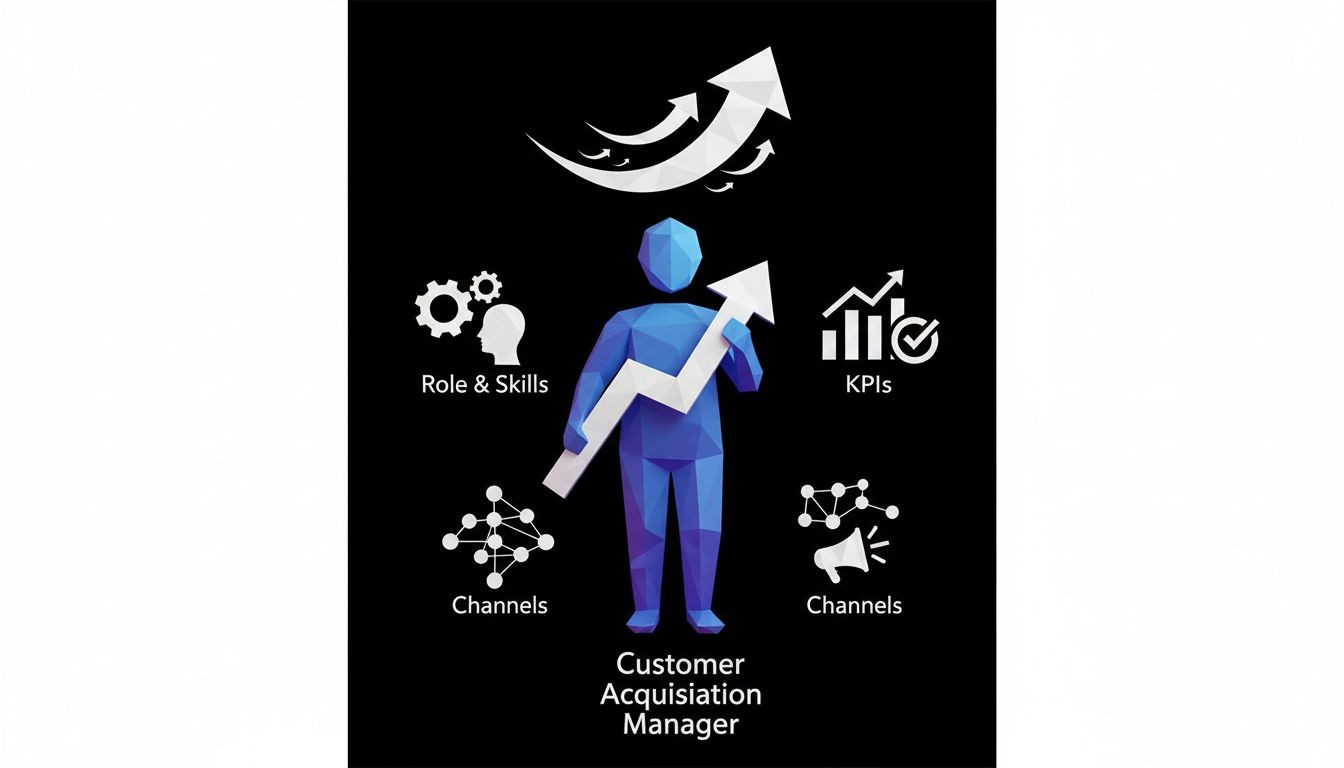
Customer Acquisition Manager: Role, Skills, KPIs, and Channels That Drive Growth
Learn what a customer acquisition manager does, which KPIs matter, and how to grow leads with ads, SEO, social, CRM, and AI chat agents that convert.
A customer acquisition manager is the person who turns interest into measurable growth. In practice, that means building systems that bring in qualified traffic, capture leads, improve conversion rates, and feed clean data back to the CRM and sales team. On a modern team, that work spans ads, search, social, landing pages, chat, and attribution, so the role is equal parts strategist, operator, and analyst. Google Ads now supports lead form assets and call assets across Search, Performance Max, Video, and Display, Meta lead ads can run as forms, click-to-message, or calling, and TikTok supports Instant Forms, website lead generation, and a Leads Center that syncs leads into CRM workflows. (business.google.com)
What a customer acquisition manager actually does
A customer acquisition manager owns the process of turning attention into pipeline. That can mean launching campaigns, testing landing pages, tightening the lead form, improving follow-up speed, and deciding which channels deserve more budget. The job is not just to buy traffic. It is to find efficient ways to create customers, which is why the role usually sits between growth marketing, performance marketing, and sales operations. That is also why clean attribution matters. GA4 traffic-source reporting is built around source, medium, and campaign dimensions, and Google Ads measurement can be strengthened with enhanced conversions for leads and conversion tracking. (support.google.com)

In day-to-day work, the best customer acquisition manager is rarely glued to one channel. They move between media buying, offer strategy, creative feedback, CRM hygiene, and reporting. If the lead flow gets expensive, they look at the whole path, not just the ad account. If lead quality slips, they ask whether the form is too open, the audience is too broad, the landing page is too vague, or the handoff is too slow.
Here is what that usually looks like in practice:
Coordinate paid search and paid social campaigns across Google Ads, Meta, and TikTok. A smart mix often includes lead forms, call extensions, click-to-message, instant forms, and dedicated landing pages. If your team needs help operationalizing that mix, paid ads management and automated social media are the execution layer that keeps the channel work moving. (business.google.com)
Build and improve lead capture flows. That means landing page copy, form length, question sequencing, thank-you pages, and handoff into CRM. A well-run funnel should reduce friction without reducing quality, which is where automated lead generation becomes useful when you want capture, routing, and follow-up to happen without manual chasing. (facebook.com)
Keep organic and paid efforts aligned. Search intent, evergreen content, and conversion-focused pages should support the same commercial goal, not compete for attention. If SEO is part of the acquisition plan, automated SEO helps turn search into a predictable source of demand instead of a side project. (support.google.com)
Work closely with sales and CRM teams so leads do not disappear after the form fill. HubSpot and Salesforce both frame lead management as capturing, qualifying, nurturing, and passing prospects to sales, which is exactly why a customer acquisition manager has to care about routing, scoring, and speed to lead. (hubspot.com)
How to measure success
A customer acquisition manager should be judged on more than clicks and impressions. The core question is simple, does the team turn spend into customers at a cost the business can live with. HubSpot’s basic CAC formula is cost of sales plus cost of marketing divided by new customers, and it recommends measuring CAC over a defined period and, when possible, by channel. (hubspot.com)
CAC, conversion rate, ROAS, and pipeline
CAC is the quickest way to tell whether acquisition is efficient. If CAC rises while revenue stays flat, something in the funnel is breaking. That break can show up in the ad account, the landing page, the offer, or the sales follow-up.
Conversion rate tells a different part of the story. A healthy click-through rate with weak conversion usually means the traffic is not matched to the offer, or the page is not convincing enough. When paid media is a major lever, ROAS matters too, because it ties the media investment back to revenue instead of traffic volume.
Pipeline generated and lead-to-customer conversion are especially important in B2B, where a form fill is not the finish line. Salesforce positions lead generation around driving pipeline, while HubSpot’s lead management tools focus on scoring, routing, nurturing, and passing leads into sales-ready stages. That is the kind of measurement a customer acquisition manager should build toward. (hubspot.com)
Attribution and data hygiene
Good acquisition work depends on good measurement. Google Analytics 4 uses traffic-source dimensions, and it recommends using manual UTM tagging or auto-tagging to understand where traffic really comes from. Google Ads also documents enhanced conversions for leads, which use first-party customer data to improve conversion accuracy and bidding performance. (support.google.com)
That matters because a customer acquisition manager cannot optimize what they cannot trust. If UTMs are missing, lead source data gets messy. If offline conversions never get imported, the team may scale campaigns that look cheap but do not create revenue. If CRM sync is delayed, the optimization loop slows down and the next budget decision is based on stale information.
A simple scorecard to keep in front of you
CAC by channel and campaign.
Lead-to-customer conversion rate.
Cost per qualified lead.
ROAS or revenue per campaign where applicable.
Pipeline generated from paid and organic sources.
Speed to lead and follow-up completion rate.
Customer acquisition manager vs similar roles
The title can sound close to growth marketing manager, demand generation manager, or performance marketing manager, but the focus is not identical.
A growth marketing manager usually has a broader experimentation mindset. They may touch onboarding, retention, referrals, and product-led growth in addition to acquisition. A performance marketer is often more channel-specific and may spend most of the time inside paid media platforms. A demand generation manager usually cares deeply about creating and nurturing interest, especially in B2B, so the work often leans on content, events, email, and handoff to sales.
A customer acquisition manager overlaps with all of those jobs, but the difference is accountability for the entire path from attention to customer. That is an inference based on the way Google, Meta, TikTok, and CRM tools now blend targeting, lead capture, routing, and measurement into one loop. (business.google.com)
In plain English, this role is less about owning one channel and more about making sure every channel contributes to revenue.
Skills and tools that matter
The best customer acquisition manager combines analytical discipline with creative judgment. They need to evaluate offers, write or brief copy, understand audience pain points, and know how to read performance dashboards without getting distracted by vanity metrics. They should also understand how lead quality shows up in the CRM, not just in the ad account.
The modern stack usually includes Google Ads, Meta Ads Manager, TikTok Ads Manager, GA4, a CRM such as HubSpot or Salesforce, and some kind of testing or landing page platform. Google’s docs show how lead form assets, call assets, conversion tracking, and enhanced conversions can work together, while Meta and TikTok both show how lead capture can happen directly in the platform and then sync to downstream systems. (business.google.com)
The soft skills matter just as much:
Clear communication with sales, creative, and web teams.
Fast interpretation of data and pattern recognition.
Budget discipline when scaling or cutting campaigns.
Strong taste for offers, hooks, and customer messaging.
Comfort with experimentation and imperfect data.
If SEO is part of the mix, the manager should also know how to connect search intent to landing pages, content, and conversion paths. If paid media is central, they should know how to balance Meta, TikTok, and search without spreading the budget too thin.
How AI is changing the job
AI is not replacing the customer acquisition manager. It is compressing the time between insight and action. Google Ads emphasizes AI in campaign setup and optimization, and Meta also pushes automation for lead campaigns. That means the manager spends less time on manual setup and more time on offer quality, audience strategy, and the quality of the follow-up. (business.google.com)

This is where AI chat agents become valuable. On Meta, click-to-message lead ads can move prospects into chat without requiring a third-party integration or live customer support, which makes automated qualification a practical part of the funnel. TikTok also supports lead gen through Instant Forms and Leads Center, which helps teams organize, filter, and sync lead information into CRM systems faster. If your team is using chat to qualify interest after hours or route leads in real time, automated AI chat agents can make that process much easier. (facebook.com)
The best use of AI in acquisition is not to hand over strategy. It is to remove repetitive work:
Drafting ad variants for testing.
Summarizing campaign performance.
Suggesting follow-up questions for lead qualification.
Routing leads faster based on source or intent.
Spotting underperforming audiences before the budget burns out.
That gives the customer acquisition manager more time to think about the thing AI cannot do well on its own, which is understanding the customer, the offer, and the commercial tradeoff behind every campaign.
How to hire or evaluate one
If you are hiring for this role, look for evidence that the candidate can connect channel activity to revenue. Someone who only talks about impressions, clicks, or CTR is not enough. You want someone who can explain how they improved lead quality, how they measured CAC, how they worked with sales when follow-up broke down, and how they decided when to scale or pause a campaign. HubSpot’s and Salesforce’s lead management materials both reinforce the same idea, acquisition is a shared system, not a solo task. (hubspot.com)
A strong interview process might include these questions:
Walk me through a campaign you scaled from test budget to meaningful pipeline.
How do you decide whether a channel is producing customers or just leads?
What do you do when CPL drops but lead quality drops too?
How do you connect Meta or TikTok lead forms to CRM follow-up?
Which metrics do you review first when performance changes suddenly?
You can also ask for a simple 30, 60, 90 day plan. In the first 30 days, the candidate should map the funnel, audit measurement, and identify quick wins. By 60 days, they should be testing offers, creative, and landing pages. By 90 days, they should be able to show cleaner reporting, stronger lead quality, or a lower cost per customer.
FAQs
What does a customer acquisition manager do?
A customer acquisition manager builds and improves the systems that bring in new customers. That usually includes paid media, landing pages, lead capture, CRM handoff, and measurement across the funnel. (business.google.com)
Is the role more marketing or sales?
It is usually both. The role lives close to marketing because it owns demand creation, but it also lives close to sales because it has to make sure leads are qualified, routed, and followed up properly. (hubspot.com)
Which KPIs matter most?
CAC, conversion rate, cost per qualified lead, pipeline generated, lead-to-customer conversion, and ROAS if paid media is central. GA4 traffic-source data and Google Ads conversion tools are especially useful for tracking those numbers cleanly. (hubspot.com)
What tools should they know?
At minimum, they should be comfortable with Google Ads, Meta Ads, TikTok Ads Manager, GA4, and a CRM. If the team runs chat or automation, they should also understand how lead routing, messaging flows, and follow-up rules work. (business.google.com)
What makes a great customer acquisition manager stand out?
They think in systems. They do not just launch campaigns. They improve the full path from click to customer, which is what keeps acquisition efficient as the company grows.
A strong customer acquisition manager is not just a media buyer or a lead generator. They are the person who keeps paid social, search, SEO, chat, and CRM working together so growth stays predictable. If that system is built well, the business gets more than traffic. It gets a repeatable way to create customers.