AI Marketing Systems for Scaleups: A Practical Guide to Grow Faster with Less Waste
Practical guide to AI marketing systems for scaleups. Learn stage-based roadmaps, tool stacks, integration playbooks, failure modes, and ROI metrics.
Customer acquisition costs keep rising while teams stay lean, and scaleups that fail to modernize their marketing stack lose momentum fast. AI marketing systems for scaleups are not magic shortcuts. When implemented correctly they cut CAC, accelerate funnel velocity, and unlock personalized experiences across channels. This guide walks through what those systems look like, how to pick tools, how to avoid common failure modes, and how to show investors the impact.
What are AI marketing systems for scaleups?

AI marketing systems for scaleups are collections of people, processes, and tools that use machine learning and generative models to automate and scale marketing activities. They combine data collection, predictive models, automated creative generation, chat agents, and ad optimization to turn top of funnel signals into qualified leads and revenue. For scaleups the emphasis is on speed, repeatability, and measurable ROI rather than academic accuracy.
Key characteristics:
Data first. Systems rely on unified customer data from product usage, ad interactions, and CRM events.
Human-led operation. AI augments marketers rather than replaces strategic judgment.
Modular tooling. Best practice is a composable stack that can swap vendors without disrupting operations.
Measurement and control. Clear KPI mapping and guardrails for spend and privacy.
Using the right architecture, scaleups can reduce CAC, shorten sales cycles, and personalize at scale while keeping headcount under control.
Why a human-led AI strategy matters for scaleups
AI will change how work gets done but it will not remove accountability for outcomes. Human-led systems keep creativity, strategy, and governance in the loop. Below are five strategic pillars every scaleup should design around.
1. Data and hygiene
Good models start with good data. Consolidate first party events, clean identifiers, and agree on canonical definitions for activation, MQL, and SQL. Treat data ingestion like a product with SLAs.
2. People and roles
Assign an AI marketing owner who sits at the intersection of marketing, product, and analytics. Define responsibilities for prompt engineering, model monitoring, and creative review.
3. Processes and governance
Create templates for prompt reviews, test windows, and rollout thresholds. Document when to switch from automated creative to manual creative based on conversion deltas.
4. Tools and integrations
Prefer tools with robust APIs and event-level export. Plan for a CDP and a lightweight orchestration layer so data moves reliably between systems.
5. Measurement and feedback
Build dashboards that map AI outputs to revenue impact. Use experiments and holdouts to validate model-driven changes before full rollout.
These pillars work together to prevent common problems like model drift, poor personalization, or wasted ad spend.
A stage-based roadmap: what to build at each growth phase
Scaleups evolve quickly and a one-size-fits-all stack wastes money. Below is a practical roadmap for the common scaleup path from seed to Series B and beyond.
Seed and early product market fit
Focus: lead capture, basic automation, and cost-efficient testing.
Essential systems: lightweight CRM (free HubSpot or similar), chat widget with rule-based flows, simple email automation.
AI uses: automated content drafts, title and meta suggestions for landing pages, simple ad creative variants.
KPIs: lead velocity, trial starts, CAC per channel.
Series A
Focus: predictable acquisition channels and qualification.
Essential systems: CDP or event pipeline, marketing automation with predictive lead scoring, conversational AI for qualification.
AI uses: lead scoring models, chat agents that hand off hot leads to sales, dynamic creative optimization for Meta and TikTok.
KPIs: conversion rates by cohort, qualified leads per rep, CAC trends.
Series B and growth
Focus: scale, attribution, and personalization.
Essential systems: advanced personalization engine, account based intelligence, deterministic attribution and incremental testing frameworks.
AI uses: predictive account intent signals, multi-variant creative optimization, automated lifecycle campaigns with triggers from product usage.
KPIs: LTV to CAC ratio, win rate uplift, revenue velocity.
Knowing which capabilities to add and when prevents overengineering and reduces technical debt.
Recommended stack: tools mapped to marketing functions
Pick vendors that match stage, budget, and integration needs. Below are functional categories with vendor examples and why they fit scaleups.
Content, SEO, and generative creative
Jasper and SurferSEO for fast draft generation and on-page optimization. Use them to produce briefs, outlines, and A/B testable copy variations.
For automated SEO workflows consider linking content tasks to your SEO pipeline and then tracking organic movement with a toolchain.
Useful resource: Automated SEO - The Social Search for setting up automated content workflows.
Chat agents and lead qualification
Drift, Intercom, and modern conversational platforms can route intent qualified leads to sales or capture detailed forms for nurturing.
Design chat flows that capture intent signals and product usage details. Keep humans in the loop for handoffs.
See service examples: Automated AI Chat Agents - The Social Search.
Social media and organic distribution
Tools like Sprout Social, Hootsuite, and Loomly automate publishing and reporting. For scaleups wanting campaign-level automation, consider dedicated AI creative calendars.
Learn about automating social presence: Automated Social Media - The Social Search.
Paid ads and creative optimization
Native Meta and TikTok ad platforms now include automated creative optimization. For enterprise features use Smartly or VidMob for asset testing and creative analytics.
Use dynamic creative for rapid multivariate testing and let AI recommend winning combinations, then validate with holdouts.
If you need help with ad operations at scale see Paid Ads Management - The Social Search.
Data and analytics
CDP and event pipelines: Segment, RudderStack and a warehouse like BigQuery. For intent data and ABM, consider 6sense or Demandbase.
Analytics: Amplitude or Mixpanel for product signal, and a BI layer for investor-ready dashboards.
Orchestration and integration
Use Make, Zapier or custom serverless functions to sync events, trigger workflows, and handle edge cases. Keep orchestration logic versioned and testable.
This stack is modular. Start with minimal viable pieces and add APIs as you validate value.
Integration playbook: how to connect systems reliably
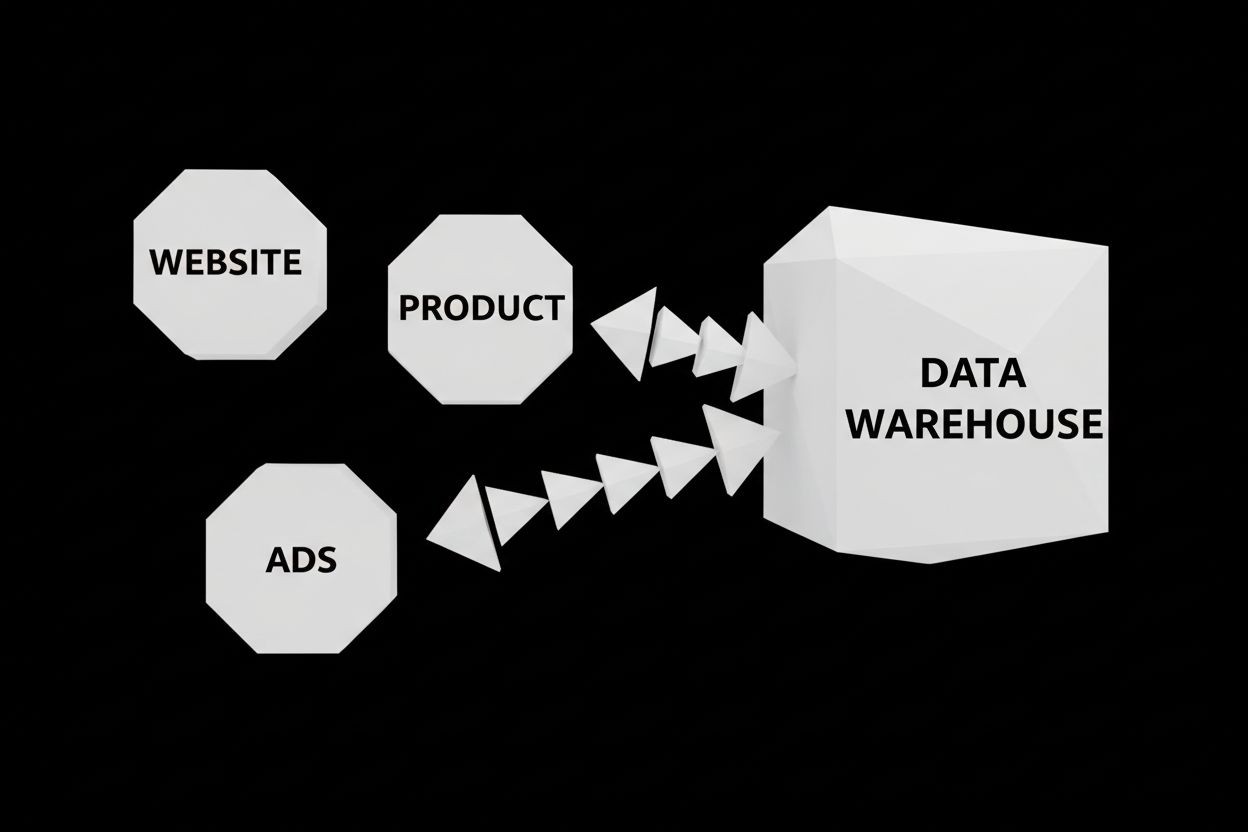
Integration mistakes cause more pain than wrong tool choices. Follow this playbook.
Map your events
List every event that matters for marketing and sales. Examples include sign up, trial start, invite sent, ad click, demo booked. Each event needs a canonical name and payload schema.
Choose a canonical source of truth
Decide whether CRM, CDP or data warehouse holds canonical identity and event history. Avoid duplicate event ownership across tools.
Use event-level integrations
Ship raw events to the warehouse and then transform them for each tool. This ensures reproducibility and easier debugging.
Orchestrate with idempotent APIs
Write connectors to be idempotent. If a webhook retries you must handle duplicate events gracefully.
Implement observability
Build logs, error alerts, and replay capabilities. Track data freshness and failed syncs.
Start with a test cohort
Validate integrations on a subset of traffic before rolling out across all campaigns.
Common failures and fixes:
Missing identifiers across systems. Fix: prioritize email or user id and backfill historical mappings.
Event schema drift. Fix: version event contracts and add monitoring for schema changes.
Latency in pipelines leading to stale personalization. Fix: prioritize near real time for high value signals like intent.
Change management, roles, and hiring tradeoffs
AI shifts work but does not eliminate the need for people. Define roles and a training plan before you deploy.
Suggested roles:
AI Marketing Lead: owns strategy, vendor selection, and KPI reporting.
Prompt Engineer / Content Ops: builds and maintains prompt templates and content checks.
Data Engineer: maintains pipelines and ensures data integrity.
Growth Analyst: runs experiments and measures lift.
Hiring vs tooling tradeoffs:
If your growth playbook depends on high quality creative, prioritize hiring a head of creative and use AI for ideation.
If you need scale across channels rapidly, invest in automation tools and a small ops team to supervise.
Training framework:
Run weekly learning sessions to share prompts, failed experiments, and best practices.
Maintain a prompt library and a creative style guide.
Measuring impact: metrics investors and boards care about
Focus on a small set of investor-friendly metrics and show causal links to revenue.
Core metrics:
CAC and CAC payback period.
LTV to CAC ratio and cohort LTVs.
Lead to MRR conversion rates by channel.
Incremental revenue from AI-driven campaigns measured via holdouts.
Generative Engine Optimization and AI search citations
To capture AI-driven discoverability, optimize content for AI search with clear authoritative snippets, structured data, and traceable citations. Track mentions in AI-driven discovery tools and measure referral velocity from AI-first sources.
Five common failure modes and how to recover
Garbage in garbage out
Symptom: models make poor recommendations. Fix: pause and audit data pipelines, backfill missing fields, and retrain with clean data.
Tool sprawl
Symptom: too many overlapping tools. Fix: rationalize by usage and cost, decommission duplicates, and enforce procurement rules.
Lack of measurement
Symptom: no causal proof for AI spend. Fix: implement holdouts and experiment windows, and publish experiment results.
Governance blind spots
Symptom: privacy or compliance issues. Fix: inventory data flows, add consent checks, and align with legal.
Over-automation of creative
Symptom: creative fatigue and declining engagement. Fix: rotate human-created assets into the cycle and use AI to amplify proven themes.
Recognize these early and you can recover in weeks rather than quarters.
Quick checklist and next steps
Inventory events and pick a canonical data store.
Assign an AI marketing owner and define success metrics.
Start with a single high impact use case: lead qualification or ad creative testing.
Run a controlled experiment with a holdout group to measure lift.
Build a template library for prompts and creative briefs.
If you want hands-on help building these systems, consider starting with automated lead workflows and ad operations. For support with lead pipelines, creative automation, SEO automation, and ad operations, these resources can help:
Automated Lead Generation - The Social Search for pipeline automation and qualification.
Paid Ads Management - The Social Search to scale Meta and TikTok campaigns with AI-driven optimization.
Automated SEO - The Social Search to systemize content production and technical optimization.
Automated AI Chat Agents - The Social Search for building conversation flows that convert.
Automated Social Media - The Social Search to keep channels active and data connected.
Deploying AI marketing systems for scaleups is about pragmatic sequencing. Pick a high impact use case, instrument measurement, and iterate rapidly. With the right mix of people, process, and tools you can accelerate growth while keeping spend efficient.
If you are ready to prototype an AI-driven campaign or need a review of your stack, map your events and start a 30 day experiment. Small bets with rigorous measurement are the fastest path to scalable growth.