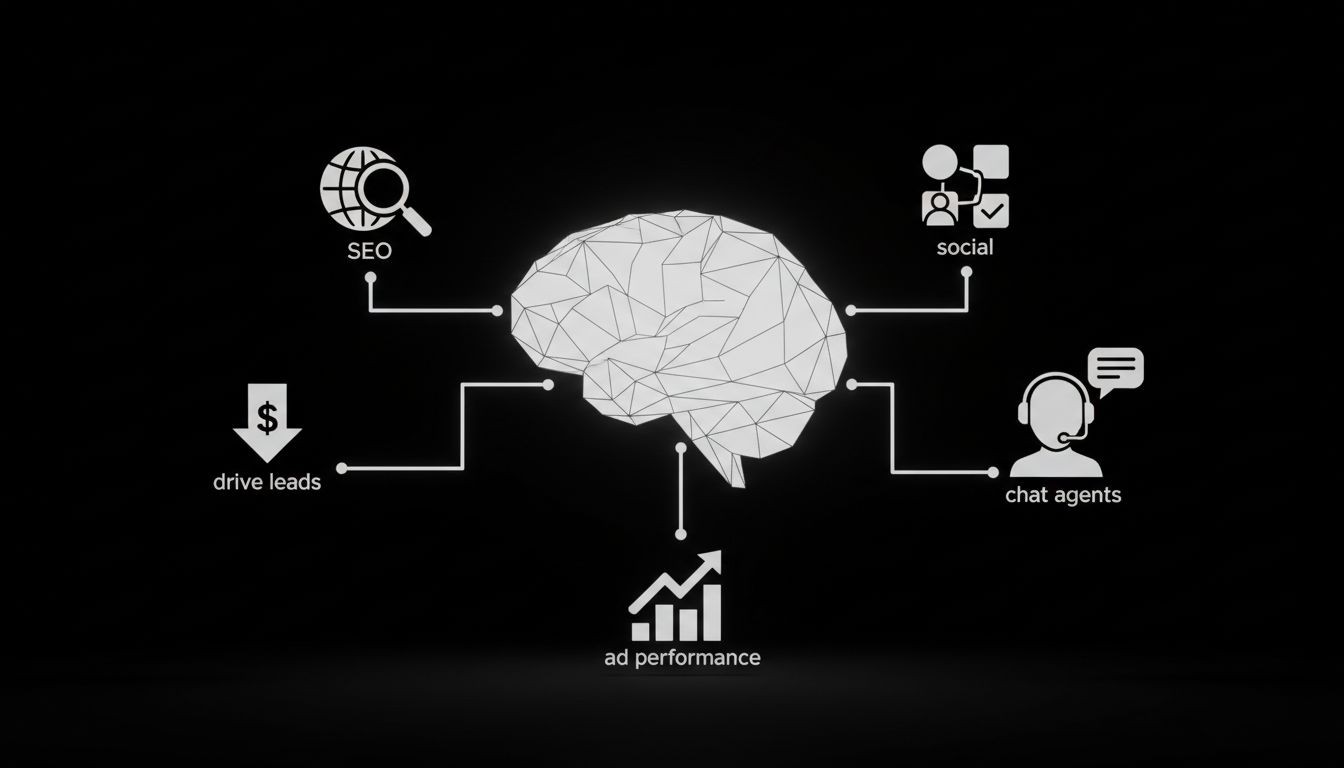
AI content automation for businesses: A practical guide to drive leads, SEO, social, chat agents, and ad performance
Learn how AI content automation for businesses drives leads, improves SEO, scales social media, powers chat agents, and optimizes Meta and TikTok ads.
Every business wants content that converts, ranks, and scales with minimal friction. AI content automation for businesses makes that possible by turning strategy into repeatable workflows. This guide shows practical steps to design systems that generate blog posts, social posts, ad creatives, and chat agent responses while keeping control over brand, quality, and performance.
Why AI content automation matters for businesses

AI content automation is not about replacing marketing teams. It is about increasing output, reducing repetitive work, personalizing at scale, and improving speed to insight. For businesses focused on lead generation and revenue, automation unlocks three concrete advantages:
Faster experimentation. Generate and test dozens of headlines, hooks, and ad variations each week instead of a few.
Better personalization. Deliver different messages to segments based on behavior, intent, or ad channel without manual copy rewriting.
Efficient scaling. Reuse templates and data-driven prompts so local teams or product lines can publish consistent content quickly.
When paired with an SEO strategy, automation can turn keyword research into an editorial calendar and bulk content production. If you want to dive deeper into automating search and organic growth, see our piece on Automated SEO for tools and process examples.
Core components of a productive AI content automation system
A reliable system has people, processes, and tooling working together. Below are the components to prioritize.
Strategy and taxonomy
Define target audiences, buying stages, and channel objectives.
Create a content taxonomy that maps topic clusters to funnel stages and formats.
Reusable templates and prompts
Build templates for blogs, social posts, ad copy, and chat responses.
Store prompts and examples so outputs remain consistent across teams.
Content generation engine
Use an LLM or multiple models for short copy, long form, and creative brainstorming.
Implement role-based access so subject matter experts can contribute safely.
Editorial workflow and human-in-loop review
Automate drafts but require human review for legal, compliance, and final brand voice.
Add status fields for draft, revision needed, approved, and published.
Distribution and scheduling
Integrate with CMS, social schedulers, ad platforms, and CRM to push content automatically.
Ensure UTM and tagging rules are applied consistently.
AI chat agents and lead capture
Use chat agents to handle common questions, book demos, and qualify leads.
Route leads into CRM for follow up and automate nurture sequences. For a dedicated solution that builds AI chat flows, review our Automated AI Chat Agents service page.
Analytics and feedback loop
Track content performance across channels and feed results back into prompt tuning and editorial guidance.
Practical workflows and example prompts
Below are reproducible workflows for the most common business goals: lead generation, SEO content, social media, and paid ads.
Workflow A - Automated lead generation blog post
Input: Keyword cluster, target persona, and desired CTA.
Prompt template: “Write a 900 word blog post for [persona] about [topic], include a short checklist, one internal link, and a CTA to book a demo. Tone: professional and helpful.”
Generate outline and ask a subject matter expert to annotate facts.
Produce full draft, human edit for accuracy and brand voice.
Auto-publish to CMS with metadata and UTM parameters.
Trigger social snippets and ad copy generation based on the published post.
Workflow B - Social content at scale
Input: Published blog or campaign brief.
Auto-generate 10 caption variations, 5 short hooks, and 3 image caption suggestions.
Apply audience segmentation to select which variants go to which audience.
Schedule posts in the social scheduler and route top-performing captions into ad creative pools.
For a platform that automates social content publishing and scheduling, see our Automated Social Media offering.
Workflow C - High velocity ad creative testing for Meta and TikTok
Feed top performing headlines and hooks into an ad writer prompt.
Generate 20 variations of primary text and 10 short video script ideas.
Auto-create UTM tagged assets and a naming convention for A B tests.
Push to ad account or to your paid ads manager for campaign creation.
If running and optimizing ads is a priority, our Paid Ads Management page outlines how automation and human oversight combine to reduce cost per lead.
Prompt examples you can copy and adapt
Blog outline prompt: “Create a structured outline for a 1 200 word article on [topic] that targets [keyword], with 5 headings, suggested word counts, and two internal link ideas.”
Ad copy prompt: “Write 10 short ad captions for Meta promoting [product]. Include a hook, benefit, and CTA in 90 characters or less.”
Chat agent prompt: “Provide concise responses to these three FAQs about [product], then ask a qualifying question to capture lead intent.”
Implementing across channels
AI content automation yields the most value when it is channel aware.
Search and SEO
Use automation to produce skeleton posts, meta descriptions, schema snippets, and internal linking suggestions.
Automate the process of turning keyword clusters into an editorial calendar. Combine automation with manual review to avoid surface level content.
Social media and community
Automate caption generation and A B test different hooks for short form platforms.
For TikTok, automate script and shot list generation so creators can record faster. Then run variations to discover which hooks drive the best watch time or conversions.
Chat agents and lead routing
Put AI chat agents on high traffic pages to qualify visitors, capture emails, and schedule calls.
Keep a human fallback and require human verification for pricing or contract negotiations.
Paid social and prospecting
Auto-generate ad creatives and audience copy, then launch multi-variant tests.
Use automation to rotate creatives and pause underperforming variants quickly.
Tie each channel back to measurable outcomes such as leads, pipeline, or revenue. If your goal is better lead operations and automated nurture, check our Automated Lead Generation page for implementation patterns.
Measuring success and scaling safely
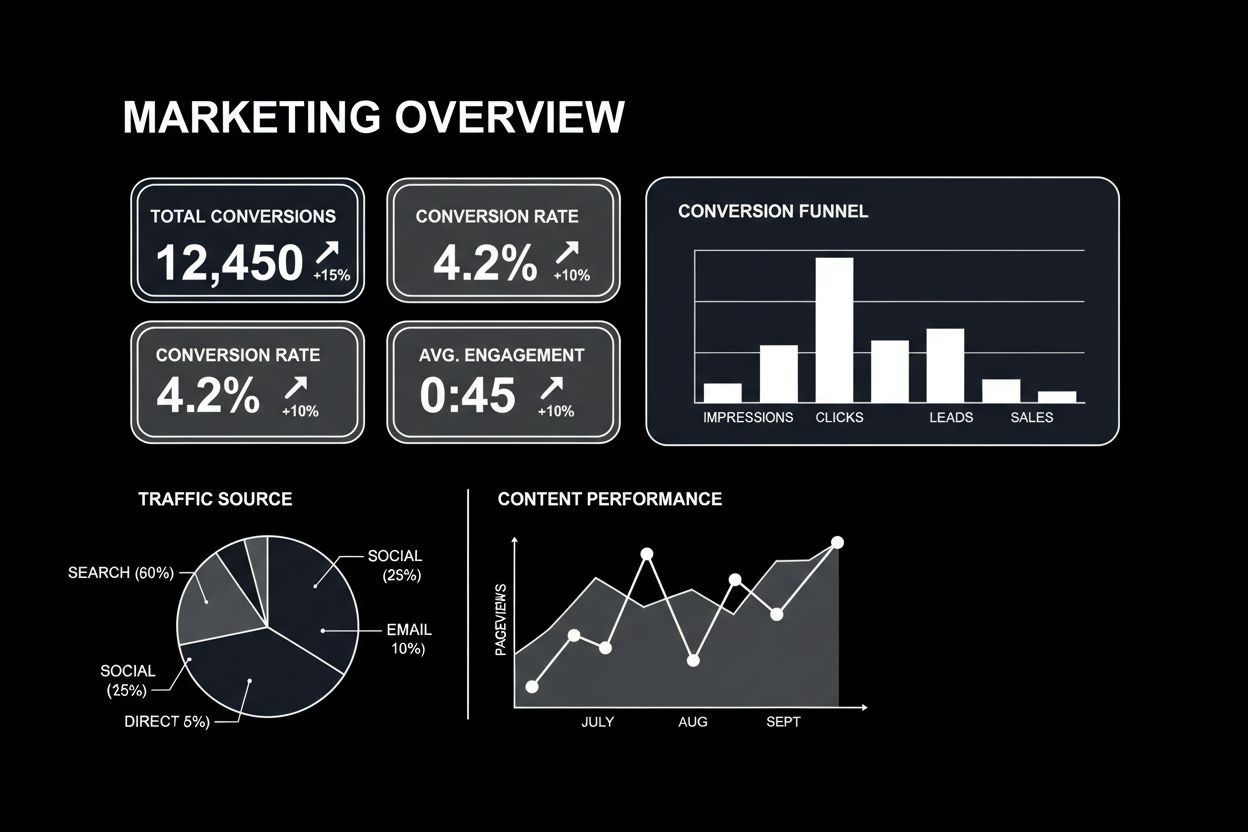
Track these KPIs to evaluate your AI automation program:
Lead volume and lead quality - measure conversions and downstream revenue.
Conversion rate by content type - compare blog, social, and chat-driven leads.
Cost per lead and cost per acquisition - critical for paid channels.
Organic traffic and keyword rankings - to evaluate SEO automation outcomes.
Time saved and throughput - quantify how many hours or FTEs are replaced or freed up.
Quality control is essential. Put these guardrails in place:
Human review for final publishing and sensitive topics.
Staging environment for content before live publication.
Automated checks for brand words, compliance phrases, and blocked terms.
Regular audits for factual accuracy and link integrity.
Scaling approach
Pilot with one product line or region.
Measure impact on KPIs and refine prompts.
Expand to other channels and teams once you have repeatable ROI.
Roadmap and budget template for a 6 month rollout
Month 1 - Discovery and foundations
Define personas, funnel stages, and content taxonomy.
Select LLM providers and automation tooling.
Build initial templates and approval flow.
Month 2 - Pilot content generation
Produce 10 blog posts and 50 social variations.
Run small ad experiments using AI-generated copy.
Month 3-4 - Integrations and chat agents
Connect CMS, social scheduler, ad manager, and CRM.
Deploy AI chat agent on two high traffic pages and measure conversion.
Month 5-6 - Optimize and scale
Run A B tests across channels, expand to more product lines, and set guardrails.
Document processes and train teams.
Sample budget ranges for a small to medium business
Tooling and model costs: $1 000 to $5 000 per month depending on usage.
Implementation and integration: $10 000 to $40 000 one time.
Ongoing content ops and review: $5 000 to $15 000 per month depending on volume.
Adjust based on how many channels you automate and the volume of content you produce.
Common pitfalls and how to avoid them
Over-automation without oversight
Risk: Harm to brand voice or factual errors. Solution: Keep human-in-loop stages and role-based approvals.
Poor prompt hygiene
Risk: Inconsistent outputs. Solution: Maintain a library of tested prompts and examples.
Ignoring measurement
Risk: You produce content but do not know what works. Solution: Define KPIs up front and automate tagging and analytics.
Legal and privacy blind spots
Risk: Data leaks or regulatory problems. Solution: Review data sources, exclude sensitive data from prompts, and maintain a privacy policy.
Running too many experiments at once
Risk: Confounding results. Solution: Stage experiments and change one variable at a time.
Quick start checklist and prompt bank
Checklist to launch in 30 days
Define 2 target personas and 5 priority topics.
Create 3 prompt templates for blog, social, and ads.
Publish 2 pilot blog posts and 10 social posts.
Deploy chat agent on one page with lead capture.
Set up analytics dashboards and UTM rules.
Copyable prompt examples
Blog brief: “Write a 1 000 word article about [keyword]. Include an H2 on common mistakes and an H3 checklist. Tone: practical and direct.”
Social caption: “Create 8 caption variants for LinkedIn announcing [feature]. Keep each under 150 characters and include one question.”
TikTok script: “Create a 30 second script with a strong hook in the first 3 seconds, three quick benefits, and a CTA to visit our link in bio.”
Chat intro: “Hi, I am the product assistant. How can I help today? If the user asks about pricing, ask one qualifying question and offer to schedule a demo.”
Final notes and next steps
AI content automation for businesses can be a growth multiplier when you pair automation with the right processes. Start small, measure rigorously, keep humans in the loop, and expand once you have validated outcomes. If you want help implementing a tailored program that covers social automation, ads, and lead capture, our services combine automation with hands on optimization. Learn more about automated lead generation at Automated Lead Generation or contact us to discuss a custom roadmap.
If you are ready to talk through a pilot or need a partner to build the infrastructure, reach out through our contact page and we will help you design a plan that drives leads and revenue.