The Ultimate Guide to Sales Marketing Success in 2026
Master sales marketing in 2026 with expert strategies, AI tools, and proven frameworks to generate leads, align teams, and drive measurable revenue growth.
Dec 6, 2025
Imagine closing more deals, faster, and with less manual effort. Welcome to the new era of sales marketing in 2026.
This ultimate guide reveals the strategies, technologies, and step-by-step processes you need to achieve sales marketing success. Discover how automation, AI-driven tools, and data-driven strategies are transforming the way businesses connect with customers.
Stay ahead by learning how to generate leads, nurture prospects, and close deals in a hyper-competitive market. Implement these proven methods to future-proof your approach and outperform your competition.
Understanding Sales Marketing in 2026
The landscape of sales marketing is transforming rapidly, setting the stage for smarter, more connected business growth in 2026. As organizations adapt to new technologies and shifting customer expectations, understanding these changes is crucial for staying ahead.
The Evolving Definition of Sales Marketing
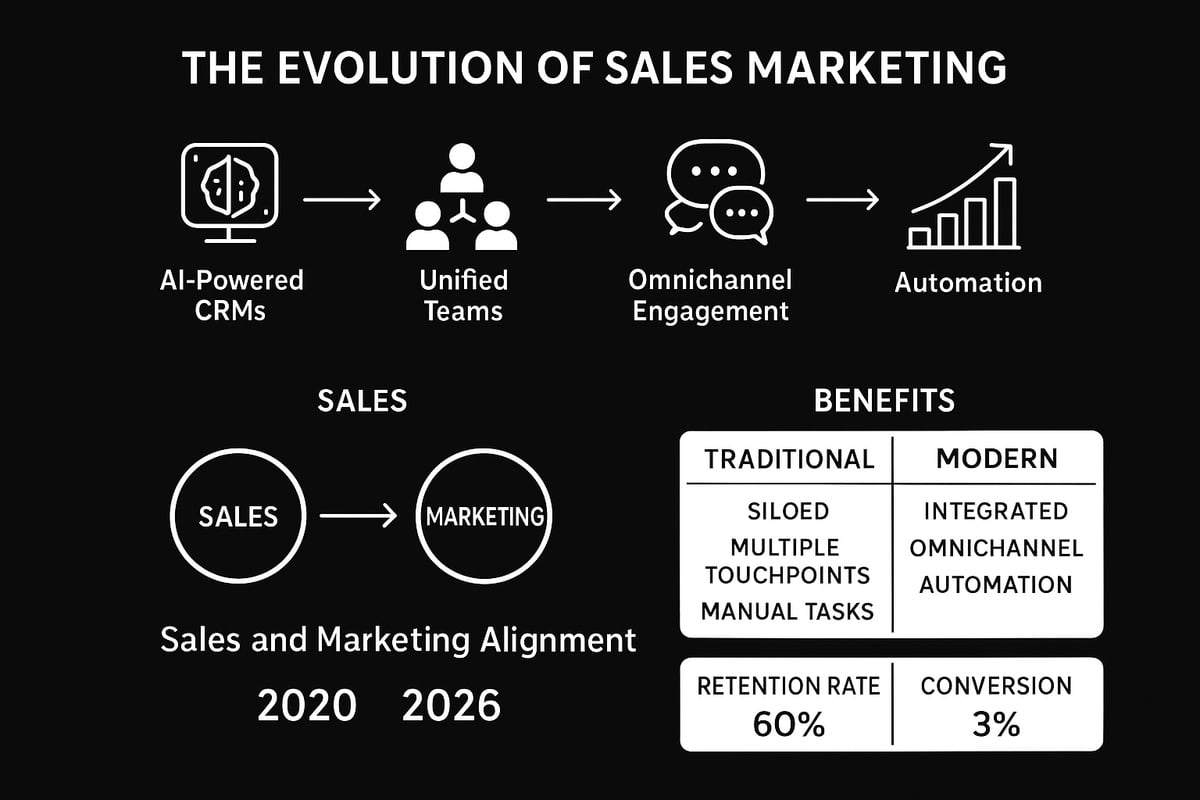
Sales marketing in 2026 goes beyond traditional boundaries, bringing together advanced AI, real-time analytics, and multi-channel engagement. The shift from separate sales and marketing teams to unified revenue operations is now essential. Companies focus on the entire customer lifecycle, prioritizing experience and value at every touchpoint.
For instance, organizations leverage AI-powered CRMs to monitor each interaction and adapt strategies dynamically. Competitors like ActiveCampaign stress the importance of alignment and automation. To explore the core principles behind this transformation, see About sales marketing strategies.
Key Benefits for Modern Businesses
Modern sales marketing offers measurable advantages for businesses ready to embrace innovation. Targeted, data-driven campaigns drive higher sales revenue and improve lead quality. Predictive analytics refine customer acquisition, while automation streamlines the sales process.
Companies adopting these tools report increased conversion rates and stronger customer retention. Marketing automation, in particular, has become a key driver for efficient prospect nurturing. Enhanced customer experiences are now a direct result of integrated sales marketing strategies.
Sales Marketing vs. Traditional Marketing and Sales
Traditional approaches often rely on manual segmentation and broad messaging, making it harder to engage today’s informed buyers. In contrast, sales marketing in 2026 leverages automation, personalization, and seamless collaboration between departments.
Aspect | Traditional Approach | Sales Marketing 2026 |
|---|---|---|
Segmentation | Manual | AI-driven |
Messaging | Generic | Personalized |
Team Collaboration | Siloed | Unified |
Technology | Basic tools | Integrated platforms |
ROI | Lower | Higher |
Businesses using unified platforms report shorter sales cycles and improved ROI, highlighting the value of modern sales marketing.
The Importance of Alignment and Integration
Alignment between sales and marketing teams eliminates friction and boosts efficiency. When organizations combine CRM, automation, and analytics, they gain a complete view of the customer, enabling more strategic decision-making.
Research shows that businesses with strong sales marketing alignment achieve 36% higher customer retention. Integrated tech stacks help teams respond faster to market changes and maintain consistent messaging throughout the buyer journey.
Challenges and Opportunities Ahead
Sales marketing teams face rapid technology changes and stricter data privacy regulations. Adapting to these shifts is challenging, but also presents a unique opportunity to stand out through exceptional customer experiences.
Companies that quickly embrace new tools and compliance standards gain an edge over competitors. The future of sales marketing belongs to those who prioritize agility, integration, and customer-centric strategies.
The 2026 Sales Marketing Tech Stack: Essential Tools and Platforms
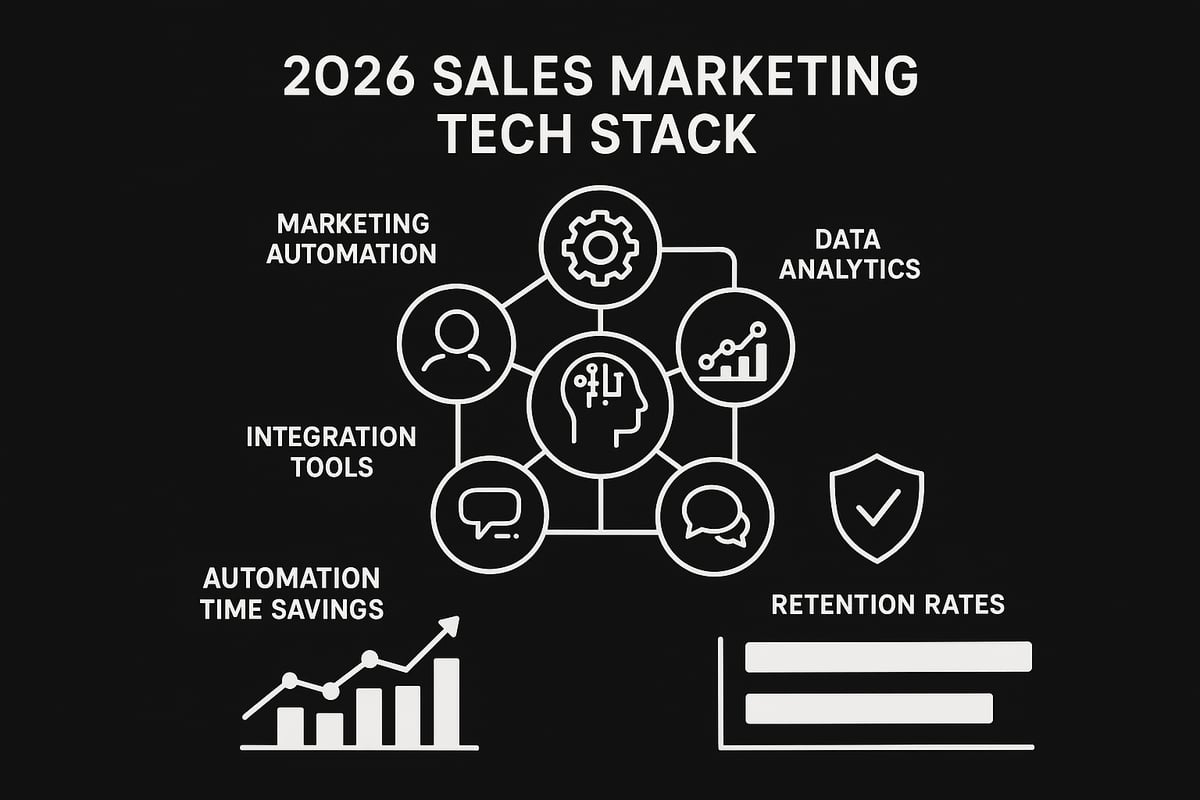
The landscape of sales marketing is evolving rapidly, driven by a tech stack designed for intelligence, automation, and seamless customer experiences. In 2026, businesses need to invest in a cohesive set of platforms that power every stage of the sales marketing process, ensuring agility and measurable growth.
AI-Powered CRM and Sales Automation
AI-powered CRM systems are the backbone of sales marketing in 2026. These platforms use machine learning to score leads, manage pipelines, and automate personalized outreach based on real-time customer behavior.
Top platforms such as Salesforce, HubSpot, and ActiveCampaign enable sales teams to delegate routine follow-ups to AI agents, freeing up time for high-value relationship building.
Key benefits include:
Automated prospect prioritization
Predictive sales forecasting
Seamless integration with other sales marketing tools
With AI at the core, sales marketing teams can act on insights faster and optimize every touchpoint.
Marketing Automation and Customer Journey Orchestration
Marketing automation is central to modern sales marketing, orchestrating campaigns across email, SMS, and messaging apps. Businesses can design and automate complex customer journeys, ensuring timely and relevant communication with every prospect.
Automated workflows not only enhance efficiency but also unlock deeper personalization. According to industry research, well-implemented automation can save teams up to 13 hours per week. For a deeper dive into how AI is transforming these processes, visit AI in marketing automation.
By leveraging marketing automation, sales marketing professionals deliver targeted content and nurture leads at scale, increasing both conversion and retention rates.
Data Analytics and Performance Tracking
Effective sales marketing hinges on actionable data. Advanced analytics platforms provide real-time dashboards, allowing teams to monitor campaign performance and customer engagement.
Predictive analytics tools help forecast sales trends, identify high-value opportunities, and inform decision-making. Sales marketing teams use these insights to refine strategies, allocate resources efficiently, and measure ROI.
A typical workflow involves:
Tracking engagement across channels
Segmenting audiences based on behavior
Optimizing campaigns through continuous analysis
With robust analytics, sales marketing becomes a data-driven engine for growth.
Omnichannel Communication Solutions
Omnichannel communication is essential for reaching customers where they are. Sales marketing teams integrate email, SMS, WhatsApp, and social media to provide a unified, personalized experience at every touchpoint.
Dynamic content ensures messaging adapts in real time, reflecting customer preferences and behavior. Retailers, for instance, report higher conversion rates by orchestrating coordinated cross-channel campaigns.
Key features include:
Centralized messaging platforms
Real-time personalization
Consistent brand voice across channels
By mastering omnichannel outreach, sales marketing professionals maximize engagement and customer satisfaction.
Integration and Workflow Automation
A truly effective sales marketing stack relies on seamless integration. Connecting CRM, marketing, sales, and support platforms ensures all teams have access to up-to-date customer data.
Popular integrations include Salesforce, Slack, Zapier, Shopify, and Google Ads. These connections eliminate manual data entry and reduce errors, while workflow automation streamlines repetitive tasks.
Benefits of integration for sales marketing:
Unified customer profiles
Faster response times
Improved collaboration across departments
Workflow automation empowers sales marketing teams to focus on strategy and customer relationships rather than administrative tasks.
Security, Compliance, and Data Privacy
As sales marketing becomes more data-driven, security and compliance are non-negotiable. Organizations must adhere to regulations such as GDPR and CCPA, using tools for consent management and secure communications.
Trust is a differentiator in sales marketing. Businesses that prioritize data protection not only avoid regulatory risks but also build stronger customer loyalty.
Security essentials include:
Encrypted communications
Automated consent tracking
Regular compliance audits
By integrating security into every layer of the tech stack, sales marketing teams safeguard their reputation and customer relationships.
Step-by-Step Blueprint for Sales Marketing Success in 2026
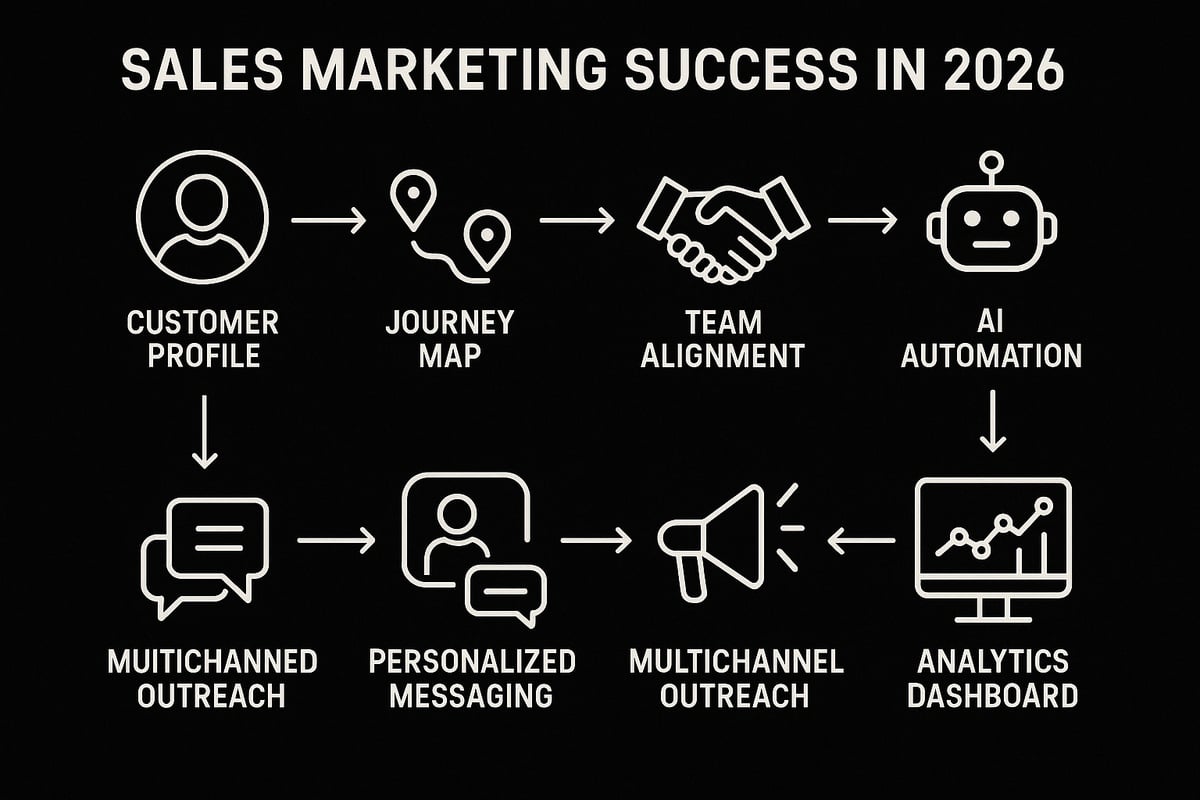
Unlocking sales marketing success in 2026 requires a systematic approach. By following a proven blueprint, modern businesses can streamline their processes, boost lead generation, and maximize revenue growth. Here is a detailed, actionable roadmap for transforming your sales marketing strategy and achieving measurable results.
Step 1: Define Your Ideal Customer Profile and Buyer Personas
Effective sales marketing in 2026 begins with a crystal-clear understanding of your ideal customer. Start by gathering demographic, behavioral, and psychographic data from your CRM and analytics platforms. AI-powered segmentation tools help reveal new patterns within your audience, making it easier to create detailed buyer personas.
For example, SaaS companies now leverage advanced CRM data to refine customer profiles, allowing for precise targeting and higher engagement rates. Consider mapping out attributes such as company size, job role, pain points, and purchase behaviors. This approach enables you to tailor sales marketing messages and campaigns for maximum relevancy.
Gather data from multiple sources
Segment using AI tools
Build detailed personas
A robust foundation at this stage fuels every subsequent step in the sales marketing process.
Step 2: Map and Optimize the Customer Journey
Once you know your audience, visualize their path from awareness to advocacy. Customer journey mapping tools allow you to pinpoint every touchpoint, including website visits, email opens, and social interactions. This clarity helps identify opportunities for improvement, reduce friction, and enhance the overall experience.
According to industry benchmarks, companies that actively map their customer journeys report up to 54% higher satisfaction rates. Use visualization platforms to analyze drop-offs and engagement gaps. Adjust your sales marketing tactics at each stage to address customer needs and expectations.
Identify all key touchpoints
Use mapping tools for visualization
Continuously refine the journey
Iterative optimization ensures your sales marketing remains aligned with evolving buyer behaviors.
Step 3: Align Sales and Marketing Teams for Unified Goals
Alignment is the engine of high-performing sales marketing organizations. Set shared KPIs and performance metrics to ensure both teams are working toward the same objectives. Schedule regular cross-functional meetings to foster collaboration and transparency.
Integrated platforms, such as unified CRMs, facilitate seamless handoffs and real-time updates. Leading businesses with aligned teams see up to 208% growth in marketing-generated revenue, according to ActiveCampaign data. For a deeper dive into strategies and best practices, consult these Sales and marketing consulting insights.
Establish shared objectives and KPIs
Integrate sales and marketing platforms
Encourage open communication
Unified efforts eliminate friction and drive consistent results in sales marketing.
Step 4: Leverage AI and Automation for Lead Generation and Nurturing
AI and automation are reshaping how organizations generate and nurture leads within sales marketing. Deploy chatbots and AI agents to engage prospects instantly, answer questions, and qualify leads around the clock. Automated workflows score leads based on behavior, ensuring your teams focus on the most promising opportunities.
For instance, e-commerce brands now use automated WhatsApp campaigns for abandoned cart recovery, resulting in higher conversion rates. Set up triggered sequences to nurture prospects with timely, relevant content throughout their journey.
Implement chatbots for instant engagement
Score leads with AI-driven analytics
Automate nurturing sequences
This level of automation streamlines the sales marketing process and increases efficiency.
Step 5: Personalize Messaging Across All Channels
Personalization is the key to cutting through digital noise in sales marketing. Use dynamic content and behavioral triggers in your email, SMS, and social media campaigns. Analyze past interactions and preferences to create offers that resonate with each individual.
Retailers, for example, have seen a 25% increase in open rates by adopting hyper-personalized campaigns. Leverage advanced tools to deliver the right message at the right time, whether your audience is browsing your website or engaging on social platforms.
Use dynamic content in communications
Trigger messages based on behavior
Tailor offers to customer preferences
Personalization at scale drives deeper connections and higher ROI in sales marketing.
Step 6: Implement Multichannel Outreach and Follow-Up
A successful sales marketing blueprint in 2026 relies on multichannel engagement. Combine email, SMS, WhatsApp, and phone calls to maximize your reach and meet customers where they are most active. Automate follow-ups and reminders to ensure no lead slips through the cracks.
Industry data shows companies using multichannel campaigns achieve 287% higher purchase rates. Orchestrate your outreach for consistency and frequency, aligning content and timing across platforms.
Integrate multiple communication channels
Automate follow-up sequences
Monitor engagement across platforms
This approach enhances touchpoint coverage and boosts overall sales marketing performance.
Step 7: Measure, Analyze, and Optimize Performance Continuously
Ongoing measurement and optimization are essential for sustained sales marketing success. Set up real-time dashboards to track KPIs such as conversion rates, pipeline velocity, and customer acquisition costs. Use A/B testing to refine messaging, offers, and channel strategies.
B2B firms have reduced acquisition costs by 30% through rigorous, data-driven optimization. Regularly review performance data and adjust your tactics to maintain a competitive edge in the fast-evolving sales marketing landscape.
Monitor KPIs with real-time dashboards
Conduct regular A/B tests
Iterate strategies based on data
Continuous improvement ensures your sales marketing remains effective as market conditions shift.
Advanced Strategies: AI, Personalization, and Omnichannel Engagement
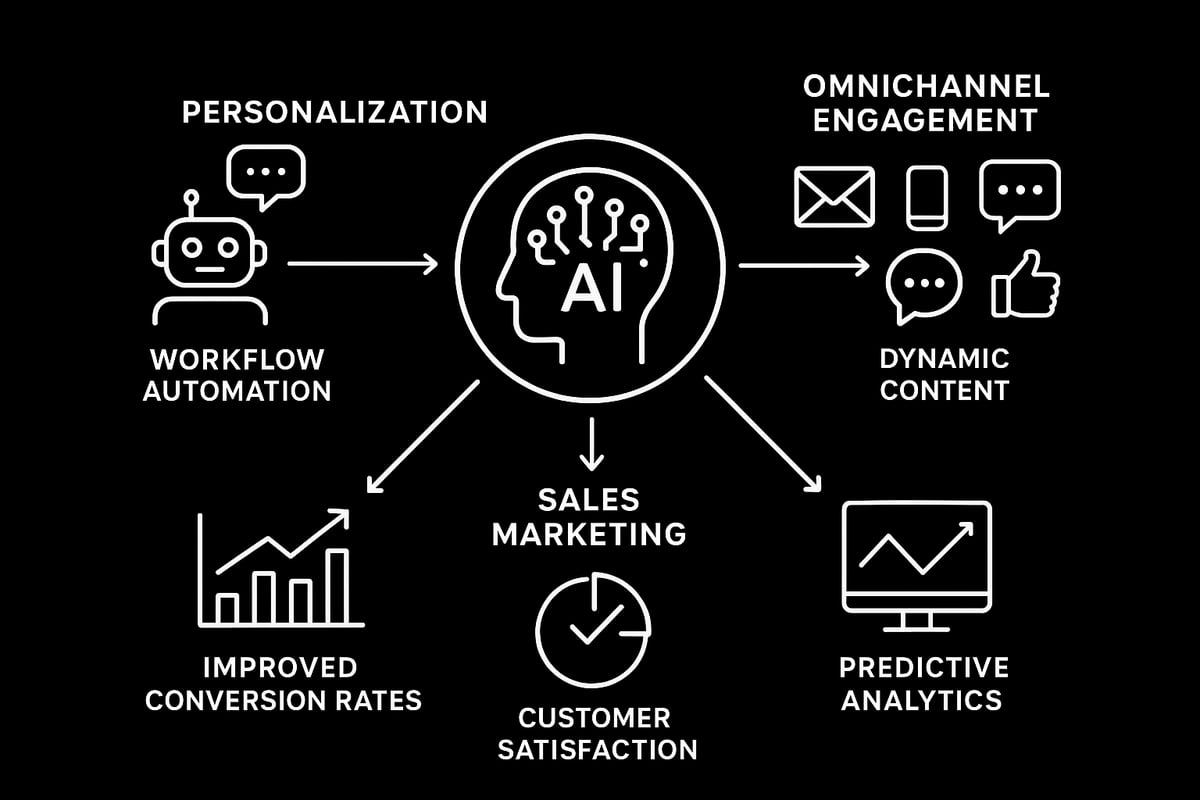
Unlocking the full potential of sales marketing in 2026 means mastering advanced strategies that leverage AI, personalization, and seamless channel integration. Organizations that embrace these techniques set themselves apart, driving measurable growth and fostering lasting customer relationships.
Harnessing AI for Predictive Sales and Marketing
Artificial intelligence is transforming sales marketing by enabling predictive lead scoring, dynamic content recommendations, and precise sales forecasting. With AI, teams can anticipate customer needs and optimize every interaction. For example, AI-driven systems now automate campaign targeting and ad creation, as seen in Meta's AI-driven ad automation by 2026.
AI agents handle routine tasks, freeing up human teams to focus on high-value relationships. Predictive analytics also empower organizations to identify the most promising prospects, boosting both efficiency and effectiveness in sales marketing.
Hyper-Personalization at Scale
Hyper-personalization is no longer a luxury, but a necessity in sales marketing. By using real-time behavioral data, companies can tailor website content, emails, and offers to each individual. Dynamic content adapts instantly, increasing relevance and engagement.
A recent industry study found that personalized campaigns deliver five to eight times the ROI of generic outreach. Teams use automation to segment audiences and trigger messaging based on user actions, making every touchpoint in the sales marketing journey feel unique.
Orchestrating Omnichannel Campaigns
Modern buyers interact across multiple channels, so sales marketing must meet them wherever they are. Orchestrating campaigns across email, SMS, WhatsApp, and social media ensures consistent messaging and maximizes reach.
Platforms now allow teams to synchronize content, timing, and offers across all channels. For example, brands integrating WhatsApp and email outreach have seen significant increases in engagement. This unified approach to sales marketing not only improves results but also delivers a seamless customer experience.
Customer Engagement and Retention Tactics
Retention is a cornerstone of successful sales marketing. Automated loyalty programs, timely re-engagement campaigns, and proactive feedback collection all play vital roles. Analytics help teams identify at-risk customers and trigger personalized retention actions.
Companies focusing on customer retention report up to 23 percent more revenue from existing clients. By nurturing relationships through automated touchpoints, sales marketing strategies can sustain growth and reduce churn, keeping customers coming back.
Case Examples from Leading Industries
Sales marketing best practices are being adopted across industries. In SaaS, automated onboarding and upsell campaigns drive product adoption. Retailers use real-time browsing data to send targeted SMS or WhatsApp offers. Service providers leverage AI-powered reminders and follow-ups to boost appointment attendance.
These examples illustrate how advanced strategies in sales marketing deliver tangible benefits, from higher conversion rates to improved customer satisfaction. Every sector can harness these tools to stay ahead in a fast-changing marketplace.
Overcoming Sales Marketing Challenges in 2026
Navigating Data Privacy and Regulatory Changes
Staying compliant with rapidly changing data privacy laws is a top sales marketing challenge for 2026. Brands must adapt to evolving standards like GDPR and CCPA, ensuring transparency in consent and data management. With AI and automation on the rise, the risks of ungoverned generative AI can be costly. According to Forrester's 2026 B2B marketing predictions, organizations must prioritize governance to prevent data mishandling and maintain customer trust.
Managing Technology Complexity and Integration
The modern sales marketing tech stack is growing more complex each year. Selecting scalable, interoperable platforms is essential for smooth operations. Many businesses face challenges integrating CRM, automation, analytics, and communication tools. Training teams to adapt to new workflows helps reduce confusion and tech stack bloat. Unified platforms simplify data management, minimize manual entry, and keep customer profiles accurate, all supporting more efficient sales marketing processes.
Aligning Teams and Maintaining Agility
Misalignment between sales and marketing teams can slow progress and create friction. Cross-functional collaboration is vital, especially in remote or hybrid work environments. Adopting agile methodologies enables rapid response to market changes and evolving customer needs. Businesses that build agile sales marketing models outperform competitors in both speed and adaptability. Regular communication, shared KPIs, and integrated platforms foster unity and keep teams focused on common goals.
Generating and Nurturing High-Quality Leads
Quality lead generation is a cornerstone of effective sales marketing. Automation tools streamline outreach, but balancing efficiency with personalization is key to avoiding "spam fatigue." Leveraging intent data helps teams reach prospects at the right moment. For actionable tactics, see this guide to lead generation for businesses. Companies focusing on lead quality over quantity consistently see higher conversion rates, making targeted nurturing strategies essential for 2026.
Measuring ROI and Demonstrating Value
Proving the value of sales marketing investments requires robust analytics and clear attribution models. Multi-touch attribution helps capture the true impact of campaigns across channels. Organizations with strong analytics capabilities are twice as likely to exceed sales targets. Regularly communicating results to stakeholders builds confidence and supports ongoing investment in innovation. By tracking the right KPIs, businesses can optimize spend, refine strategies, and drive sustained growth.
Future Trends and Predictions for Sales Marketing
The landscape of sales marketing is rapidly shifting as new technologies and strategies redefine how businesses connect with customers. Looking ahead to 2026, several emerging trends promise to reshape the way organizations approach sales marketing. By staying ahead of these developments, businesses can position themselves for sustained growth and greater competitive advantage. For a comprehensive view of these shifts, review IDC's tech marketing and sales trends.
The Rise of Autonomous Marketing and AI Agents
Autonomous marketing systems are set to become a cornerstone of sales marketing strategies by 2026. These systems leverage AI agents to manage campaigns, nurture leads, and provide real-time reporting with minimal human intervention. As a result, sales marketing teams will be able to focus on strategy and creative direction while AI handles repetitive tasks.
For example, AI-powered agents can orchestrate end-to-end customer journeys, personalize touchpoints, and optimize timing for outreach. This shift is expected to drive efficiency, reduce costs, and enable faster scaling of sales marketing efforts across industries.
Voice, Chat, and Conversational Commerce
The growth of voice assistants and chatbots is transforming the customer journey. By 2026, conversational commerce will be a core component of sales marketing, allowing customers to interact with brands through voice-enabled devices, chat applications, and embedded website bots.
Sales marketing teams can use conversational AI to qualify leads, answer questions, and facilitate transactions directly within messaging platforms. According to industry forecasts, 60% of businesses plan to adopt conversational AI solutions, further accelerating this trend.
Data-Driven Personalization and Privacy Balance
Personalization remains a top priority in sales marketing, but balancing it with customer privacy is becoming more complex. New tools are emerging to facilitate zero-party and first-party data collection, enabling marketers to personalize experiences without compromising trust.
Sales marketing leaders must navigate evolving regulations and consumer expectations. Future-proofing strategies will include transparent consent practices and leveraging secure analytics platforms to deliver relevant content while respecting privacy boundaries.
The Expansion of WhatsApp and Messaging-First Sales
WhatsApp and similar messaging platforms are set to become primary sales channels, especially in regions where mobile-first behaviors dominate. Businesses are increasingly closing deals, providing support, and nurturing relationships directly through messaging apps.
Sales marketing strategies will focus on integrating these channels to deliver timely offers, personalized recommendations, and seamless customer support. In Asia-Pacific, for instance, messaging-first commerce is already driving significant growth and customer engagement.
Cross-Industry Innovations and New Revenue Models
Sales marketing best practices are spreading across sectors such as SaaS, retail, healthcare, and education. Organizations are experimenting with subscription, usage-based, and hybrid revenue models to diversify income streams.
AI-driven content creation, including the use of generative AI in video advertising, is gaining traction as highlighted in IAB's report on GenAI in video ads. This innovation supports dynamic, personalized campaigns that resonate with diverse audiences and drive measurable results.
Skills and Team Structures for the Future
The future of sales marketing will require teams to upskill and adapt. Key roles will include data analysts, automation specialists, and AI strategists. Collaboration between sales and marketing will intensify as new tools demand cross-functional expertise.
Role | Key Skillset | Importance in 2026 |
|---|---|---|
Data Analyst | Data modeling, visualization | High |
Automation Specialist | Workflow design, integration | Essential |
AI Strategist | AI application, ethics | Critical |
Customer Experience | Journey mapping, personalization | Growing |
According to recent surveys, 85% of sales marketing leaders plan to invest in upskilling their teams in AI and data analytics to stay competitive in the coming years.
If you’re ready to put these strategies into action and future proof your business, I’m here to help you take the next step. Whether you want to streamline your sales process, automate your lead generation, or simply get ahead of your competitors with the latest AI driven tools, you don’t have to figure it out alone. Let’s talk about your unique challenges and design a roadmap for sustainable growth together. You can Book a free consultation to discuss how these proven approaches can work specifically for your business and set you up for sales marketing success in 2026.