The Essential Guide to Marketing Automation and AI in 2026
Unlock the future of marketing automation and AI in 2026 with expert insights, real case studies, and actionable steps to boost engagement and business growth.
Dec 1, 2025
In 2026, a new era of digital marketing is here, powered by the seamless blend of marketing automation and AI. Businesses now achieve levels of efficiency and personalization that were once unimaginable.
This essential guide reveals how marketing automation and AI are reshaping customer engagement, campaign performance, and business growth. Whether you are a marketer, business leader, or digital strategist, you will find actionable insights tailored for today’s dynamic landscape.
Explore the latest breakthroughs, practical steps for implementation, inspiring case studies, and the must-have tools leading the charge. See what the future holds and learn how to stay ahead.
Get ready to unlock next-level marketing success—discover how to transform your strategy with the power of automation and intelligence.
The Evolution of Marketing Automation and AI
The journey of marketing automation and ai has transformed the way organizations engage customers, optimize campaigns, and drive growth. Understanding this evolution is essential for marketers aiming to succeed in 2026. Let’s break down the major phases and advancements that have shaped today’s landscape.
The Early Days: Rule-Based Automation
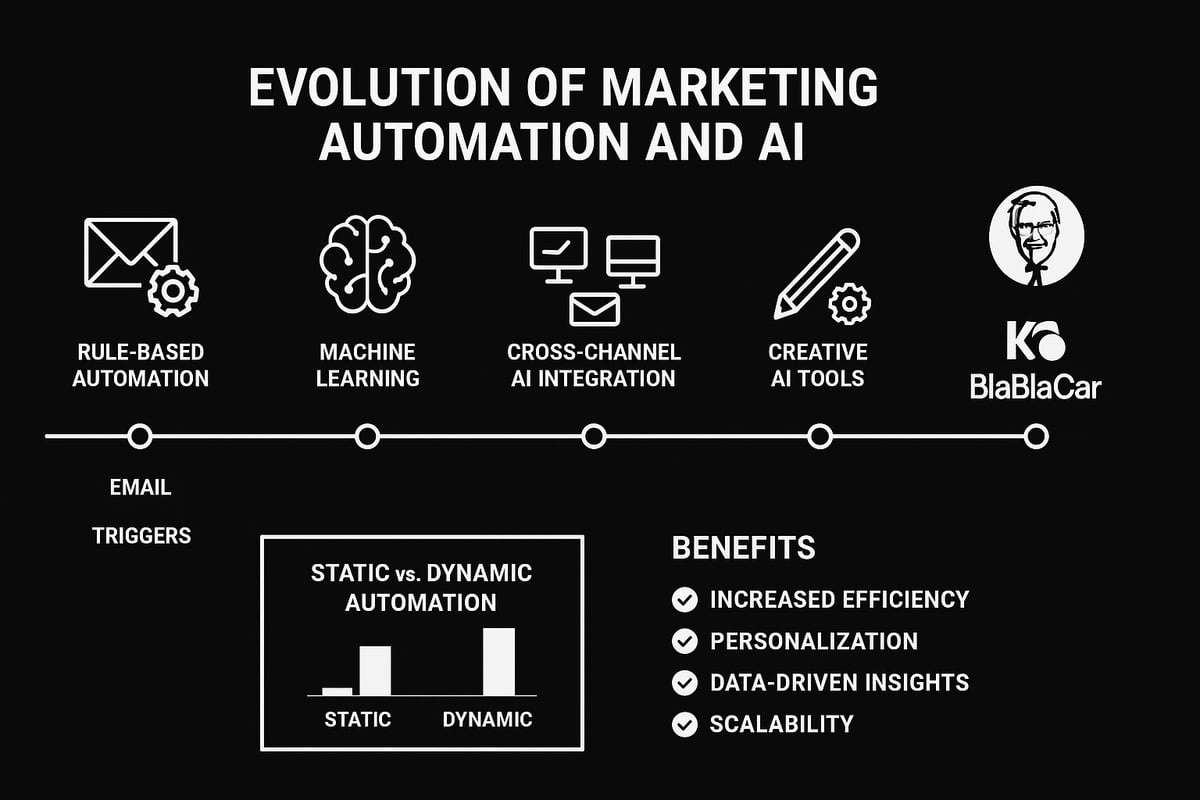
In the early stages, marketing automation and ai were not yet intertwined. Traditional automation relied on static rules, such as sending scheduled emails or segmenting audiences based on basic criteria.
Workflows depended heavily on manual logic. For example, if a user abandoned a cart, a reminder email was sent at a fixed interval. These systems, while innovative at the time, struggled with real-time adaptation and required continuous oversight.
Marketers also faced scalability challenges as campaign complexity grew. By 2023, up to 50% of professionals reported automation fatigue, citing the burdens of maintaining static systems and diminishing returns.
Rise of AI-Driven Marketing Automation
The next phase saw marketing automation and ai converge as machine learning and advanced analytics entered mainstream platforms. After 2020, marketers began leveraging AI to analyze massive datasets and adapt campaigns in real time.
This shift moved the industry from rigid rules to predictive models capable of recognizing behavioral patterns and optimizing engagement. AI could now forecast customer churn, identify the best times to send messages, and personalize experiences at scale.
For a deeper dive into how AI is transforming these processes, explore AI in Marketing Automation, which highlights real-world applications and the tangible impact on business outcomes.
Key Milestones Leading to 2026
Several milestones have shaped the current state of marketing automation and ai. One major leap was the integration of cross-channel automation, allowing brands to orchestrate consistent experiences across email, SMS, apps, and web platforms, all powered by AI insights.
AI-powered creative tools also emerged, enabling marketers to generate copy, images, and personalized recommendations rapidly. For example, KFC South Africa used AI image generators to speed up campaign deployment, while platforms like BrazeAI delivered 1:1 personalization at scale.
These advancements have made it possible to launch, test, and optimize campaigns faster, reducing dependence on manual processes and unlocking new levels of agility.
AI vs. Traditional Automation: What’s Changed?
The transformation from traditional automation to marketing automation and ai can be summarized in the following table:
Feature | Traditional Automation | AI-Driven Automation |
|---|---|---|
Segmentation | Static | Dynamic, real-time |
Triggers | Manual, rule-based | Predictive, adaptive |
Optimization | Manual A/B testing | Continuous, self-learning |
Personalization | Limited | 1:1 at scale |
Dynamic segmentation and real-time journey orchestration are now standard. Instead of static workflows, AI continuously learns from user actions, optimizing content and timing on the fly. Companies like BlaBlaCar have achieved a 30% increase in bookings through AI-powered journey automation.
Benefits of AI in Marketing Automation
The evolution of marketing automation and ai has unlocked enhanced personalization, improved ROI, and significant reductions in manual workload. Marketers can now focus on strategy and creativity instead of repetitive tasks, benefiting from faster experimentation and deeper insights.
Core Capabilities of Marketing Automation and AI in 2026
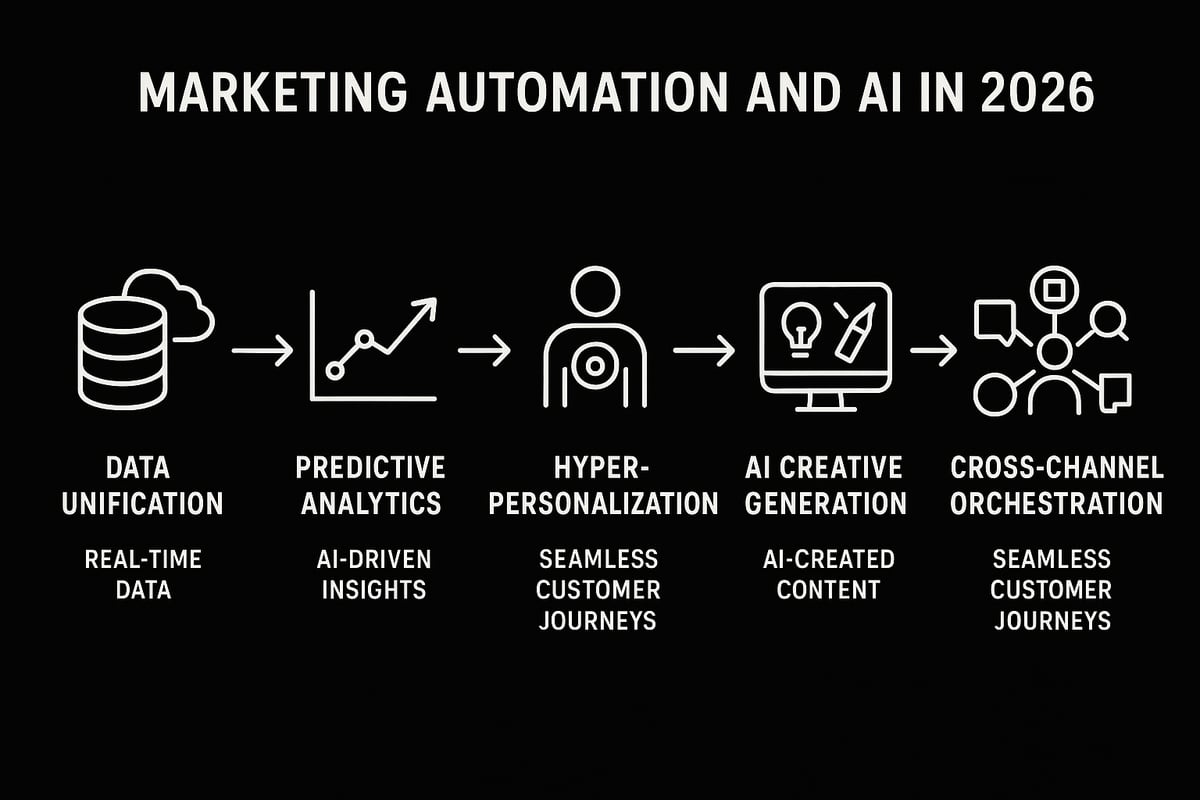
The landscape of marketing automation and AI in 2026 is defined by several core capabilities that empower businesses to connect with customers in smarter, faster, and more meaningful ways. Let us break down these transformative features that set today’s top solutions apart.
Data Unification and Real-Time Processing
Modern marketing automation and AI platforms begin with robust data unification. These solutions integrate behavioral, transactional, and engagement data across every customer touchpoint. Instead of siloed systems, all information is centralized, providing a single source of truth.
AI-driven data cleansing and enrichment ensure accuracy and reliability. This means duplicate records, missing fields, or outdated attributes are automatically resolved. For instance, platforms like Braze Data Platform create unified audience profiles, allowing marketers to act on real-time insights. As a result, campaigns are more responsive, and engagement strategies are always one step ahead.
Predictive Analytics and Customer Insights
A key advantage of marketing automation and AI is the ability to forecast customer behaviors with impressive accuracy. AI models analyze historical and real-time data to predict critical outcomes such as churn risk, likelihood to convert, or potential upsell opportunities.
Marketers can segment audiences dynamically, adjusting strategies as customer journeys evolve. For example, Upday leveraged predictive churn modeling to re-engage over half a million dormant users, demonstrating the practical impact of AI-powered insights. This level of intelligence transforms traditional campaigns into proactive, data-driven experiences.
Hyper-Personalization at Scale
Hyper-personalization is now possible at a scale that manual methods could never achieve. Marketing automation and AI platforms tailor content, timing, and channel selection for each individual, based on preferences and behaviors.
AI recommendations power everything from product suggestions to curated content and targeted offers. The result is a more relevant experience for every user, driving higher conversion rates. With these tools, marketers can deliver personal touches to millions, without increasing creative workload or sacrificing consistency.
Automated Creative Generation
The creative process has been revolutionized by marketing automation and AI. Copywriting assistants, such as those built on OpenAI, generate campaign messages in seconds, ensuring brand alignment and fresh ideas.
AI image generators produce on-brand visuals instantly, reducing reliance on design teams and accelerating campaign launches. The Fork, for example, used AI to diversify messaging and eliminate creative bottlenecks. With these capabilities, teams can test new concepts rapidly and maintain a steady stream of compelling content.
Cross-Channel Orchestration and Journey Automation
Coordinating multi-step, cross-channel experiences has never been easier thanks to marketing automation and AI. AI manages entire customer journeys across email, SMS, apps, web, and WhatsApp, dynamically selecting the best path based on real-time engagement.
Personalized Paths and Action Paths, as seen in BrazeAI, automate journey adjustments, ensuring every interaction is timely and relevant. For a deeper dive into orchestrating effective workflows, explore Marketing Automation Workflows.
These core capabilities enable marketers to shift from static campaigns to living, learning, and highly adaptive engagement strategies. In 2026, mastering marketing automation and AI is the key to staying ahead in a rapidly evolving digital world.
Implementing AI-Powered Marketing Automation: Step-by-Step Guide
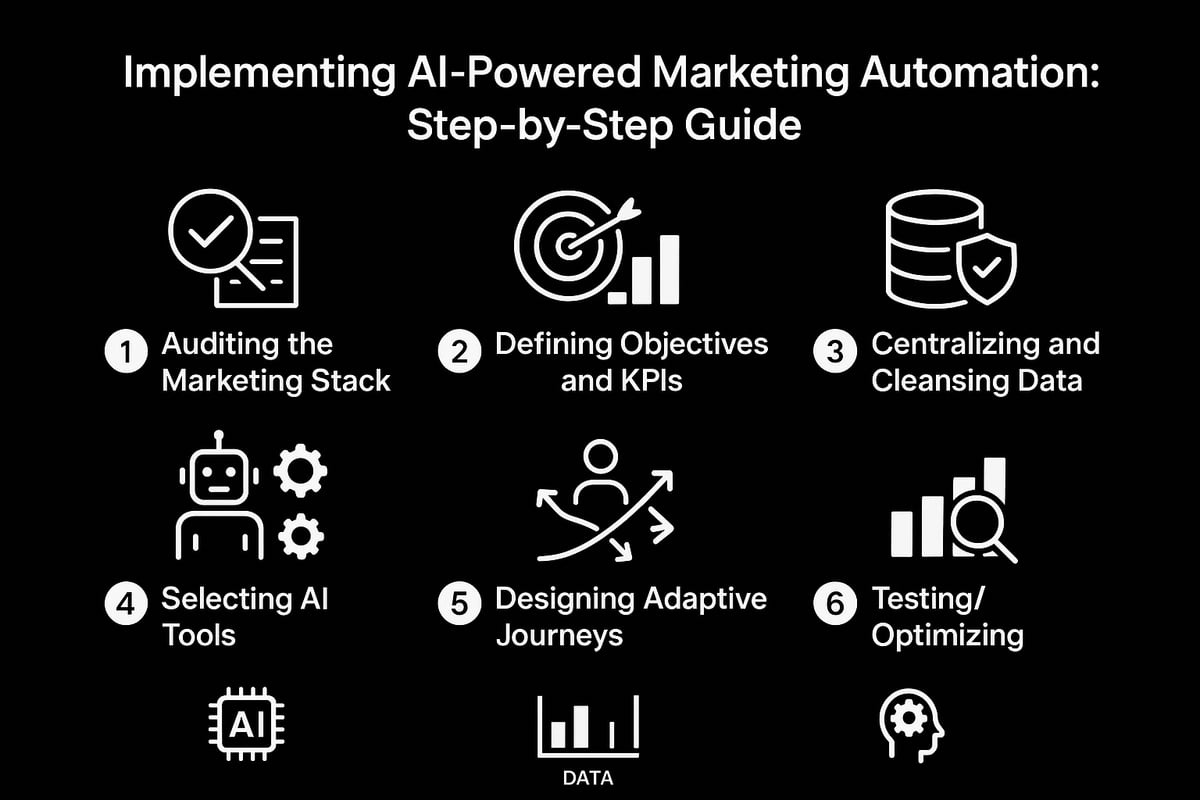
Embarking on the journey to integrate marketing automation and ai into your strategy requires a structured, methodical approach. Below is a practical, step-by-step guide to ensure successful implementation, maximize ROI, and future-proof your marketing operations.
Step 1: Audit Your Current Marketing Stack
Begin by thoroughly auditing your existing marketing stack. Catalog all active tools, platforms, and data sources. Identify every automation workflow currently in place, such as triggered emails, lead scoring, and segmentation processes.
Check for data silos or integration gaps that might hinder the adoption of marketing automation and ai. Assess how well your systems communicate and whether they support real-time data flow.
Evaluate workflow efficiency and pinpoint areas with excessive manual intervention. This step lays the foundation for a seamless transition to an AI-powered approach, ensuring you know exactly where improvements are needed.
Step 2: Define Objectives and KPIs
Set clear, measurable goals before deploying marketing automation and ai. Start by identifying your primary objectives, such as customer acquisition, retention, engagement, or increased revenue.
Determine the key performance indicators (KPIs) that will measure success. These might include churn rate, conversion rate, customer lifetime value, or click-through rates.
Align these objectives and KPIs with your broader business outcomes. This ensures that every automation and AI initiative directly supports your organization’s growth and customer experience targets.
Step 3: Centralize and Cleanse Data
Centralizing and cleansing your data is critical for effective marketing automation and ai. Integrate all customer touchpoints and behavior data into a unified platform, ensuring nothing is lost between systems.
Use AI-driven tools for data cleansing, deduplication, and enrichment to maintain accuracy. Make sure your platform adheres to privacy regulations like GDPR and CCPA, and that security protocols are robust.
Unified, high-quality data enables accurate AI predictions and real-time personalization, setting the stage for advanced automation strategies.
Step 4: Select the Right AI-Powered Tools
Choosing the right tools is essential for maximizing the power of marketing automation and ai. Evaluate platforms that offer predictive analytics, journey orchestration, and creative automation.
Consider criteria such as scalability, ease of integration, and support for cross-channel campaigns. Platforms like BrazeAI, Salesforce Einstein, and Adobe Sensei are prominent options. For a foundational overview of automation solutions and best practices, see Automation for Marketing.
The right tools will empower your team to deploy AI-driven campaigns quickly and efficiently, accelerating time-to-value.
Step 5: Design Adaptive Customer Journeys
Map out the full customer lifecycle, identifying key touchpoints and decision moments. Use marketing automation and ai to design adaptive journeys that respond to real-time user behavior and preferences.
Leverage dynamic segmentation and AI-powered triggers to adjust messaging, timing, and channels for each individual. For example, implement Action Paths to automatically optimize for specific goals, such as reducing churn or increasing conversions.
This approach ensures every customer receives a personalized, relevant experience, boosting engagement and loyalty.
Step 6: Test, Optimize, and Scale
With your marketing automation and ai framework in place, launch pilot campaigns to validate AI-driven predictions and personalization strategies. Closely monitor performance metrics, gathering insights on what works and what can be improved.
Iterate by refining creative elements, journey paths, and targeting based on data-driven feedback. Once proven, scale successful workflows across all segments and channels.
Continuous testing and optimization ensure your AI-powered marketing remains agile, effective, and aligned with business goals.
Real-World Use Cases and Success Stories
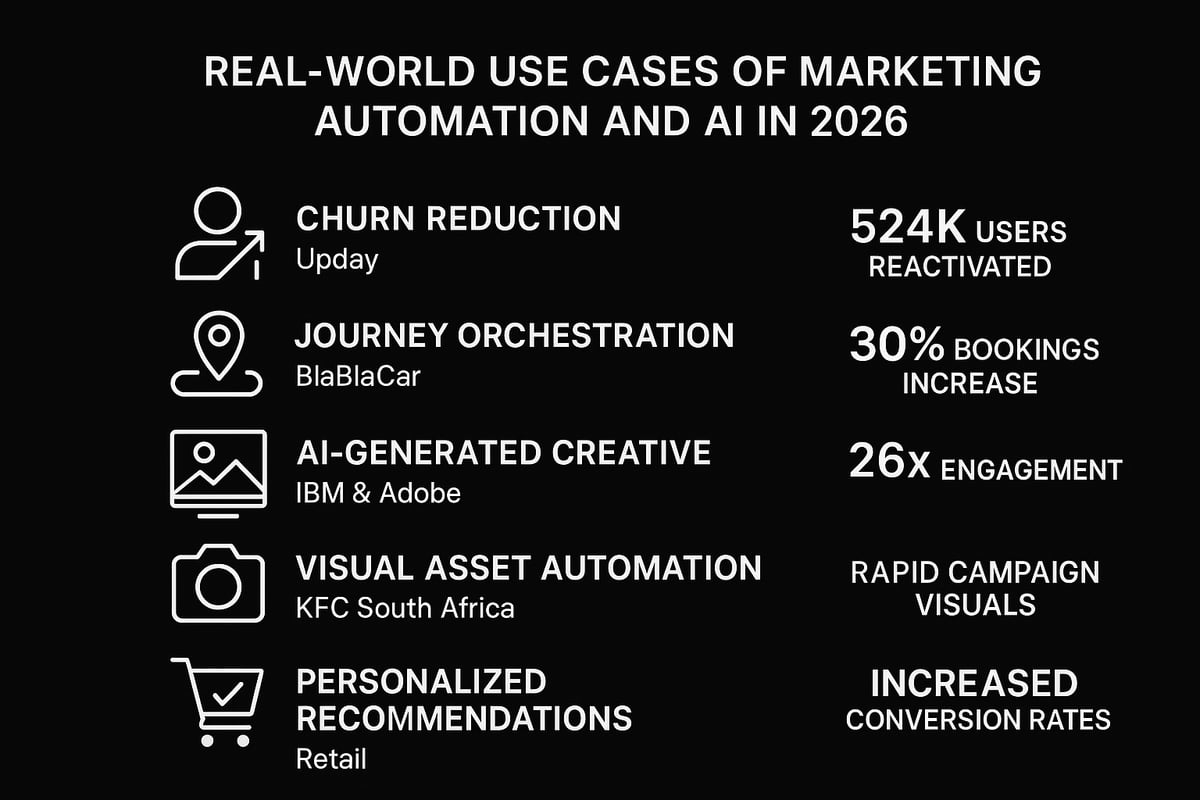
The true impact of marketing automation and ai becomes clear when examining real-world success stories. Across industries, organizations are leveraging these technologies to transform engagement, drive growth, and deliver measurable results.
Predictive Churn and Retention Campaigns
Upday has demonstrated how marketing automation and ai can re-engage dormant users at scale. By deploying predictive churn models, Upday identified segments at risk and tailored reactivation strategies. These included timely push notifications and personalized offers, crafted to address each user's preferences.
Through this approach, Upday reactivated 528,000 users who might otherwise have left the platform. The campaign achieved a significant lift in user retention and ongoing engagement, proving that marketing automation and ai are essential tools for combating churn in competitive digital markets.
Dynamic Journey Orchestration for Increased Conversions
BlaBlaCar harnessed marketing automation and ai to orchestrate dynamic, cross-channel customer journeys. Using Action Paths, the platform delivered personalized messages and optimized timing based on real-time user interactions across email, app, and SMS.
This adaptive journey management led to a 30 percent increase in bookings and a 48 percent uplift in click rates. By letting marketing automation and ai drive journey orchestration, BlaBlaCar ensured every user received relevant communication, maximizing conversion opportunities.
AI-Generated Content and Creative
The Fork revolutionized campaign creation by embracing AI-powered copywriting assistants and automated creative tools. These platforms rapidly generated diverse messaging options, reducing bottlenecks and accelerating campaign timelines.
A compelling example comes from IBM, which leveraged Adobe's Firefly AI to produce personalized marketing materials and achieved engagement rates 26 times higher than typical benchmarks. This real-world result shows how IBM's AI-Driven Marketing Success underscores the benefits of marketing automation and ai for both creativity and performance.
Visual Asset Automation with AI Image Generators
KFC South Africa tapped into marketing automation and ai to streamline the creation of campaign visuals. By using AI image generators, the brand produced on-brand holiday assets in seconds, reducing the need for manual design work and enabling rapid campaign launches.
This accelerated process allowed KFC to quickly test multiple creative variants, leading to faster optimization and more effective campaigns. Visual asset automation through marketing automation and ai is now a cornerstone for brands seeking agility without sacrificing quality.
Personalized Recommendations and Offers
Retailers are increasingly relying on marketing automation and ai to deliver tailored product and content recommendations. AI algorithms analyze individual user behavior and preferences in real time, surfacing the most relevant offers and items at each touchpoint.
The result is higher conversion rates and increased average order values, as users are more likely to engage with personalized suggestions. By integrating marketing automation and ai into their digital ecosystems, retailers can consistently meet customer expectations and drive measurable business outcomes.
Best Practices, Pitfalls, and Ethical Considerations
Navigating marketing automation and ai in 2026 requires a careful balance of strategy, technology, and ethics. As businesses adopt these advanced tools, understanding best practices and common pitfalls ensures sustainable growth and trust with customers. Below, we outline essential guidelines and considerations for marketers committed to responsible and effective use of marketing automation and ai.
Best Practices for AI-Driven Marketing Automation
To maximize the value of marketing automation and ai, organizations should begin with well-defined objectives and measurable KPIs. Marketers must ensure robust data governance, prioritize data quality, and maintain compliance with evolving privacy standards. Collaboration between marketing, data science, and IT teams unlocks the full potential of automation.
Continuous learning and adaptation are vital. Regularly updating models and processes helps maintain accuracy. According to a recent study, Generative AI's Impact on Marketing ROI, 93% of CMOs now report clear ROI from generative AI, underscoring the importance of strategic implementation.
Common Pitfalls and How to Avoid Them
Despite its advantages, marketing automation and ai can introduce risks if not managed carefully. Over-reliance on automation may lead to impersonal experiences or missed opportunities for human insight. Poor data quality can cause inaccurate predictions and reduce campaign effectiveness.
To avoid these pitfalls, organizations should:
Regularly audit data sources for accuracy.
Combine AI insights with human oversight.
Adapt campaigns based on ongoing results.
For example, practical resources like Lead Generation with AI offer guidance on integrating AI with existing strategies to maintain a balanced approach.
Data Privacy, Security, and Compliance
Data privacy and security are foundational to trustworthy marketing automation and ai. Adhering to regulations such as GDPR and CCPA is non-negotiable. Transparent data collection, clear consent processes, and secure storage protocols protect both consumers and brands.
Marketers need to stay informed about emerging laws and prioritize ethical data usage. Regular compliance reviews and privacy training help ensure that all team members understand their responsibilities. A strong culture of privacy builds lasting customer trust and minimizes legal risks.
Human Creativity and AI Collaboration
While marketing automation and ai streamline workflows, human creativity remains essential. AI excels at handling repetitive tasks, data processing, and predictive analytics, but strategic thinking and brand storytelling require a human touch.
Empowering marketers to focus on creative strategy allows organizations to differentiate their messaging. AI can inspire new ideas and enable faster execution, but humans must guide the vision and ensure campaigns resonate emotionally with audiences. This collaboration leads to more innovative and effective marketing outcomes.
Emerging Ethical Challenges
As marketing automation and ai evolve, so do ethical considerations. Marketers must address algorithmic bias, ensure fairness, and promote transparency in AI-driven decisions. Explaining how AI impacts customer experiences and providing opt-out choices are vital for responsible use.
Ongoing education and ethical reviews help teams anticipate new challenges. By preparing for stricter standards and embracing transparency, organizations can build more equitable, future-ready marketing automation and ai strategies.
Future Trends in Marketing Automation and AI
The landscape of marketing automation and ai is rapidly evolving as we approach 2026. Forward-thinking marketers are preparing for a new era where intelligent systems, generative content, and predictive analytics redefine customer engagement. According to AI Marketing Trends for 2026–2030, the next wave of innovation will be marked by deeper automation, immersive experiences, and smarter decision-making.
Autonomous Marketing Systems
Autonomous marketing systems are set to become the backbone of marketing automation and ai strategies. These platforms will independently manage campaigns, optimize budgets, and adapt messaging in real time. AI agents will monitor customer activity 24/7, ensuring rapid response and seamless experiences.
Imagine a scenario where AI not only segments audiences but also launches, tests, and refines campaigns with minimal human input. This shift empowers marketing teams to focus on strategy and creative vision while AI handles execution. The result is a more agile, responsive approach to digital marketing.
Conversational AI and Voice-Driven Interactions
Conversational AI is transforming how brands engage with customers. Advanced chatbots and voice assistants will operate across SMS, WhatsApp, and web platforms, providing instant, natural interactions. These technologies make customer support, sales, and engagement more accessible and human-like.
In the future, marketing automation and ai will enable businesses to offer hyper-personalized conversations at scale. Voice-driven interfaces will streamline product discovery, order placement, and feedback collection, enhancing satisfaction and loyalty. Brands that master conversational AI will set new standards for responsiveness.
Generative AI for Content and Creative
Generative AI is revolutionizing content production in marketing automation and ai. AI models can now generate engaging copy, images, and even personalized videos tailored to each customer. This capability accelerates campaign creation and unlocks new creative possibilities.
Marketers can dynamically test creative variants and adapt messaging in real time. As highlighted in AI Marketing Trends for 2026–2030, the future will see AI-driven content seamlessly integrated into omnichannel strategies, reducing creative bottlenecks and driving higher engagement.
Predictive and Prescriptive Analytics
Predictive and prescriptive analytics are at the forefront of marketing automation and ai innovation. AI will move beyond forecasting outcomes to recommending the best actions for each customer segment. This evolution enables marketers to anticipate needs, personalize offers, and optimize journeys proactively.
By harnessing real-time data, marketers will orchestrate experiences that adapt to shifting behaviors and preferences. The future points to a world where marketers act as orchestrators, supported by AI execution engines that deliver measurable business results.
As you look ahead to 2026 and consider how AI and marketing automation can redefine your business growth, it’s clear that staying ahead means more than just following trends—you need a strategy tailored to your unique goals. We’ve explored the critical steps, tools, and real-world success stories to help you get started, but every business faces its own challenges. If you’re ready to see how intelligent automation can streamline your processes and drive sustainable results, let’s talk about your next steps. Book a free consultation and let’s build your roadmap together.