Lead Generation for Companies: The Expert Guide 2026
Master lead generation for companies in 2026 with expert strategies, AI tools, and proven tactics. Drive growth, measure ROI, and stay ahead of industry trends.
Dec 9, 2025
Did you know that 68% of B2B companies report lead generation as their top growth challenge in 2025? As competition intensifies, mastering lead generation for companies is essential to survive and thrive in 2026.
This expert guide unveils a proven roadmap to help your business understand, implement, and optimize modern lead generation strategies. With the rise of AI, automation, and data-driven methods, the landscape is evolving faster than ever.
Unlock exponential growth by staying ahead of the curve. In this guide, you’ll discover how to understand lead generation, build a powerful strategy, leverage technology, measure results, and adapt for the future.
Understanding Lead Generation for Companies in 2026
The landscape of lead generation for companies is rapidly evolving, shaped by technology, buyer behaviors, and regulatory shifts. Companies must adapt to thrive, moving beyond traditional tactics to adopt a holistic, digital-first approach. Understanding these changes is the first step toward building a successful lead generation engine that drives sustainable growth.
The Evolving Definition of Lead Generation
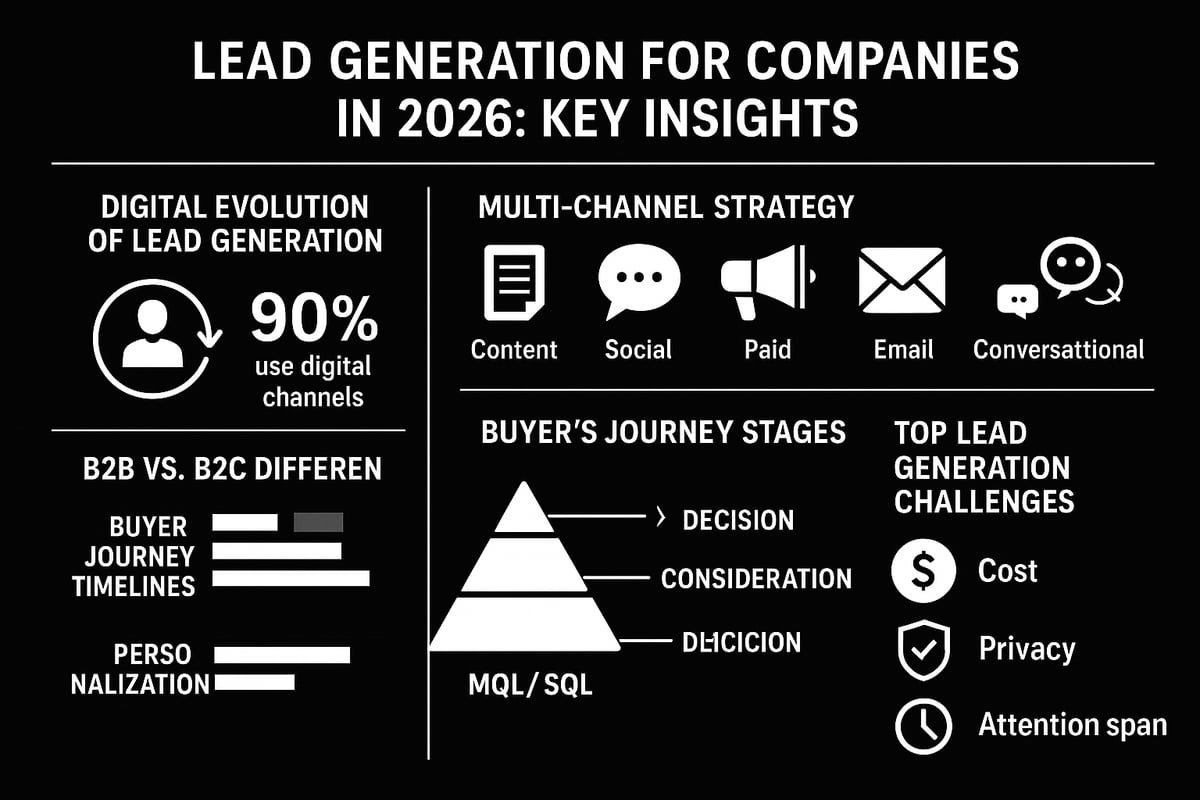
Lead generation for companies has transformed from cold calling and traditional networking to a digital-first, omnichannel strategy. Modern approaches blend inbound methods, like content marketing and SEO, with outbound tactics such as targeted outreach on social and paid media.
A clear example is the shift from physical trade shows to virtual events and webinars, allowing companies to engage prospects globally. This evolution creates new opportunities and challenges, requiring businesses to rethink their approach. For an in-depth look at these changes, explore lead generation for businesses to understand how modern strategies can drive results.
Key Lead Generation Channels in 2026
Today, lead generation for companies leverages diverse channels, each offering unique strengths. Content marketing, social media engagement, paid advertising, email outreach, and conversational platforms like chatbots form the backbone of a multi-channel strategy.
According to HubSpot (2025), 75% of companies now invest in multiple channels to optimize reach and conversion. For B2B tech, a mix of LinkedIn, webinars, and whitepapers excels, while e-commerce often combines Instagram ads, influencer partnerships, and email campaigns. This flexibility allows businesses to tailor their channel mix to industry needs and audience preferences.
B2B vs. B2C Lead Generation: Critical Differences
Lead generation for companies differs significantly between B2B and B2C environments. B2B buyers typically follow longer decision cycles, require multiple touchpoints, and prioritize relationship-building. Personalization is crucial, with tailored content and one-on-one engagement driving results.
In contrast, B2C lead generation focuses on high-volume outreach and automation. Speed and simplicity matter, often leveraging retargeting ads and quick purchase incentives. For example, SaaS firms use lead nurturing sequences for B2B clients, while e-commerce brands rely on retargeting to convert browsing consumers.
Aspect | B2B Approach | B2C Approach |
|---|---|---|
Buyer Journey | Longer, multi-stage | Shorter, impulse-driven |
Personalization | High, relationship-focused | Moderate, automation-driven |
Common Tactics | Demos, webinars, account-based | Retargeting, social ads, offers |
The Buyer’s Journey and Lead Qualification
A core element of lead generation for companies is mapping content and outreach to the buyer’s journey: Awareness, Consideration, and Decision. Each stage requires tailored messaging and resources to move prospects forward.
Leads are categorized as Marketing Qualified Leads (MQLs) or Sales Qualified Leads (SQLs) based on engagement and readiness to buy. Setting clear qualification criteria ensures higher conversion rates. According to DemandGen Report (2025), effective lead scoring can increase conversions by 20%, highlighting the value of structured qualification processes.
Common Lead Generation Challenges for Companies
Despite advances, lead generation for companies faces persistent challenges. Acquisition costs are rising as competition intensifies and attention spans shorten. Stricter data privacy laws, including GDPR and CCPA, demand new approaches to consent and outreach.
Expanding into new regions, such as APAC, often requires navigating complex privacy regulations. Companies must balance effective lead generation with ethical practices and transparency, ensuring trust and compliance in every interaction.
Building a High-Impact Lead Generation Strategy
Designing a high-impact lead generation strategy is essential for companies that want to outperform competitors in 2026. A well-structured approach ensures every step, from goal setting to compliance, is aligned for sustainable growth. Let’s break down each critical component so your business can build a strategy that delivers measurable results.
Setting Clear Lead Generation Goals
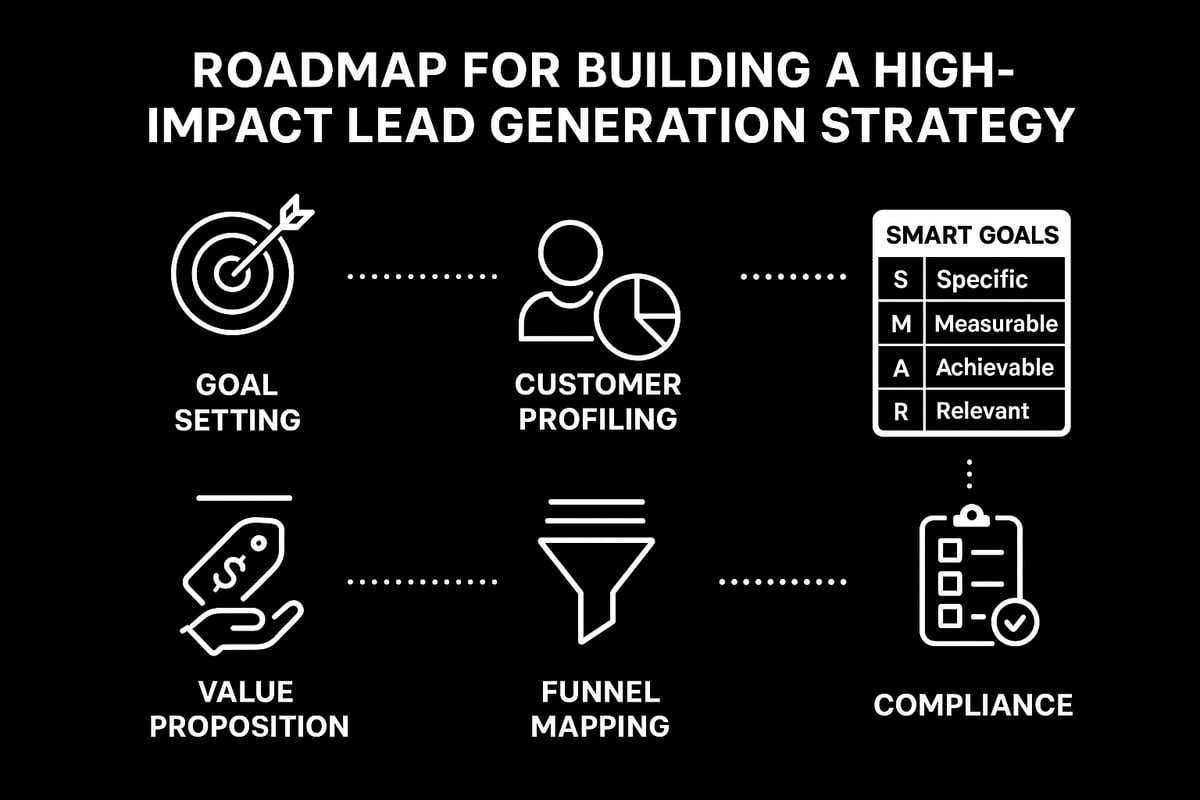
The foundation of lead generation for companies is setting clear, actionable goals that align with broader business objectives. Without precise targets, it is impossible to measure progress or optimize results. The SMART framework is essential here:
Goal Element | Description | Example |
|---|---|---|
Specific | What do you want? | 500 MQLs in Q1 |
Measurable | How will you track? | CRM dashboards |
Achievable | Is it realistic? | Based on past data |
Relevant | Does it support biz? | Drives revenue growth |
Time-bound | By when? | By March 31st |
Lead generation for companies should always start with quarterly or campaign-based targets, such as increasing marketing qualified leads (MQLs) by 20 percent. These targets guide your team, keep efforts focused, and provide benchmarks for success.
Identifying and Understanding Your Ideal Customer Profile (ICP)
For lead generation for companies to be effective, you must deeply understand who your ideal customer is. Developing a detailed ICP using data analytics and buyer personas helps your team target the right audience with precision.
Start by analyzing current customer data, using tools like LinkedIn Insights for B2B or Google Analytics for B2C. Segment your audience by factors such as industry, company size, role, and pain points. This information allows you to tailor messaging and channel selection for maximum impact.
An accurate ICP ensures your lead generation for companies efforts are not wasted on unqualified prospects. Instead, your resources go toward high-value targets with the greatest potential to convert.
Crafting Compelling Value Propositions and Offers
A strong value proposition is the heart of lead generation for companies. Your offer must solve real problems for your ideal customer and stand out from competitors. Effective offers include content upgrades, free trials, demos, or exclusive resources.
Consider this case: a SaaS company revamped its lead magnet with a personalized toolkit, resulting in a 30 percent increase in qualified leads. To optimize, test different offers and messaging regularly.
Leverage Automated lead generation strategies to streamline how you deliver and promote offers. Automation helps you present the right value at the right time, increasing response rates and nurturing prospects efficiently.
Mapping and Optimizing the Lead Funnel
Visualizing the lead funnel is essential for lead generation for companies. Break down the funnel into TOFU (Top of Funnel), MOFU (Middle of Funnel), and BOFU (Bottom of Funnel) stages:
TOFU: Awareness content like blogs, videos, and webinars
MOFU: In-depth guides, case studies, and nurturing emails
BOFU: Demos, consultations, and sales calls
Identify bottlenecks using analytics. For example, if landing page conversion rates are low, A/B test headlines, CTAs, and form fields. Companies that optimize their funnel often see conversion rates jump from 2 percent to 6 percent, driving more value from existing traffic.
Integrating Sales and Marketing Teams
True success in lead generation for companies depends on seamless collaboration between sales and marketing. Aligned teams ensure that qualified leads are handed off efficiently and followed up promptly.
Implement Service Level Agreements (SLAs) to define clear responsibilities and response times. For example, marketing commits to delivering a set number of MQLs, while sales commits to following up within 24 hours. According to MarketingProfs, companies with aligned sales and marketing generate 208 percent more revenue.
Regular meetings and shared dashboards foster transparency, helping both teams adapt strategies quickly and improve lead quality.
Compliance and Ethical Considerations
Compliance is a non-negotiable part of lead generation for companies. Global data privacy regulations such as GDPR and CCPA require strict consent and transparency in every outreach.
Best practices include using double opt-in forms, clear privacy statements, and offering easy unsubscribe options. For example, GDPR-compliant forms collect only necessary data and provide explicit consent checkboxes.
Ethical outreach builds trust with prospects and protects your brand from legal risks. Always review local regulations, especially if targeting international markets, to ensure your lead generation for companies strategy remains compliant and future-proof.
Leveraging Technology and Automation in Lead Generation
In 2026, technology is fundamentally reshaping lead generation for companies. AI, automation, and advanced data tools are no longer optional but necessary for businesses seeking scalable, efficient results. Let’s examine how these innovations are transforming every stage of the process.
AI and Machine Learning for Smarter Lead Generation
AI is powering a new era of lead generation for companies. Machine learning algorithms analyze massive datasets to identify promising prospects and predict buying intent with greater accuracy. AI-driven lead scoring helps prioritize high-value opportunities, while chatbots and conversational AI capture and qualify leads 24/7, improving response times. For example, businesses using AI tools have reduced manual lead qualification time by 50%. To explore specific solutions, review this resource on AI-driven lead generation tools, which highlights platforms making these advancements accessible and effective.
Marketing Automation Platforms: Selection and Best Practices
Choosing the right marketing automation platform is essential for lead generation for companies. Top options like HubSpot, Marketo, and Salesforce Pardot allow businesses to automate repetitive tasks, manage campaigns, and nurture leads efficiently. When selecting a platform, consider your company’s size, integration needs, and budget. Best practices include segmenting audiences, automating drip campaigns, and monitoring performance metrics. Automated email sequences, for instance, can nurture prospects and move them through the funnel with minimal manual effort, freeing teams to focus on strategy and creative development.
Integrating CRM Systems for Seamless Lead Management
A robust CRM system is the backbone of lead generation for companies. Centralized data management enables complete visibility across the sales pipeline—from initial contact to conversion. Leading CRMs like Salesforce offer features such as lead segmentation, scoring, and automated workflows that help teams track progress and tailor outreach. Integration between marketing automation and CRM ensures that no lead is lost and that sales and marketing remain aligned. Companies leveraging CRM platforms have reported a 21% increase in lead conversion rates, thanks to improved tracking and personalized engagement.
Data Enrichment and Personalization Tools
Personalized outreach is now a requirement in lead generation for companies. Data enrichment tools tap into third-party sources to build detailed lead profiles, filling gaps in contact information and firmographics. Personalization engines then use this data to deliver targeted messages, dynamic website content, and tailored offers that resonate with each lead. For example, companies deploying dynamic content have seen engagement rates jump by 40%. By refining segmentation and messaging, businesses can stand out in crowded markets and build trust with their ideal customers.
Automation Pitfalls and How to Avoid Them
While automation offers significant benefits, it is not without risks for lead generation for companies. Over-automation can erode the personal touch, trigger spam filters, or result in tone-deaf communications. To avoid these pitfalls, balance automation with human interaction, regularly review automated workflows, and personalize outreach whenever possible. Steer clear of generic messages and ensure your processes comply with privacy regulations. Businesses that combine smart automation with genuine engagement see stronger results and higher response rates than those relying solely on automated campaigns.
How The Social Search Empowers AI-Driven Lead Generation
The Social Search is redefining lead generation for companies by harnessing AI-driven automation tailored for SMEs. Their platform streamlines sales and marketing workflows, enabling rapid scaling and significant cost savings. With a focus on WhatsApp-based customer engagement, The Social Search delivers direct, real-time communication that boosts lead response rates and conversions. Businesses benefit from expert consultation and setup, ensuring automation is both personalized and compliant with evolving data privacy laws. Companies using The Social Search report faster lead handling and a decisive edge over competitors, thanks to innovative AI integration.
Proven Tactics and Best Practices for Lead Generation Success
Mastering lead generation for companies in 2026 means blending traditional tactics with cutting-edge approaches. The following proven strategies will help your business attract, nurture, and convert high-quality leads in a dynamic marketplace.
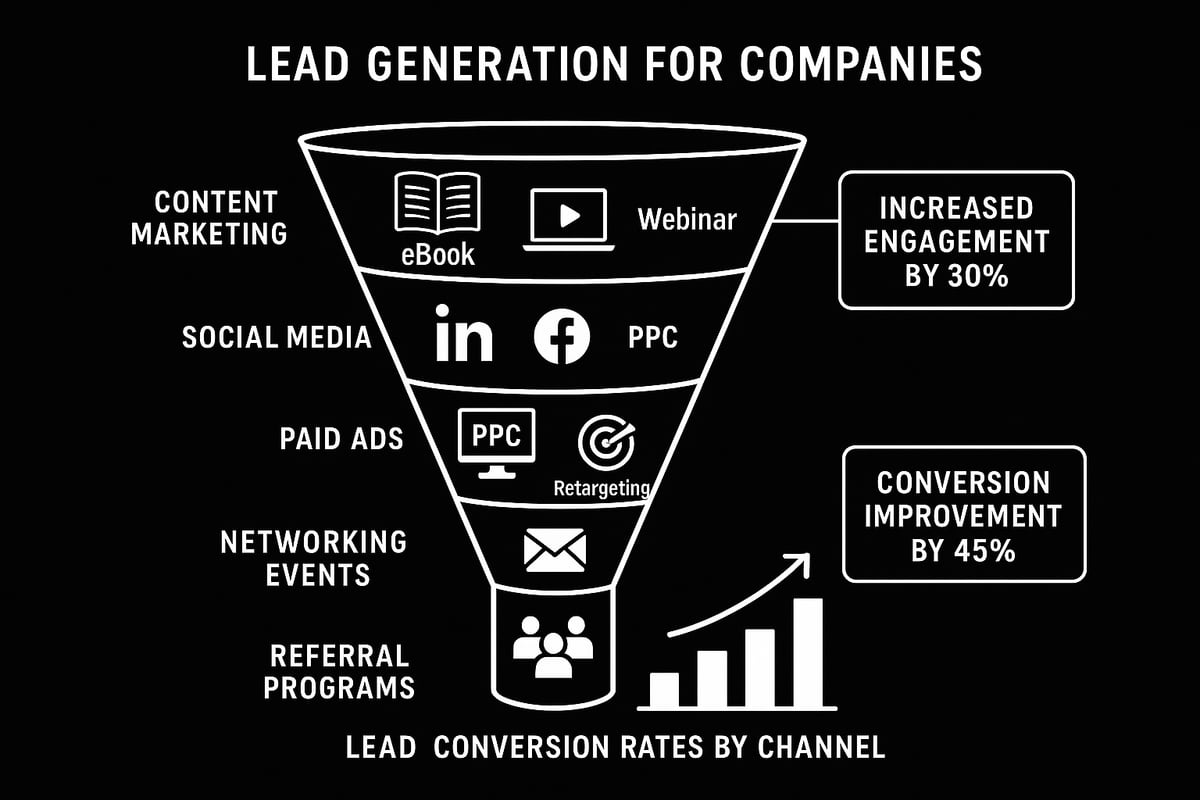
Content Marketing and Lead Magnets
Content remains the backbone of effective lead generation for companies. Creating high-value resources such as eBooks, webinars, and whitepapers positions your business as a trusted authority. Gated content, where users provide contact details in exchange for access, is a proven method to capture qualified leads.
To maximize results, align your content with each stage of the buyer’s journey. For example, offer in-depth guides for those in the consideration phase and quick checklists for awareness-stage prospects. Optimize SEO and distribute content across relevant platforms to extend your reach.
For a comprehensive approach to nurturing and qualifying leads, refer to this guide on Lead generation and qualification. By refining your content strategy, you can generate 1,000+ leads monthly and build a robust sales pipeline.
Social Media and Community Engagement
Social platforms play a pivotal role in lead generation for companies. LinkedIn, Facebook, and niche communities offer direct access to your target audience, enabling real-time engagement. Use social listening tools to identify prospects’ needs and pain points.
Engage in direct outreach by joining relevant groups and participating in industry conversations. Share thought leadership content, host live Q&As, and encourage user-generated content to foster brand loyalty.
According to Statista, 61% of companies find LinkedIn most effective for B2B lead generation. Consistent interaction and authentic community building can significantly boost your inbound lead flow.
Paid Advertising and Retargeting
Paid ads remain a cornerstone of lead generation for companies seeking rapid results. Platforms like Google Ads, Facebook, and LinkedIn offer precise targeting options to reach ideal prospects. Start with a small budget, test various ad creatives, and refine based on performance metrics.
Retargeting is key for re-engaging visitors who did not convert initially. Use pixel tracking to serve tailored ads to users who have interacted with your website or content. This strategy keeps your brand top-of-mind and increases the likelihood of conversion.
E-commerce businesses have doubled their lead volume by leveraging Facebook retargeting, demonstrating the power of persistent, relevant advertising.
Email Marketing and Nurture Sequences
Email marketing remains one of the most reliable tactics for lead generation for companies. Build segmented lists to deliver personalized messages that speak directly to each lead’s interests and stage in the funnel. Create drip campaigns that nurture leads over time, gradually guiding them toward a purchase decision.
A/B test subject lines, content, and CTAs to optimize open and conversion rates. Automated nurture sequences can improve lead-to-customer conversion by as much as 35%, ensuring no opportunity slips through the cracks.
Invest in tools that support automation and analytics for continuous improvement of your email campaigns.
Events, Webinars, and Networking
Events and webinars provide direct engagement opportunities that are invaluable for lead generation for companies. Host virtual or in-person sessions to showcase your expertise, answer questions, and build relationships with prospects.
Collaborate with industry influencers or partners for co-branded webinars to expand your reach. Promote events through multiple channels, including email and social media, to maximize attendance.
A single well-executed webinar can generate 500 or more qualified leads, making live engagement a high-impact tactic for sustained growth.
Referral and Partner Programs
Referral and partner programs are powerful levers in lead generation for companies. Encourage your satisfied customers to refer peers by offering incentives such as discounts or exclusive access. Word-of-mouth referrals often convert at higher rates due to established trust.
Develop strategic partnerships with complementary businesses for co-marketing initiatives. These collaborations can introduce your brand to new audiences and drive a steady flow of high-quality leads.
Companies implementing referral programs have seen a 25% increase in lead flow, highlighting the value of leveraging existing relationships for growth.
Measuring, Analyzing, and Optimizing Lead Generation Efforts
Effective measurement and analysis are crucial for maximizing the impact of lead generation for companies. By tracking the right metrics, implementing continuous improvement, and leveraging insights, businesses can drive better results and sustainable growth.
Key Lead Generation Metrics and KPIs
To optimize lead generation for companies, tracking the right metrics is essential. Core KPIs include lead volume, conversion rates, cost per lead, and lead quality. Establishing clear benchmarks enables ongoing performance evaluation.
A simple table of common KPIs:
Metric | Definition | Benchmark* |
|---|---|---|
Lead Volume | Total new leads generated | 1,000/month |
Conversion Rate | % of leads becoming customers | 2-6% |
Cost per Lead | Total spend divided by leads | $60 (SaaS avg.) |
Lead Quality Score | Value assigned to leads | 70+/100 |
*Benchmarks vary by industry and source.
For the latest insights, refer to Lead management statistics 2025 which details current trends shaping lead generation for companies.
Attribution Models and Tracking ROI
Understanding which channels drive the highest ROI is vital for lead generation for companies. Attribution models, like single-touch or multi-touch, help allocate value to each touchpoint in the buyer journey.
Single-touch attribution: Credits the first or last interaction.
Multi-touch attribution: Distributes credit across all interactions.
Using tools like Google Analytics and UTM parameters enables precise tracking. Companies that master attribution can optimize budgets and focus on the channels delivering the best results. For a deeper dive into industry trends, see B2B lead generation statistics 2025.
A/B Testing and Continuous Optimization
Continuous improvement is the backbone of lead generation for companies. A/B testing allows you to compare different versions of landing pages, emails, or calls-to-action to see what resonates most with your audience.
For example:
Test two landing page headlines to see which drives more signups.
Experiment with email subject lines to increase open rates.
Analyzing test results and implementing the winning variant can yield conversion uplifts of 10-20%. Regular experimentation ensures that lead generation for companies keeps pace with changing audience preferences.
Using Feedback Loops and CRM Insights
Feedback loops turn raw data into actionable insights for lead generation for companies. Collect feedback from sales teams on lead quality and use CRM analytics to spot trends and areas for improvement.
Key practices include:
Reviewing closed-lost reasons to refine targeting.
Analyzing lead behavior in the CRM to adjust scoring models.
By leveraging CRM insights, companies can continuously refine their approach and reduce lead churn. Regular review sessions keep strategies aligned with evolving business goals.
Reporting and Dashboards for Stakeholders
Transparent reporting is essential for aligning teams and informing decision-making in lead generation for companies. Real-time dashboards give marketing and sales teams instant visibility into performance trends.
Features of effective dashboards:
Visual KPIs for quick assessment
Drill-down capabilities for deeper analysis
Automated updates for up-to-date data
Sharing actionable insights empowers teams to pivot quickly and maximize results. Weekly or monthly reporting rhythms help maintain momentum and accountability.
Scaling and Adapting Lead Generation Strategies
As businesses grow, scaling lead generation for companies requires adaptable strategies. Identify which tactics are most efficient and invest in automation or new technologies to expand reach.
Adapt to market shifts by:
Embracing new channels like short-form video or messaging apps
Testing scalable content formats and distribution methods
Incorporating workflow automation for efficiency
Staying agile ensures that lead generation for companies remains effective, even as competition and customer expectations evolve.
Future Trends in Lead Generation for Companies
The landscape of lead generation for companies is evolving rapidly as we move toward 2026. To stay competitive, businesses must anticipate and adapt to emerging trends that are reshaping how leads are captured, nurtured, and converted. Below, we explore the five most significant trends poised to define the future of lead generation for companies.
The Rise of Conversational Marketing and Messaging Apps
Conversational marketing is transforming lead generation for companies by enabling real-time, personalized interactions. Messaging platforms such as WhatsApp, Messenger, and WeChat are now key channels for engaging prospects. These apps allow businesses to initiate conversations, answer queries instantly, and qualify leads more efficiently.
According to Gartner, 80% of businesses plan to use messaging apps for lead generation by 2026. This shift is fueled by changing consumer preferences, where prospects expect immediate responses and seamless communication. Companies embracing this approach often see higher engagement rates and improved lead quality.
To maximize results, businesses should integrate chatbots and automated workflows within messaging apps, ensuring every interaction moves leads further down the funnel.
Predictive Analytics and Hyper-Personalization
Predictive analytics is revolutionizing lead generation for companies by allowing organizations to anticipate buyer needs before they are explicitly stated. By analyzing behavioral data and leveraging machine learning, businesses can deliver hyper-personalized content and offers at the perfect moment.
Dynamic content engines tailor website experiences and email campaigns, leading to higher conversion rates. Tools that automate segmentation and targeting are essential for scaling these efforts. For actionable strategies, explore Marketing automation workflows to see how automation supports predictive lead nurturing.
As competition intensifies, companies that invest in predictive analytics and personalization will consistently outperform those relying on generic outreach.
Privacy, Compliance, and Trust in Lead Generation
Data privacy regulations are reshaping lead generation for companies worldwide. Laws like GDPR and CCPA, along with emerging standards in APAC, require businesses to be transparent and accountable in their data practices. Modern consumers also demand more control over their personal information.
Building trust is now a critical differentiator. Companies with clear privacy policies and consent-based lead capture see up to 30% higher completion rates on forms. To remain compliant, businesses should prioritize secure data handling, transparent disclosures, and easy opt-out options.
Proactively adapting to privacy trends not only mitigates risk but also strengthens brand reputation and customer loyalty.
Integrating Human and AI-Powered Outreach
A hybrid approach that combines human expertise with AI technology is becoming essential in lead generation for companies. AI-driven tools can automate repetitive tasks, analyze data at scale, and score leads with impressive accuracy. Meanwhile, human sales teams add value through relationship-building and nuanced conversations.
The AI2Agent deployment framework offers insights into deploying AI agents for outreach and qualification, helping organizations streamline workflows while maintaining a personal touch. By balancing automation with human interaction, businesses can optimize efficiency and conversion rates.
Successful companies will empower their teams with AI support tools, ensuring outreach remains both authentic and scalable.
Preparing for the Next Wave: Voice, Video, and Emerging Channels
Emerging technologies are unlocking new opportunities in lead generation for companies. Voice search is becoming a vital part of the buyer journey, especially as smart speakers gain popularity. Interactive video content and AR/VR experiences are also capturing attention and driving engagement.
Early adopters of these channels benefit from less saturated competition and innovative ways to connect with prospects. For example, companies piloting voice-based lead generation report higher engagement in tech-focused sectors.
To future-proof their strategy, businesses should monitor these trends closely and experiment with new formats, ensuring they remain at the forefront of lead generation innovation.
As we’ve explored, mastering lead generation in 2026 means staying agile—adapting to new technologies like AI, aligning your sales and marketing teams, and always putting your ideal customer at the center of your strategy. If you’re ready to move from theory to action and want personalized guidance on automating your lead generation for real, measurable growth, let’s connect. You can Book a free consultation to discuss how your business can scale smarter, save time, and stay ahead of the competition with expert support every step of the way.