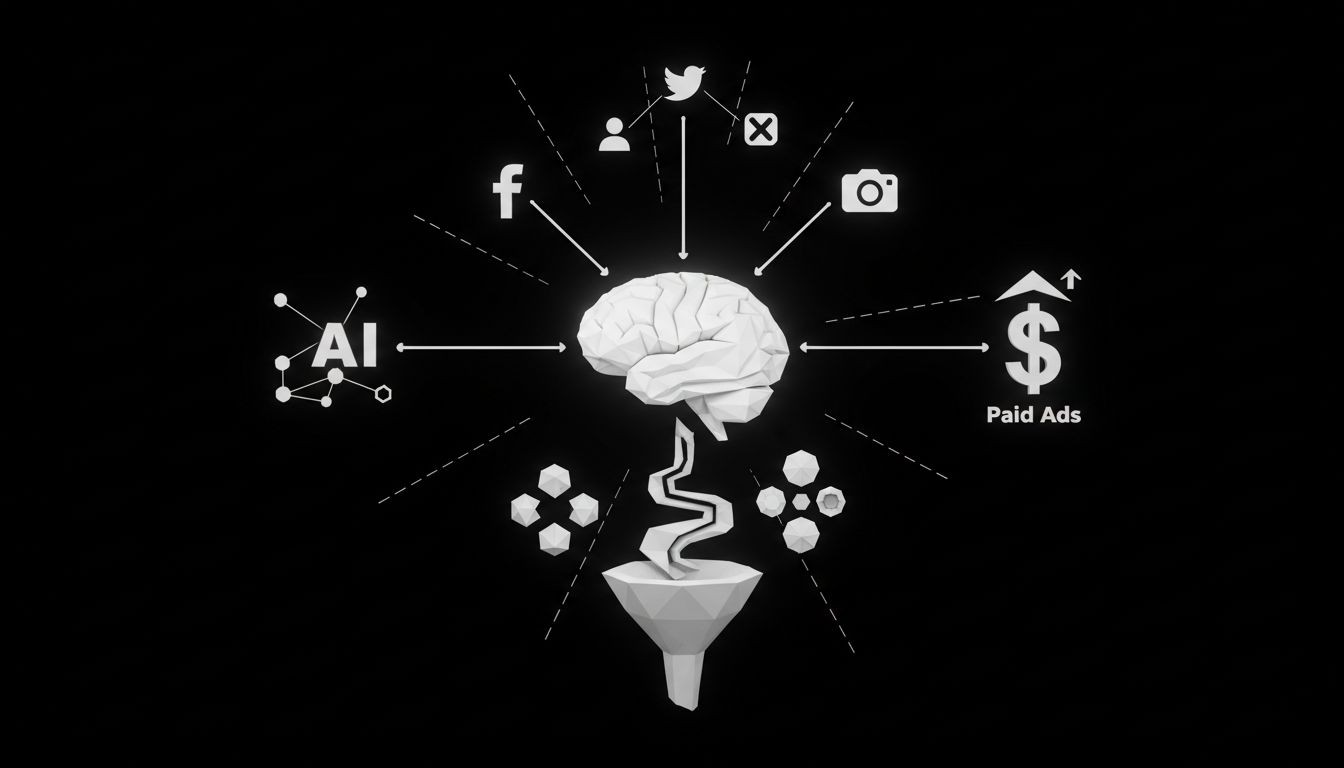
What Is a Marketing Strategy: A Practical Guide to Build One That Drives Leads with AI, Social Media, and Paid Ads
Discover what is a marketing strategy, how to build one with AI, social media, and paid ads. Practical steps, measurable KPIs, examples, and templates.
A strong marketing strategy gives your team focus. It defines who you serve, why they choose you, and how you will reach them consistently to grow sales and lifetime value. This guide explains what is a marketing strategy, how it differs from a marketing plan, and how to build one that uses AI, social media automation, and paid ads to generate qualified leads.
What is a Marketing Strategy?

A marketing strategy is the long term approach a business uses to attract, engage, and retain customers. It sets the direction for every marketing activity by aligning business goals, customer insights, positioning, and channel choices. A strategy answers three core questions:
Who are we targeting and why do they care
What value do we deliver that is different from competitors
Which channels and tactics will create measurable results over time
Key components of a marketing strategy
Value proposition and positioning
Target audience and customer personas
Core marketing goals and KPIs
Competitive analysis and market research
Channel strategy and media mix
Budget and resource allocation
Measurement and iteration cadence
Unlike a marketing plan, which lists specific campaigns, timelines, and budgets for a short period, a marketing strategy creates the high level framework that informs every plan and campaign.
Marketing Strategy vs Marketing Plan
A clear distinction reduces wasted effort:
Marketing strategy: sets the why and who. It is long term and directional.
Marketing plan: lists the how and when. It is tactical and short term.
Use a marketing strategy to decide which kinds of plans to run, for which products, and how success will be measured. For example, your strategy might prioritize organic social and AI chat agents for lead capture, while a quarterly marketing plan would outline the specific Meta and TikTok ad creative to run that month.
Marketing Strategy Frameworks and Models
Frameworks help structure thinking. Use the right tool for your problem:
4 Ps: Product, Price, Place, Promotion. Useful for product-market fit and pricing.
SWOT: strengths, weaknesses, opportunities, threats. Quick competitive snapshot.
Porter’s Five Forces: industry structure and competitive pressure analysis.
Ansoff Matrix: when to pursue market penetration, product development, market development, or diversification.
Jobs to Be Done: focus on the customer’s goal rather than product features.
Blue Ocean Strategy: find uncontested market spaces.
Customer Journey Mapping: map touchpoints that lead to conversion and retention.
Combine frameworks. For example, use Jobs to Be Done to refine value proposition, then map that proposition against customer journeys and choose channels with the marketing mix.
How to Create a Marketing Strategy: Step by Step
Below is an actionable process you can use to build a strategy that supports lead generation, social media growth, and paid media efficiency.
1. Define business and marketing goals
Start with measurable outcomes. Examples:
Increase qualified leads by 40 percent in 12 months
Improve customer lifetime value by 25 percent
Reduce cost per acquisition by 20 percent on Meta and TikTok
Good goals are specific, measurable, achievable, relevant, and timebound.
2. Conduct market and competitor research
Research components:
Market size and growth
Customer needs and pain points
Competitor positioning and channels
Pricing and distribution models
Tools and techniques: surveys, interviews, win-loss analysis, social listening, and simple PESTEL scans. Use Porter’s framework to evaluate structural threats and opportunities.
3. Build customer profiles and personas
Move beyond demographics to behavior. Capture:
Job to be done
Decision triggers
Preferred channels and content formats
Buying cycle length and objections
For digital lead generation, create intent-based personas that capture search behavior, ad response, and social engagement patterns.
4. Define your value proposition and messaging
Template: “For [target audience], [brand] provides [unique benefit] because [reason to believe].”
Keep messages concise and tailor them by persona and channel. Use a testing roadmap to refine messaging with ads and organic content.
5. Select channels and build your media mix
Choose channels based on where your audience spends time and how they prefer to buy. Typical modern mix:
Organic social and community building
Paid social ads on Meta and TikTok for reach and direct response
Search ads for high intent capture
Email and SMS for nurture and retention
AI chat agents and conversational automation for immediate lead capture and qualification
Content and SEO for discovery and trust
Consider omnichannel strategies that let users move between discovery, social proof, conversations with AI chat agents, and paid conversion funnels.
6. Plan budgets and resource allocation
Allocate by expected return and strategic importance. Practical approach:
40 percent to high ROI, scalable channels (paid social, search)
30 percent to owned channels and retention (email, CRM)
20 percent to experimentation (new social platforms, creator partnerships)
10 percent to tooling and analytics
Use a test and scale model. Start small with new channel experiments and scale winners.
7. Choose MarTech and automation
A modern strategy needs a lightweight, integrated stack. Typical components:
CRM with lifecycle automation
Analytics and attribution tools
Ad management and creative testing tools
AI chat agents for 24 7 lead capture and qualification
Social scheduling plus performance dashboards
If you want an automated solution for AI chat or lead generation, see services like Automated AI Chat Agents - The Social Search and Automated Lead Generation - The Social Search.
8. Set KPIs and measurement approach
Move beyond vanity metrics. Core KPIs:
Cost per acquisition (CPA)
Lifetime value (LTV or CLV)
Conversion rate by funnel stage
Return on ad spend (ROAS)
Marketing influenced revenue
Advanced measurement: implement attribution modeling, marketing mix modeling, and predictive analytics to forecast channel impact and allocate media more precisely.
9. Execute, test, and iterate
Run prioritized tests with clear success criteria. Use agile marketing practices with short sprints, rapid hypothesis testing, and weekly check ins. If something fails, document learnings and reallocate resources quickly.
Industry Specific Considerations
Strategies differ by business model. A few examples:
SaaS: focus on free trials, product led growth, content that reduces time to value, and retention metrics.
E commerce: prioritize paid social and marketplace optimization, abandonment cart flows, and influencer partnerships.
B2B: invest in account based marketing, thought leadership, LinkedIn ads, and AI chat agents for qualification.
Local businesses: lean on local SEO, community social proof, Google Business Profile, and hyperlocal ads.
If you need help automating social workflows, look at Automated Social Media - The Social Search. For SEO automation, consider Automated SEO - The Social Search.
Measurement Deep Dive: Attribution, CLV, and Predictive Analytics
Attribution: use multi touch attribution to understand which touchpoints influence conversion. Mix first touch, last touch, and multi touch models to see full impact.
Customer Lifetime Value: calculate CLV and use it to set sustainable CAC targets. CLV should inform acquisition budgets.
Predictive analytics: score leads and forecast churn risk so you can prioritize retention and high value audiences.
Marketing mix modeling: analyze how channels interact and the incremental lift of spend changes.
Investing in proper analytics ensures that your marketing strategy is evidence based and scalable.
Common Pitfalls and How to Avoid Them
Treating tactics as strategy, not aligning to business goals. Fix by documenting the strategic rationale for each major campaign.
Overreliance on one channel. Build a balanced media mix and backup plans for platform changes.
Ignoring creative testing. Create a repeatable creative testing plan for Meta and TikTok ads.
Neglecting organizational buy in. Get stakeholders aligned with a one page strategy brief and quarterly reviews.
Failing to measure properly. Start with basic KPIs and add advanced measurement as you scale.
Marketing Strategy in 2025 and Beyond

Emerging elements to include in every new strategy:
AI and automation: AI chat agents for qualification, AI assisted creative testing, and predictive ad bidding will become table stakes.
Privacy first: plan for reduced third party tracking by investing in first party data and contextual targeting.
Creator economy integration: work with creators not just for reach but for co created products and owned communities.
Omnichannel experience: seamless transitions between social, web, chat, and in person.
Sustainability: purpose and transparency will increasingly influence purchase decisions.
If you plan paid ads on Meta or TikTok, include creator led testing and AI generated creative variations to improve relevance and lower CPA. For paid ad management, consider support from dedicated services such as Paid Ads Management - The Social Search.
Examples of Effective Strategies
SaaS business focusing on self service adoption
Strategy: lower friction for trial activation and reduce time to first value.
Channels: product onboarding emails, targeted search ads, educational content, retargeting.
Measurement: trial to paid conversion, churn by cohort, CLV.
DTC e commerce brand scaling on social
Strategy: build brand awareness with creators and convert with short form video ads.
Channels: TikTok, Meta, influencer partnerships, email automation for retention.
Measurement: ROAS by creative, repeat purchase rate, subscriber LTV.
Local services business
Strategy: dominate local search and use chat agents for immediate booking.
Channels: local SEO, Google Business Profile, community social, paid local ads.
Measurement: calls and bookings, cost per booking, review growth.
Practical Templates and Tools
Quick value proposition template
For [target customer], [brand] helps [job to be done] by [unique benefit], unlike [competitor] we [key difference].
KPI dashboard essentials
Top of funnel: impressions, reach, traffic
Mid funnel: leads, engagement, qualified leads
Bottom funnel: conversions, CPA, ROAS
Retention: repeat rate, CLV, churn
Tool checklist
CRM and lead automation
Analytics and attribution tool
Ad creative testing tool
AI chat agent
Social scheduling and reporting
If you want help building an automated website and landing pages that capture and route leads into chat flows, see Automated Website Creation - The Social Search.
Frequently Asked Questions
What is the single most important part of a marketing strategy
Understanding your customers and the value you deliver is the most important part. Everything else flows from that clarity.
How long does it take to see results
Early signals appear in 30 to 90 days from targeted testing. Consistent, scalable results usually require 6 to 12 months.
Should I prioritize organic social or paid ads
Both. Use paid ads to scale acquisition quickly and organic to build trust and reduce long term acquisition costs.
How does AI change strategy
AI accelerates testing, personalization, and conversational capture. Strategy should plan for AI to increase efficiency across creative, bidding, and qualification.
What if my strategy is not working
Run diagnostics: check audience fit, creative effectiveness, channel mix, and measurement accuracy. Reallocate budget to winning tests and iterate rapidly.
The Bottom Line
A marketing strategy is the long term blueprint that turns customer insight into repeatable growth. Modern strategies must combine classic frameworks with AI enabled automation, an omnichannel customer journey, and rigorous measurement. Start by clarifying goals and your value proposition, then select channels, build a test and scale plan, and use analytics to optimize spend.
Ready to convert strategy into leads and revenue with automation and paid media? Learn how automated lead capture, AI chat agents, social automation, and paid ads can work together by exploring these services: Automated Lead Generation - The Social Search, Automated AI Chat Agents - The Social Search, Automated Social Media - The Social Search, Paid Ads Management - The Social Search, and Automated SEO - The Social Search.
If you want a one page strategy brief or a custom blueprint, contact us to get a tailored roadmap that fits your product and budget: Contact The Social Search.