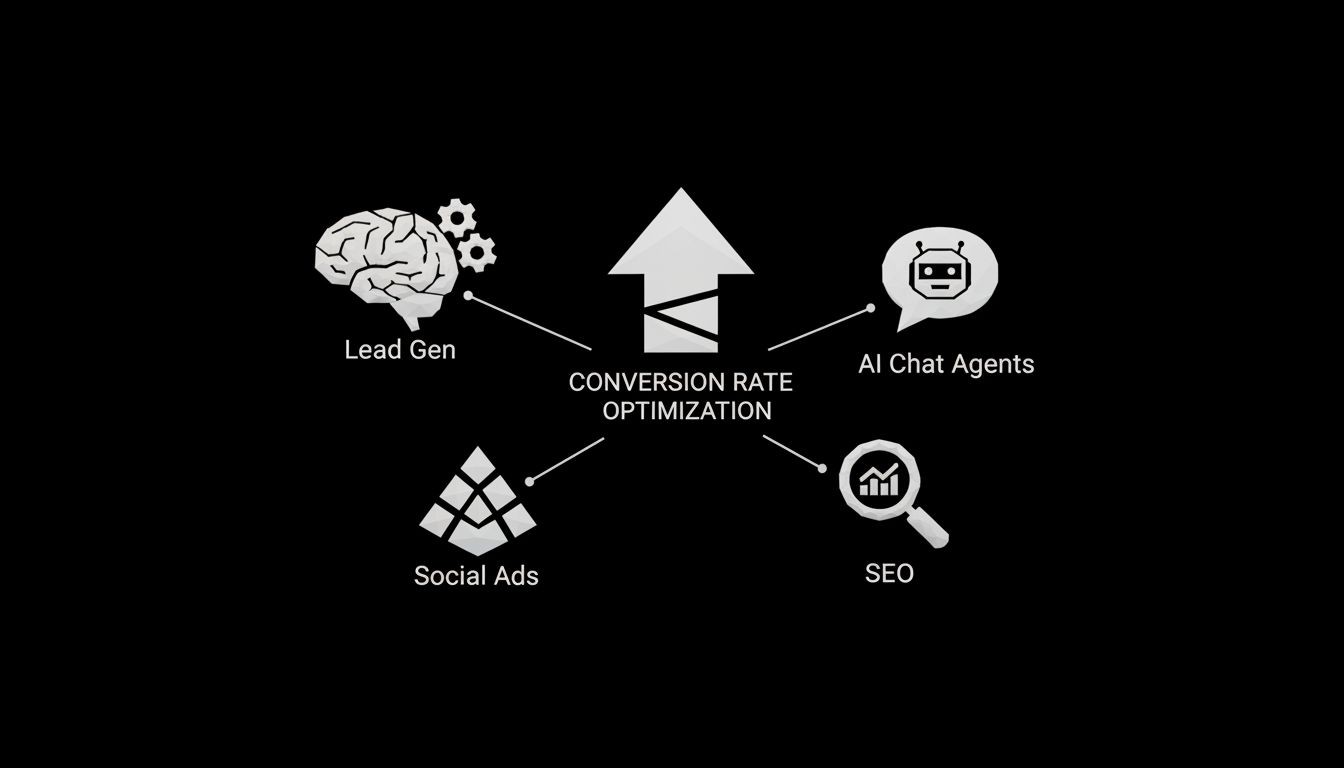
Conversion Rate Optimization Marketing: A Practical Guide for Lead Gen, AI Chat Agents, Social Ads, and SEO
Practical guide to conversion rate optimization marketing: frameworks, channel tactics for social and paid ads, AI chat agents, testing, and conversion templates.
Every visitor is an opportunity. Conversion rate optimization marketing is the disciplined process of turning more of those visitors into leads, trials, or customers by combining data, psychology, copy, and targeted experiments. This guide gives a practical, channel-focused roadmap you can use today to increase lead quality, lower acquisition costs, and scale predictable revenue using AI chat agents, social media, Meta and TikTok ads, and SEO.
What is conversion rate optimization marketing?
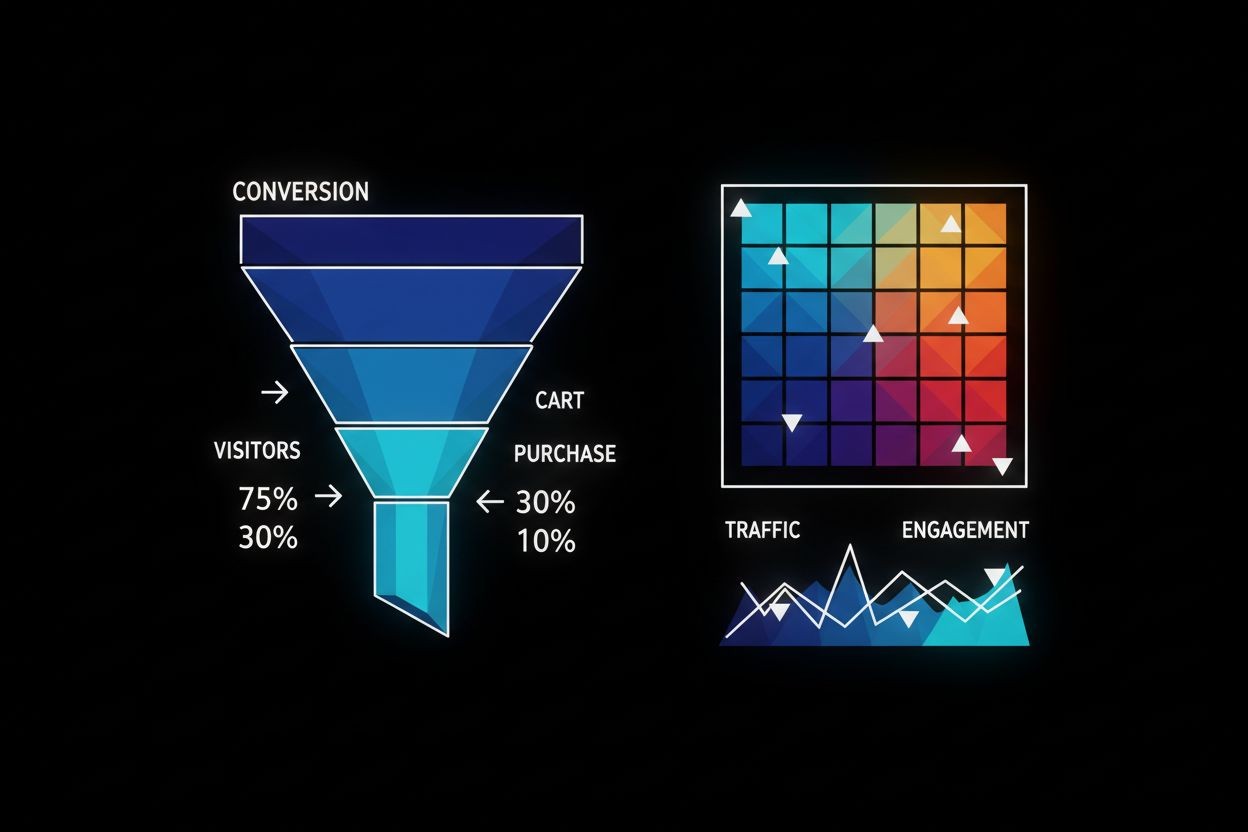
Conversion rate optimization marketing refers to the intentional, measurable work you do to increase the percentage of users who complete desired actions across marketing channels. That might mean more demo requests from paid ads, more trial signups from organic search, or more qualified leads from social campaigns. The conversion rate formula is simple: (conversions ÷ visitors) × 100. The strategy is not.
Conversion rate optimization marketing blends user research, experimentation, analytics, creative copy, and technical implementation. It treats each channel as part of a conversion ecosystem. Focusing on any single best practice without tests can waste budget. The best improvements come from structured hypothesis-driven experiments that respect context, audience, and intent.
Why CRO matters for modern marketing
Higher conversion rates lower cost per acquisition, improve ad efficiency, and generate more predictable pipeline for sales. For lead generation-heavy businesses, even small percentage improvements compound into major revenue gains. CRO also amplifies the returns on your SEO and paid media investments by capturing more value from the same traffic.
Benefits of a disciplined CRO program:
Lower CPA and higher return on ad spend
Faster growth with existing traffic
Better quality leads and shorter sales cycles
More reliable signals for audience targeting and personalization
If you run Meta or TikTok ads, for example, optimizing landing pages and post-click experience improves algorithmic learning. If you deploy AI chat agents, integrating them with experiment variants can capture micro-conversions and reduce friction without increasing ad spend.
A step-by-step CRO framework you can implement
Follow these seven steps for a systematic program that generates repeatable wins.
Step 1: Define clear conversion goals
List macro conversions like purchases, demo requests, or paid trials. Then identify micro conversions such as content downloads, chat starts, or add-to-cart events. Track both so you can detect early signs of a test moving in the right direction.
Metric examples:
Conversion rate (macro and micro)
Cost per acquisition
Average order value
Lead qualification rate
Time to conversion
Step 2: Map the funnel and touchpoints
Draw the funnel from the first click to the final conversion. Include organic search, social posts, paid ads, email nurture, and chat interactions. Note where drop-offs happen and which touchpoint is most expensive.
Step 3: Gather quantitative and qualitative data
Use analytics, heatmaps, session recordings, and surveys to find blockers. Talk to sales and support to understand lead quality. Set up event tracking for key actions and capture downstream outcomes such as demo-to-deal rates.
Step 4: Formulate hypotheses
Turn insights into testable ideas. Frame each hypothesis like this: “If we X on the landing page, then Y will happen because Z.” For example: “If we move the CTA above the fold and simplify the form to two fields, then demo requests will increase because time to complete drops.” Prioritize by potential impact and implementation cost.
Step 5: Design experiments and segment audiences
A/B test one variable at a time for clarity. Use multivariate tests only when your traffic supports them. Segment audiences by behavior, acquisition channel, device, and lifecycle stage so results are actionable.
Step 6: Run tests and measure properly
Determine sample size and test duration before launching. Monitor for external events such as major traffic sources or funnel changes. Analyze primary and secondary metrics to avoid winning on vanity metrics alone.
Step 7: Learn, iterate, and document
Treat each result as an insight. Document hypotheses, setup, results, and learnings in a central repository. Winning variants should be rolled out and then re-tested as circumstances change.
CRO across channels: tactics for lead gen, social, ads, and SEO
Conversion rate optimization marketing needs channel-specific tactics because user intent and interaction vary.
Landing page and post-click optimization
Match ad copy and landing page messaging to keep expectation intact.
Reduce cognitive load: clear headline, single value proposition, social proof, short form.
Use progressive disclosure for complex offers. Show key benefits up front then reveal details on demand.
Speed matters: optimize images, compress assets, and enable caching to improve load times.
Relevant resource: for broader automated site strategies see Automated Website Creation.
Social media with AI for conversions
Social platforms are discovery channels. Use social to start micro-conversions like content clicks and chat starts. Leverage AI to personalize responses and route hot leads.
Tactics:
Embed chat prompts in ads and landing pages to capture intent
Use short, action-oriented CTAs that fit the platform context
Measure view-through conversions for social video campaigns
Try combining automated content scheduling and AI personalization. For setup and automation read Automated Social Media.
Paid ads on Meta and TikTok
Paid channels require fast learning. Optimize both creative and the post-click experience.
Best practices:
Test creative formats and hooks in parallel with landing page variants
Use conversion-focused audiences but test prospecting with AI lookalikes
Track micro-conversions like add-to-cart and chat initiation to accelerate signal
If you use an agency or platform for ad operations, coordinate tests so experiments in ads and landing pages do not conflict. For managed campaigns consider Paid Ads Management.
Email and nurture flows
Email is where intent often converts. Use behavioral triggers and segmented copy.
Tactics:
Send an immediate follow-up to site visitors who start a chat or download a resource
Personalize subject lines and preview text to reflect recent actions
Use one clear CTA per email and track the micro-conversion funnel from email to goal
SEO and organic search
SEO drives high-intent visitors. CRO helps convert organic traffic without harming rankings.
SEO-friendly CRO tips:
Keep content accessible to search bots and users
Avoid cloaking content just for experiments
Improve dwell time with better headings, quick answers, and scannable content
More on programmatic SEO and automation is available at Automated SEO.
Psychology, persuasion, and copywriting that convert
Conversion optimization is part science and part psychology. Use persuasion principles to shape choices.
Key principles:
Social proof: customer logos, reviews, success metrics
Scarcity and urgency only when factual and transparent
Authority: credentials, press mentions, case results
Reciprocity: offer useful content before asking for a sale
Loss aversion: frame benefits in terms of what users avoid by acting
Copy tips:
Lead with benefits and outcomes, not features
Use headline formulas: problem, promise, proof
Reduce risk with guarantees, privacy assurances, and clear next steps
Microcopy matters. Button text, form labels, and error messaging influence completion rates.
Form and checkout optimization
Forms are a major friction point in lead gen. Every extra field reduces completion probability.
Techniques:
Minimize fields. Only ask what you need for qualification.
Use multi-step forms to reduce perceived effort
Use conditional logic to hide irrelevant fields
Offer social sign-on or autofill alternatives
Make validation helpful, not punitive
For e-commerce checkouts:
Show shipping and tax transparency early
Offer multiple payment options
Save progress for returning users
Use cart recovery emails and chat nudges to recapture intent
Metrics beyond conversion rate
Conversion rate is the headline number. Expand the dashboard to include metrics that capture value and sustainability.
Important metrics:
Cost per acquisition
Lifetime value of customer
Average order value
Lead-to-deal conversion rate
Time to conversion
Micro-conversion lift
Build dashboards that show both short term test performance and downstream impact on revenue.
Testing, statistical significance, and implementation
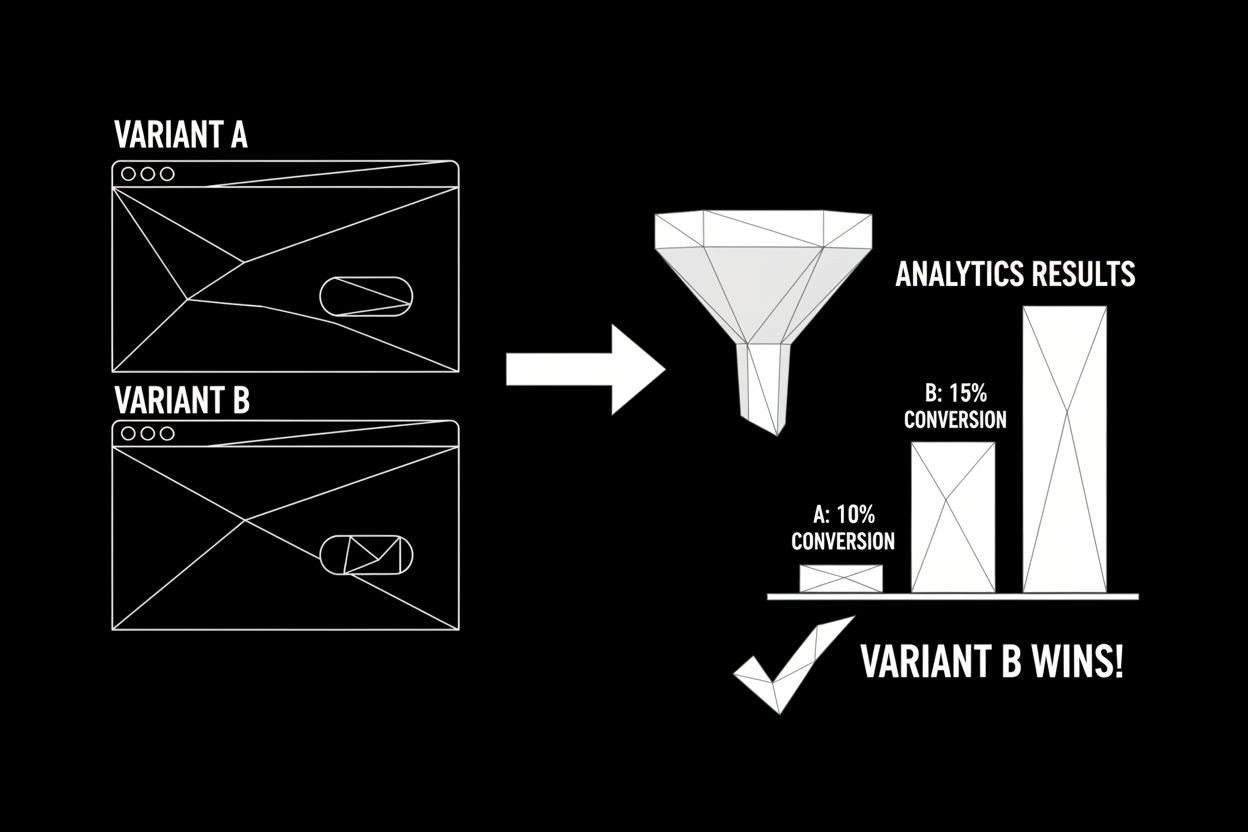
A test without the right sample size is noise. For reliable results consider these points:
Calculate required sample size based on baseline conversion rate, minimum detectable effect, and confidence level
Run tests long enough to capture weekday and weekend behavior
Segment results by device and traffic source
Watch for novelty effects in ad-driven traffic
Use centralized experiment tracking to prevent duplicate tests and to document learnings. Implementation often requires developers, tag managers, and analytics updates. If you deploy chat agents as part of variants, ensure backend events are captured consistently.
For teams using conversational automation, connect experiments with your chat agent platform so you can measure conversions that start in conversation. If you need help implementing AI chat agents, see Automated AI Chat Agents.
Tools and tech stack recommendations
Core categories:
Analytics: Google Analytics 4, server-side tracking platforms
Experimentation: Optimizely, VWO, Google Optimize alternatives
Heatmaps and session replay: Hotjar, FullStory
Funnel and attribution: Mixpanel, Amplitude, GA4 enhanced funnel reports
Chat and automation: Conversational AI platforms with web SDK and event hooks
Choose tools that integrate with your CRM and tag manager to maintain consistent signals across channels. Combine qualitative tools with quantitative data for faster hypothesis generation.
Short case examples you can learn from
Mini case 1: Lead gen SaaS
Problem: High trial signups but low demo requests.
Action: Added a short chatbot to the pricing page to pre-qualify visitors and offered a scheduled demo link for qualified users.
Result: Demo requests doubled and cost per demo dropped by 30 percent.
Mini case 2: Ecommerce during launch
Problem: Paid social drove traffic but poor checkout completion.
Action: Simplified checkout to single page with prominent shipping transparency and a guest checkout option.
Result: Checkout completion rate improved 22 percent and ROAS increased.
Mini case 3: Local service provider
Problem: Organic traffic had high bounce rates.
Action: Focused on location-based landing pages, quick FAQs to answer immediate questions, and a click-to-chat prompt tied to booking.
Result: Leads from organic search increased and time to booking shortened.
For tactical lead generation setups and automation, check Automated Lead Generation.
Seven common CRO mistakes that kill conversion wins
Testing too many variables at once and misattributing wins
Stopping tests too early
Ignoring downstream metrics like lead quality
Copy and creative mismatch between ad and landing page
Forgetting mobile-first design
Using fake scarcity or urgency
Not documenting experiments or centralizing learnings
Avoid these and your program will scale more predictably.
Checklist and templates to start today
Quick CRO audit checklist:
Do headlines match primary user intent?
Is there a single primary CTA above the fold?
How many form fields are required?
Is page load under 3 seconds on mobile?
Are tracking events firing correctly for key actions?
Are micro-conversions tracked and reported?
Template idea: Hypothesis tracker
Page/variant
Hypothesis statement
Primary metric
Secondary metrics
Sample size and duration
Result and action
Automation tip: Use your CMS and tag manager to deploy variants quickly and wire results to a central analytics view. If you need help automating your site and CRO lifecycle, see Automated Website Creation.
Frequently asked questions
What is a good conversion rate?
Benchmarks vary by industry and channel. Rather than chase a single number, compare to your historical baseline and audience sources.
How long should a test run?
Long enough to reach required sample size and to capture weekday/weekend cycles. Avoid stopping early based on temporary spikes.
Can AI chat agents help CRO?
Yes. Well-designed chat agents reduce friction, capture intent, and qualify leads. They also create rich event data for more precise experiments.
Next steps: build a CRO plan that scales
Start with one funnel, gather baseline data, and run small, fast tests that you can scale when they win. Layer in AI chat agents and channel-specific optimizations for paid social and SEO to accelerate results. If you want hands-on support with testing, automation, or paid campaigns, we manage experiments and ad programs end to end. Learn about our Paid Ads Management offerings or contact us to get a tailored plan.
Conversion rate optimization marketing is continuous. With the right measurement, experiments, and focus on real buyer intent you can turn more traffic into meaningful growth without increasing ad budgets. Start small, document everything, and scale what works.