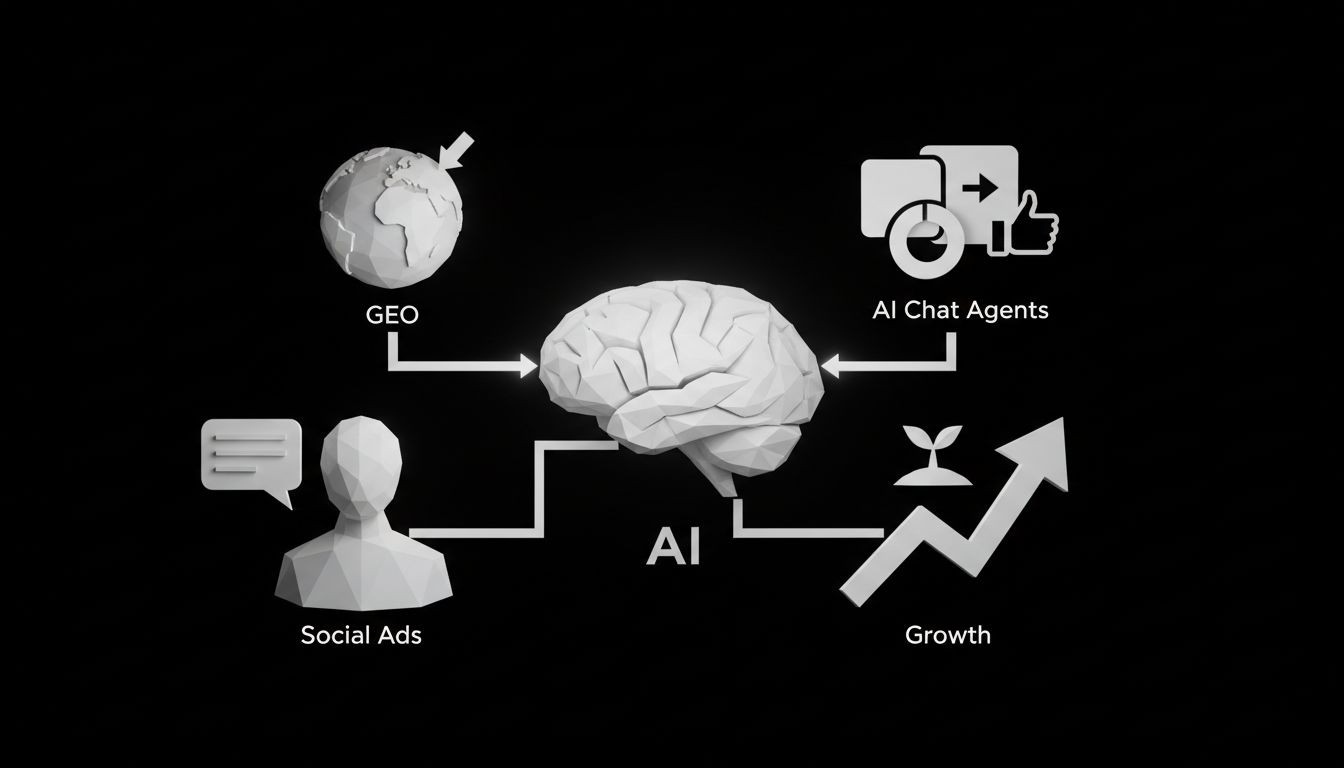
AI SEO Services: A Practical Guide to GEO, AI Chat Agents, Social Ads, and Growth
Practical guide to AI SEO services, covering GEO, schema, API integration, chat agents, Meta and TikTok ads, pricing, timelines, tools, and measurable tactics.
AI search is changing how customers discover brands. If your marketing still treats search like it did five years ago you will miss recommended answers, featured snippets, and AI-driven referrals that now drive clicks and conversions. This guide explains AI SEO services in actionable terms, with a step-by-step plan, tools, content templates, and real-world priorities you can use to start getting traction fast.
What are AI SEO services and why they matter
AI SEO services focus on optimizing a brand for recommendation driven results across generative engines, conversational agents, and AI-powered search layers. The goal shifts from traditional ranking to becoming the trusted source that AI platforms cite or recommend. That means building semantic authority, structured knowledge, and content designed for AI consumption rather than only for SERP placement.
Benefits of AI SEO services
Improve visibility inside AI overviews, answers, and recommendations
Reduce reliance on organic snippet clicks by capturing recommendation placements
Control brand narrative across multiple AI platforms
Turn conversational queries into owned lead pathways via chat agents and landing pages
Who should invest in AI SEO services
E commerce brands that want product discovery inside AI shopping answers
B2B companies that need to be the cited vendor in enterprise AI summaries
Local services that want profile visibility in voice and assistant replies
Any marketer running Meta or TikTok ads who wants AI-backed landing page credibility
How Generative Engine Optimization works in practice

Generative Engine Optimization, or GEO, is the set of tactics to ensure your content, entities, and data sources are selected by generative models when they answer queries. GEO is not a single algorithm you can reverse engineer. It is a process that combines structured data, trusted signals, entity authority, and content format optimization.
Key mechanics to understand
Entity signals
AI platforms rely on entity recognition. Entities are people, companies, products, locations, and concepts. If your website and external profiles consistently describe the same entity with matching facts you increase the chance AI will cite you.
Structured data and knowledge graphs
Providing high quality schema markup and public data feeds helps AI systems extract reliable facts. Use organization, product, FAQ, review, and localBusiness schema to feed facts into knowledge graphs.
Source trust and linking profile
AI models weight trust. References from recognized publishers, consistent NAP for local entities, and clear sourcing on pages help. Backlinks still matter but context and topical relevance matter more than sheer volume.
Query intent and format
AI systems prefer concise, modular answers. Content that is chunked into clear facts, definitions, steps, and examples is easier for models to ingest. Think short answer blocks, bulleted takeaways, and clear canonical pages.
Freshness and monitoring
AI systems value fresh signals for time sensitive topics. Automated monitoring and rapid content updates are required to stay visible for breaking queries.
Core components of an AI SEO services offering
A practical AI SEO program should include tactical, technical, creative, and monitoring elements. Here are the components to expect and to request when evaluating providers.
AI visibility audit
Entity map of your brand, products, authors, and locales
Structured data coverage and gaps
Content formats and canonicalization issues
Technical optimization
Schema implementation and validation
API feeds for product, inventory, and events data
Server side rendering or pre rendering for dynamic content
Content engineering
Atomic content approach: short, answerable blocks
Template-driven pages for entities, FAQs, and how to guides
Prompt engineering for conversational snippets and agent responses
Platform-specific optimization
ChatGPT and OpenAI API recommendations, prompt frames, and role content
Google Gemini and Search Generative Experience tuning
Perplexity and Bing integration best practices
AI chat agents and conversion flow
Integrate AI agents that greet, qualify, and capture leads
Hand off to human sales when intent is high
Sync chat transcripts to CRM and ad platforms
Paid media alignment
Landing pages optimized for AI answers and ad quality
Meta and TikTok ad creative that aligns with recommended snippets
Ongoing monitoring and governance
Alerting for brand misattribution or hallucinated facts
Monthly performance reporting and iteration
Step by step implementation plan
This is a practical timeline you can follow for internal teams or to evaluate vendors.
Phase 0: Discovery and entity mapping (Week 1)
Map brand entities, product SKUs, location pages, and author profiles
Run a schema audit and a crawl for canonical issues
Phase 1: Quick wins and technical fixes (Weeks 2 to 4)
Fix broken schema and validate with testing tools
Publish 10 atomic answer pages for highest intent queries
Set up analytics and event tracking for AI referrals
Phase 2: Content engineering and platform alignment (Months 2 to 3)
Build templates for entity pages and FAQs
Create AI answer blocks and canonical summaries
Integrate product feeds via API for inventory and price accuracy
Phase 3: Chat agent and ad integration (Months 3 to 4)
Deploy AI chat agent to capture qualified leads and route them
Align Meta and TikTok campaigns to pages optimized for GEO
Phase 4: Scale and governance (Month 4 and ongoing)
Expand entity coverage to long tail queries
Set up monitoring for hallucinations and misattributions
Quarterly model and prompt reviews
Timeline expectations
You should expect initial visibility signals in 6 to 12 weeks for high intent queries and structured pages. For broad authority gains across platforms allow 3 to 6 months. Full entity authority at scale can take 6 to 12 months depending on the sector.
Tools and integrations to include
Use a mix of SEO, AI, and monitoring tools. Here are practical recommendations and what to use them for.
OpenAI API and GPT-based models: prompt experiments, answer blocks, chat agents
Google Cloud AI and Gemini exposure: test how your content appears in Google AI answers
Perplexity and Bing Chat: test alternative AI engine citation behavior
SERP APIs: track AI answer placements and recommendation features
Schema validators: ensure structured data is error free
Content platforms: headless CMS that supports JSON Ld and API feeds
Analytics and tag managers: capture AI referral events and chat conversions
Backlink and topical tools: Ahrefs or Moz for entity-related linking analysis
Practical integration notes
Feed product inventory via API rather than manual uploads to avoid stale facts
Expose canonical answer snippets in page HTML to make extraction easier
Use server side rendering for dynamic content to ensure content is available to crawlers
Content templates and prompt examples you can use
Below are ready to use content templates for pages you should prioritize. Modify them to match brand voice and facts.
Product answer block template
One line product summary
3 bullet points with key specs or benefits
Price and availability line
Short customer testimonial or rating
FAQ snippet template
Q: Short direct question
A: 1 to 2 sentence answer, then 3 step quick guide, then a link to learn more
Prompt example for creating answer snippets
“You are a concise expert. Produce a 30 word answer to ‘How long does [product] battery last’ and then list three troubleshooting tips in bullets.”
Agent script for qualification
Greeting: “Hi, I can help with [X]. Which of these best describes you: Researching, Ready to buy, Need support?”
If Ready to buy: ask budget and timeline, then capture contact details
If Researching: offer a 1 page PDF or link to an answer page and ask to sign up for updates
AI chat agents and social media with AI

Integrating AI chat agents with social platforms and landing pages converts recommendations into leads. When an AI platform suggests your brand the next click should go to a page or agent that captures intent.
Tactics for conversion
Add a chat widget that can answer the question the AI was asked
Preload the agent with the query context so it can continue the conversation
Offer a short funnel: answer, qualify, schedule call or collect contact
Social media and AI content alignment
Use short, factual content on platforms so AI can surface it as a source
Push canonical answer pages from social posts to increase citation paths
Automate distribution of answer snippets to social feeds for freshness
For social automation and agent integration see our guide on Automated Social Media and explore how chat flows feed lead pipelines in Automated AI Chat Agents.
Running ads on Meta and TikTok with AI-optimized landing pages

AI SEO services are not separate from paid media. Ads signal intent, and AI visibility supports landing page credibility. When your ad sends traffic to an AI-ready landing page you increase conversion rates and reduce wasted spend.
Practical ad alignment tips
Use ad copy that mirrors the answer language used by AI platforms to create continuity
Route high intent ad clicks to short answer pages with clear CTA and chat agent handoff
Use UTM tagging and capture the ad prompt in the chat agent so you can measure lift
Budget and testing guide for Meta and TikTok
Start with a 30 day test budget. For small businesses allocate $1,500 to $5,000 to learn creative and landing page matches
Run creative variants that map to different intents: price, features, reviews
Measure CPA on pages optimized for AI answers versus generic product pages
For paid media management tied to AI SEO consider aligning with your ad team or Paid Ads Management provider to reduce friction.
Pricing, packages, and how to evaluate vendors
Transparent pricing varies by scope and scale. Use these ranges as a reality check.
Audit only: $2,500 to $7,500 one time
Core package: $3,000 to $8,000 per month for small to mid sized businesses. Includes schema, 8 to 12 answer pages, and chat agent setup
Enterprise scale: $10,000 to $30,000 per month for multi locale, API integrations, and continuous monitoring
What to insist on in a contract
Clear deliverables and timelines
Ownership of content and schema
Reporting metrics tied to business outcomes
Escalation clause for hallucination or brand misattribution incidents
If your objective is lead growth ask to see examples of lead metrics. Many providers can show case studies but request raw numbers and timeframes for transparency. A partner who ties work to pipeline is preferable to one that focuses only on vanity metrics.
Measuring success and key performance indicators
Track a mix of technical, content, and business KPIs.
Technical metrics
Number of pages with valid schema
Crawlable entity pages and knowledge graph signals
Content and discovery metrics
Number of AI citations and recommendation placements
Traffic from AI referrals and conversational platforms
Share of voice in answer features
Business metrics
Leads captured via chat agents
Conversion rate on AI-optimized landing pages
Cost per acquisition for Meta and TikTok campaigns routed to AI pages
Tie these metrics to revenue where possible. A simple LTV to CPA comparison helps prove ROI for AI SEO services. For lead-focused programs align results with your Automated Lead Generation process.
Common pitfalls and how to avoid them
Over optimizing text for models without user value
Keep human clarity first. If content is only optimized for machines it will not convert.
Ignoring schema quality
Poor or invalid schema can make matters worse. Validate every change.
Not monitoring hallucinations
AI systems can attribute wrong facts. Monitor brand mentions and have a rapid correction workflow.
Treating AI SEO as one time work
This is continuous. Models change and so do query patterns. Budget for ongoing optimization.
Quick checklist to get started
Map your brand entities and confirm consistent facts across web profiles
Fix broken or missing schema on top 20 pages
Create 10 atomic answer pages for your highest intent queries
Deploy a basic chat agent that captures intent and contact data
Align one Meta or TikTok campaign to an AI-optimized landing page
Set up monitoring for AI mentions and a monthly review cadence
If you want practical implementation help look at our Automated SEO resource for process and tooling alignment.
Final recommendations
AI SEO services require a mix of engineering discipline, content craft, and ad alignment. Start with a focused pilot that targets three high value entities, pair it with a chat agent and a paid test, and measure end to end. That approach will show whether GEO lifts discovery and whether the added visibility drives leads and sales.
If your team needs technical support or a partner to run a pilot consider starting with a visibility audit and a conversion focused landing page experiment. Treat AI visibility as channel infrastructure that feeds both organic discovery and paid performance.